Taxes in Spain: Every Tax Type Explained
This guide covers income tax, wealth tax, capital gains, the non-resident tax on Spanish property, Modelo 720, exit tax and IVA. It explains how the tax-residency determination affects which rules apply, then points to the relevant detailed guide, calculator or professional review.

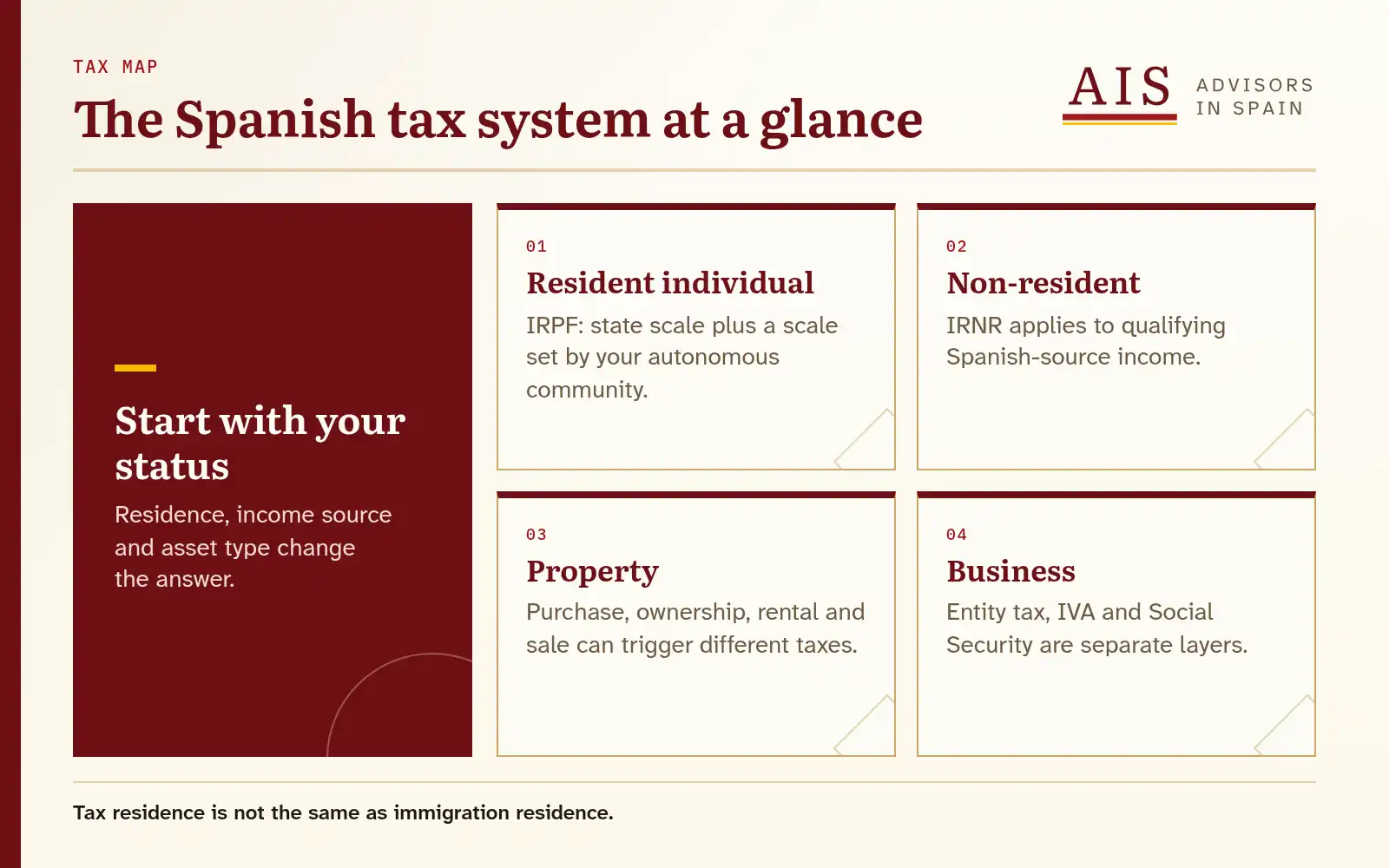
Diagram text version
Spanish tax residents generally enter IRPF, whose general scale has state and autonomous-community parts. Non-residents may enter IRNR for Spanish-source income. Property and business each add separate transaction, ownership, entity, VAT and Social Security questions.
Spain taxes residents on worldwide income and non-residents only on Spain-sourced income and assets, across several separate taxes. Taxes in Spain reach residents, property owners and self-employed workers on different terms: IRPF income tax, wealth tax, capital gains, the Modelo 210 non-resident tax, the Modelo 720 overseas-asset report, exit tax and IVA. This guide closes by pointing to the relevant detailed guide, calculator or professional review.
What Taxes in Spain Do You Have to Pay?
Whether you owe income tax, wealth tax, capital gains tax or the non-resident tax on Spanish property depends in part on the tax-residency determination, which considers both time in Spain and where your economic ties sit.
A Spanish resident can face IRPF income tax on salary and rental income, wealth tax on net worth above a personal allowance, and capital gains tax on the sale of property or investments. A property owner who is not a Spanish tax resident instead faces the non-resident income tax, filed on Modelo 210, on the same property. Anyone holding bank accounts, securities or property outside Spain above the reporting threshold has to file Modelo 720, an information return with no payment due on the form itself. An autonomo or company making taxable supplies collects VAT (IVA) where the IVA rules apply. Inheritance and gift tax (ISD) sits outside this list on its own national law with its own regional allowances, covered on inheritance tax in Spain, and local property taxes such as IBI, ITP and plusvalia are covered on property taxes in Spain. Which of the taxes above actually reaches you starts with the residency determination, covered next.
How Does Spain Decide If You’re a Tax Resident?
Spain treats you as a tax resident when either of two tests is met, under article 9 of Ley 35/2006. The first is the 183-day test: you spend more than 183 days in Spanish territory during the calendar year, counting sporadic absences unless you can prove tax residence elsewhere. The second is the center-of-economic-interests test: the main base of your activities or economic interests sits in Spain, directly or indirectly.
A third rule sits alongside those two and does not stand on its own. Spain presumes you are a tax resident when, applying the two tests above, your non-legally-separated spouse and dependent minor children habitually reside in Spain, unless you prove otherwise. This family-tie presumption only fires through the same two tests; it is not an independent third trigger.
The stake is direct. A Spanish tax resident is taxed on worldwide income and worldwide assets. A non-resident is taxed only on Spain-sourced income and Spain-situated assets. Every section below turns on which side of that line you sit.
What Income Tax Do You Pay in Spain?
Spanish income tax, IRPF, splits your income into two separate bases that are taxed differently. The general base covers salary, business income and rental income. The savings base covers interest, dividends and most capital gains.
The general base is where region matters. Article 63 sets a state scale that applies nationally, and article 74 adds a regional scale that each comunidad autonoma sets for itself. Your total general-base bill is the sum of the two, so it genuinely differs by where you live. The savings base works differently: article 76 writes the regional half of that scale directly into the same national statute as the state half in article 66, at identical rates in every comunidad. Interest, dividends and most capital gains are taxed the same wherever in Spain you live.
Spain tax rates carries the bracket table for both, region by region where the figure varies.
What Is Spain’s Wealth Tax and Who Has to Pay It?
Spain’s wealth tax, Impuesto sobre el Patrimonio, is an annual tax on what you own on 31 December each year. It sits apart from IRPF, which taxes what you earn. A resident owes it on worldwide assets, and a non-resident owes it only on assets located in Spain, under Ley 19/1991, article 5. It is filed on Modelo 714, in the same 8 April to 30 June filing window as the income tax return, according to Orden HAC/277/2026.
Wealth tax Spain covers the allowance figures and rate tables for the comunidades autonomas included there.
How Is Capital Gains Tax Calculated in Spain?
For a Spanish IRPF taxpayer, a gain from selling property or investments falls inside the IRPF savings base covered above. A non-resident seller is taxed under IRNR instead. On a non-resident sale of Spanish property, the buyer withholds 3% of the agreed sale price and pays it to Agencia Tributaria on Modelo 211, according to RDLeg 5/2004, article 25.2. That retention is an advance payment, not the final tax. A non-resident seller reclaims any amount over the actual tax due on Modelo 210. The property itself can be charged for the amount under the same article if the buyer never pays the retention over, so the paperwork on this step matters to both sides of the sale.
Capital gains tax Spain carries the rate table and the allowances that reduce the taxable gain.
What Tax Do Non-Residents Pay in Spain?
A non-resident who owns Spanish property is taxed on that property under IRNR, the non-resident income tax, filed on Modelo 210. The general rate is 24%, reduced to 19% for residents of another EU or EEA state where an effective exchange of tax information exists, according to RDLeg 5/2004, article 25.1.a.
Even a property that earns no rent creates a bill. Spain imputes income on an unrented, non-business urban property at 2% of its cadastral value, or 1.1% where that value was recently revised, under LIRPF article 85, applied the same way to non-residents under Modelo 210. UK-resident owners lost the 19% rate and a related expense deduction from 1 January 2021, once the Brexit transition period ended, according to Agencia Tributaria. Non-resident tax Spain covers the full set of Modelo 210 deadlines, which differ by income type.
What Is Modelo 720 and Who Has to File It?
Modelo 720 is Spain’s information return for assets held outside Spain, filed by residents whose overseas holdings cross a reporting threshold. It is a reporting obligation, not a tax in itself: no payment is due on the form, and filing it does not by itself change what you owe elsewhere.
Modelo 720 covers the specific asset categories and reporting threshold. The obligation still applies: a 2022 legal change replaced the form’s old penalty structure with the ordinary tax-penalty regime in the Ley General Tributaria, but the filing requirement itself was not removed.
What Is Exit Tax in Spain and Who Does It Affect?
Exit tax reaches a narrow group under LIRPF article 95 bis. The taxpayer must have been a Spanish IRPF taxpayer for at least 10 of the previous 15 tax periods before giving up Spanish tax residency. Once that gate is met, either the combined market value of the shareholdings or the size and value of a stake in a single company can trigger the rule.
exit tax Spain covers the exact shareholding thresholds that trigger it. The rule reaches residents with sizeable company holdings, not property owners, cash savers or ordinary investment accounts merely because they hold those assets.
What Tax Do Self-Employed Workers (Autonomos) Pay in Spain?
An autonomo in Spain pays IRPF income tax on business profit, calculated on the general base covered above, plus a separate monthly RETA social security contribution that is not part of the tax system at all. The two are worked out differently, and paying one does not reduce the other.
Since a 2023 reform, an autonomo does not pick a fixed RETA contribution freely. Seguridad Social publishes yearly income bands, called tramos, each with its own minimum and maximum monthly contribution base, and the autonomo forecasts which band their net income will land in, according to Seguridad Social. Actual income is reconciled against that forecast once the tax year closes, with a refund or an extra payment following. The autonomo tax calculator turns the current bands into a monthly figure, and autonomo vs SL covers whether registering as a company changes the picture.
How Much VAT (IVA) Do You Pay in Spain?
IVA applies to taxable business supplies, not an employee’s wages. Exemptions and the type of transaction can change whether IVA is charged. Ley 37/1992 sets three separate rate bands: a general rate under article 90 that applies by default, and two reduced rates under article 91, one for a defined list of goods and services and a lower “super-reduced” rate for a narrower list that includes basic foodstuffs.
VAT in Spain carries the current rates and which goods and services sit in which band. VAT registration in Spain covers registering for it.
Which Spain Tax Question Needs a Specialist?
A search result cannot see your income, your assets or your residency history, so the guide you need next depends on your own situation. The table below routes each common situation to the guide that answers it.
| Your situation | Where to go next |
|---|---|
| You want the bracket rates for your own region | Spain tax rates |
| You sold property or investments this year | Capital gains tax Spain |
| Your net worth is high and you are not sure wealth tax reaches you | Wealth tax Spain |
| You own Spanish property but live somewhere else | Non-resident tax Spain |
| You hold bank accounts, investments or property outside Spain | Modelo 720 |
| You work for yourself in Spain | Autonomo tax calculator |
| You run a business and need to charge VAT | VAT in Spain |
| You hold company shares and are leaving Spanish tax residency | Exit tax Spain |
| None of the above fits, or more than one does | A Spain tax advisor |
Each row routes to the sibling guide built to carry that tax's rates, allowances and deadlines.
How Can You Estimate What You’ll Owe in Spain?
The fastest way to get a figure before talking to anyone is one of two calculators. The Spain tax calculator works out an income tax estimate from the current brackets. The autonomo tax calculator works out a self-employed worker’s IRPF and RETA contribution together. Both use the state and regional scales covered above, so the region you select changes the result.
A calculator estimates. It does not file a return, and it does not account for every deduction, allowance or edge case in your own situation. Anything beyond a simple return still needs a specialist who can see your actual numbers.
What Happens If You Miss a Spanish Tax Filing Deadline?
Spanish tax law treats a late filing differently depending on who catches it first. File and pay late on your own initiative, before Agencia Tributaria acts, and Ley 58/2003, article 27 sets a surcharge (recargo) of 1% plus a further 1% for each complete month of delay, excluding any penalty. Past 12 months, the surcharge becomes a flat 15%, with default interest charged from that point. Paying the surcharge and the underlying debt in full within the following window cuts the surcharge by 25%.
A worse regime applies once Agencia Tributaria has already acted first. Article 191 treats the same unpaid debt as an infraction, with a proportional fine starting at 50% for the mildest case and rising from there. Self-correcting first gets you the capped surcharge; Agencia Tributaria catching you first gets you the fine.
Talk to a Spain Tax Advisor
Ready to find out what you actually owe?
The Spanish tax advisory service covers income tax, wealth tax, capital gains and non-resident filings.
Questions
Common questions
How much tax do I pay in Spain?
What is Beckham's law?
Do you need a Spanish tax advisor, or can you file your own return?
Are taxes higher in Spain than in the USA?
How do you avoid double taxation in Spain?
Is there a wealth tax exemption for your main home in Spain?
Does Brexit change anything about how UK nationals are taxed in Spain?
Do you need a NIE number before you can pay tax in Spain?
When is the deadline to file your Spanish income tax return?
Start here
Your request is in
Your enquiry is with Advisors in Spain. We assess your requirements and reply by email with the appropriate next steps.
We review your enquiry today. If you have not heard back within two working days, write to us and we chase it the same day.
Our guides are prepared in accordance with our Editorial Standards.