Autonomo vs SL in Spain: How to Choose
Autonomo registers a sole trader with unlimited personal liability and low setup cost. An SL registers a separate legal person whose liability is generally limited to the capital put in, at a higher setup and running cost. This guide compares both on liability, cost, tax and the factors that determine the choice.

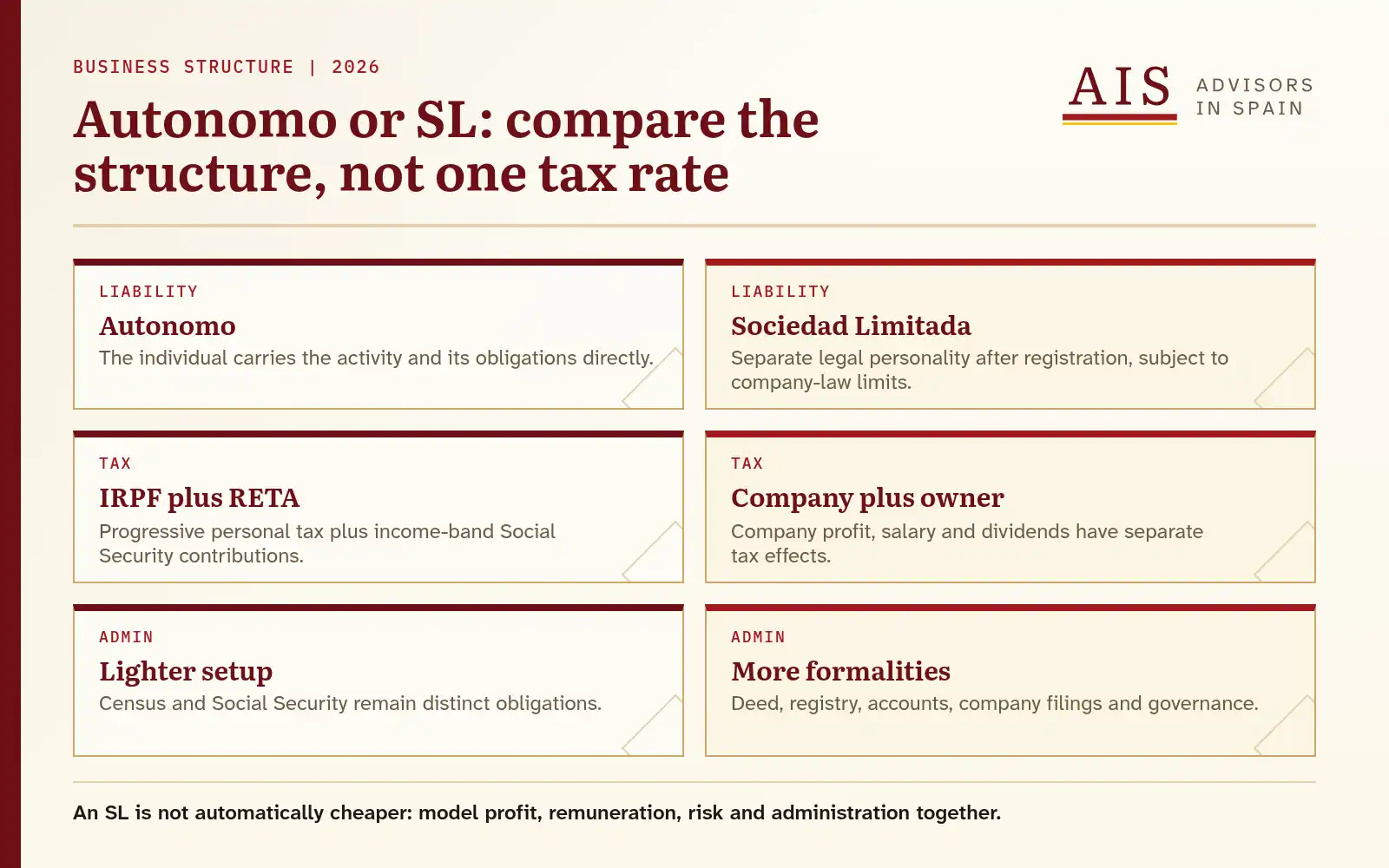
Diagram text version
An autonomo conducts the activity personally and combines progressive IRPF with RETA contributions. An SL has separate legal personality after registration and pays corporate tax, while salary or dividends create separate consequences. The SL adds incorporation, accounts, governance and filing obligations.
Autonomo means unlimited personal liability and simple paperwork; an SL limits liability but costs more to set up and run. This guide compares both on liability, cost and tax, naming the RETA registration every autonomo completes and the €1 minimum SL share capital under Ley 18/2022 (Crea y Crece).
Should You Register as Autonomo or Form an SL in Spain?
Autonomo offers simpler administration but leaves the owner with unlimited personal liability. An SL separates the company from its owners but brings formation and running costs. The choice depends on liability exposure, profit and extraction plans, financing, hiring and administrative capacity.
Liability and tax treatment decide it. Autonomo, Spain’s self-employed registration (glossed further below), makes you and the business the same legal person, so a creditor can reach your personal assets. An SL, a Sociedad Limitada (glossed further below as Spain’s standard limited company), is a separate legal person from its founders, so a shareholder’s liability is generally limited to the capital they put in.
Cost moves in the opposite direction. Autonomo carries little upfront cost beyond the ongoing Social Security contribution set out further down this page. An SL now needs as little as €1 in share capital, according to the Ley de Sociedades de Capital as amended by Ley 18/2022, but a notary deed and Registro Mercantil filing push the real formation cost above that figure. Professional help adds a separate fee where commissioned.
The sections below work through liability, cost and tax in full, then set out the factors to test for each route.
What Is an Autonomo in Spain?
Autonomo is Spain’s self-employed, or sole-trader, registration: you and the business are the same legal person, so your personal assets and your business debts sit on one balance sheet.
Anyone over 18 who habitually, personally and directly carries out a for-profit economic or professional activity on their own account must register with RETA, the Regimen Especial de Trabajadores Autonomos, Social Security’s self-employed regime, under article 305 of the Ley General de la Seguridad Social, according to BOE. That obligation applies whether or not you employ others, and it sits alongside a separate tax registration with the Agencia Tributaria, covered in the registration steps further down this page.
RETA registration is a Social Security obligation, separate from the immigration authorization a foreign national needs before starting the activity. The self-employed visa guide covers that immigration route in full.
What Is an SL (Sociedad Limitada) in Spain?
An SL, a Sociedad Limitada, is Spain’s standard private limited company: a legal person separate from its founders, so a shareholder’s liability is generally limited to what they put into the company.
The capital of an SL may not be less than €1, under article 4 of the Ley de Sociedades de Capital, as amended by Ley 18/2022 (Crea y Crece), according to BOE. That €1 figure carries a condition: while the company’s capital stays below €3,000, at least 20% of profit must go to a legal reserve until capital plus reserve reach that figure, and if the company is liquidated with insufficient assets, the shareholders answer jointly for the shortfall between €3,000 and the capital actually subscribed.
Forming an SL requires a notarial deed and inscription at the Registro Mercantil, under LSC articles 20 and 33, according to BOE. The company gains its own legal personality only once that inscription is done, and shares cannot be transferred before it.
How Do Autonomo and SL Compare on Liability, Tax and Cost?
Autonomo and SL differ most in liability, formation cost, ongoing cost and how profit is taxed. The table below sets out both routes side by side; the sections that follow give each row its full detail and sourcing.
| Factor | Autonomo | SL |
|---|---|---|
| Liability | Unlimited and personal | Generally limited to capital contributed; a reserve and shortfall rule apply below €3,000 |
| Minimum capital | None | €1, with a legal-reserve requirement building to €3,000 |
| Setup cost and time | Census declaration plus RETA registration | Notary deed €60-€150, plus a separate Registro Mercantil fee €40-€100 |
| Ongoing costs | Monthly RETA contribution, base chosen within an income-tramo band | Corporate filings and annual accounts deposit |
| Tax treatment | IRPF (personal income tax); Modelo 130 applies under estimacion directa unless an exemption applies | Impuesto de Sociedades (corporate tax), plus tax on any salary or dividends drawn |
| Decision factors | Personal liability exposure, administration and IRPF treatment | Separate legal personality, formation and running costs, financing and profit extraction |
Figures from BOE (Ley de Sociedades de Capital, RD 1426/1989, Decreto 757/1973, Orden PJC/297/2026) and Seguridad Social. Checked 25 August 2026.
Each row is sourced in full further down this page: liability and minimum capital under “What Is an SL,” setup and ongoing cost under “What Does It Cost,” and tax treatment under “Does an Autonomo or an SL Pay Different Taxes.”
Who Should Choose Autonomo, and Who Should Form an SL?
A solo freelancer or consultant may prefer autonomo when simple administration matters and the owner accepts unlimited personal liability. Turnover alone does not decide the structure.
A founder may prefer an SL when separate legal personality, hiring, outside capital or limited shareholder liability matters enough to justify the additional administration and cost.
A freelancer or digital nomad operating under a Spanish visa still needs to assess the legal and tax structure for the activity. The self-employed visa guide covers the immigration route, and digital nomad visa tax covers the separate tax election some digital nomad visa holders can make once they are working in Spain.
These factors are not a legal test. Model the tax, liability and administration for your own case before choosing.
Have Your SL Formed From Name Reservation to Registration
Recognize yourself in the SL profile above? A company formation specialist handles the parts of forming an SL that carry real legal weight: the negative certification and name reservation, the notary deed, the company NIF application and the Registro Mercantil filing.
The Advisors in Spain team can coordinate the structure review and incorporation steps through the Registro Mercantil inscription. The full company registration steps walk through that process in detail if you want to see every stage first.
The company formation service covers structure advice, the notary deed and the Registro Mercantil filing.
How Do You Register as an Autonomo in Spain?
You register as an autonomo by getting an NIE if you need one, filing a census declaration with the Agencia Tributaria, registering with RETA, and then starting to invoice and file quarterly returns.
- Get an NIE, if you don’t already have one.Every non-Spanish national needs an NIE before completing the steps below. The NIE guide covers the application in full.
- File the census declaration and register your IAE activity code.Modelo 036 goes to the Agencia Tributaria before you start your activity, naming the economic activity’s IAE (Impuesto sobre Actividades Economicas) code, according to Agencia Tributaria. An individual is exempt from paying IAE itself, with no turnover test, but still has to file this alta and get an epigrafe assigned, under article 82 of the Ley Reguladora de las Haciendas Locales, according to BOE.
- Register for RETA.Registration with the Regimen Especial de Trabajadores Autonomos runs through the Seguridad Social / TGSS, online or in person, and is mandatory once you are habitually, personally and directly carrying out a for-profit activity on your own account, under article 305 of the Ley General de la Seguridad Social, according to BOE.
- Start invoicing and file the returns that apply.Once registered, you invoice under your own name or trading name. An autonomo under estimacion directa files Modelo 130 in the first 20 days of April, July and October, and between 1 and 30 January for the fourth quarter, unless an exemption applies. Professionals are generally exempt if at least 70% of their previous year’s professional income was subject to withholding. “Does an Autonomo or an SL Pay Different Taxes” below covers the IRPF mechanism.
What Does It Cost to Register as Autonomo or Form an SL?
The ongoing autonomo cost includes the monthly RETA contribution. Forming an SL adds the minimum share capital, a notary deed and a Registro Mercantil filing.
The RETA contribution is not one flat number. Each month, Social Security applies a combined rate to a contribution base you choose from within an income-based tramo published every year. For 2026, that combined rate is 31.50% of the chosen base: 28.30% for contingencias comunes, 1.30% for contingencias profesionales, 0.90% for the mecanismo de equidad intergeneracional, 0.90% for cese de actividad and 0.10% for formacion profesional, according to Orden PJC/297/2026, articles 18 and 37. The base itself is chosen from within your income tramo. It is not set freely: the lowest 2026 tramo sets a minimum monthly base of €653.59, and the highest tramo runs to a maximum base of €5,101.20, according to the same order.
Forming an SL needs the minimum €1 share capital described above plus two separate fees from two different offices. The notary charges €150 and the Registro Mercantil charges €100 for an electronic filing with no shareholder that is itself a company, capital at or below €30,000, and one, several joint-and-several, or two joint administrators, according to BOE. Both drop, to €60 and €40, where capital also stays at or below €3,100 and the company uses articles approved by the Ministerio de Justicia. A foreign parent company forming a Spanish SL fails the no-legal-person-shareholder condition and pays neither reduced fee. Professional fees depend on the work commissioned.
Does an Autonomo or an SL Pay Different Taxes in Spain?
Yes. An autonomo pays personal income tax, and an SL pays corporate tax, and the two run on different mechanisms.
An autonomo pays IRPF, Impuesto sobre la Renta de las Personas Fisicas, Spain’s personal income tax. An autonomo under estimacion directa makes quarterly payments on account through Modelo 130 unless an exemption applies. Professionals are generally exempt if at least 70% of their previous year’s professional income was subject to withholding. An SL pays Impuesto de Sociedades, corporate tax, on the company’s own profit; corporate tax in Spain covers the current rates and how they depend on turnover and company age. An SL’s owners then pay separately, through their own personal tax, on any salary or dividends they draw from the company.
Both structures may also need to register for and file VAT (IVA) once they are trading. VAT in Spain covers when that applies and how the registration and filing work, and the autonomo tax calculator provides a planning estimate for your own numbers.
Can You Switch From Autonomo to an SL Later?
Yes, but no single filing converts an autonomo registration into an SL. Spanish law sets out no dedicated conversion procedure for it.
In practice, a founder incorporates a new SL through that same notary-deed-and-Registro-Mercantil process, then separately transfers or winds down the autonomo activity into the new company and deregisters the old RETA and census entries. That transfer step can carry its own tax and administrative consequences, so get advice on the transfer before moving assets or contracts.
Timing affects which legal person signs contracts and holds assets. Plan the incorporation and the transfer before signing under the new structure.
Need Help Registering as Autonomo, or Still Deciding on an SL Later?
Working through the autonomo steps above, or thinking ahead to an eventual SL? Either way, a specialist can check your case before you file anything.
A company formation specialist handles both non-resident and resident founders. The specialist checks your NIE and RETA paperwork if you are registering as autonomo now, or works through timing and structure with you if you are planning ahead to an SL. Company formation in Spain covers the process in full.
The company formation service covers autonomo registration and the steps required to form an SL.
Fees, rates and legal references on this page are current as of 25 August 2026.
Questions
Common questions
How much tax does an autonomo pay in Spain?
How much does it cost to register as autonomo compared to forming an SL?
What does "autonomo" mean in Spain?
How do I register as an autonomous worker in Spain?
What are the requirements for obtaining an autonomo visa in Spain?
Can I switch from autonomo to an SL later?
Do I need a gestor, accountant or solicitor to register as autonomo or form an SL?
Start here
Your request is in
Your enquiry is with Advisors in Spain. We assess your requirements and reply by email with the appropriate next steps.
We review your enquiry today. If you have not heard back within two working days, write to us and we chase it the same day.
Our guides are prepared in accordance with our Editorial Standards.