VAT in Spain: Rates, Registration and Filing (2026)
Spain's VAT, called IVA, applies at three rates set by Ley 37/1992: 21% general, 10% reduced and 4% super-reduced. This guide explains what IVA is, how the charge-and-reclaim mechanism works, who has to register, and how it differs from VAT or sales tax elsewhere, then explains what a tax advisor handles for registration itself.

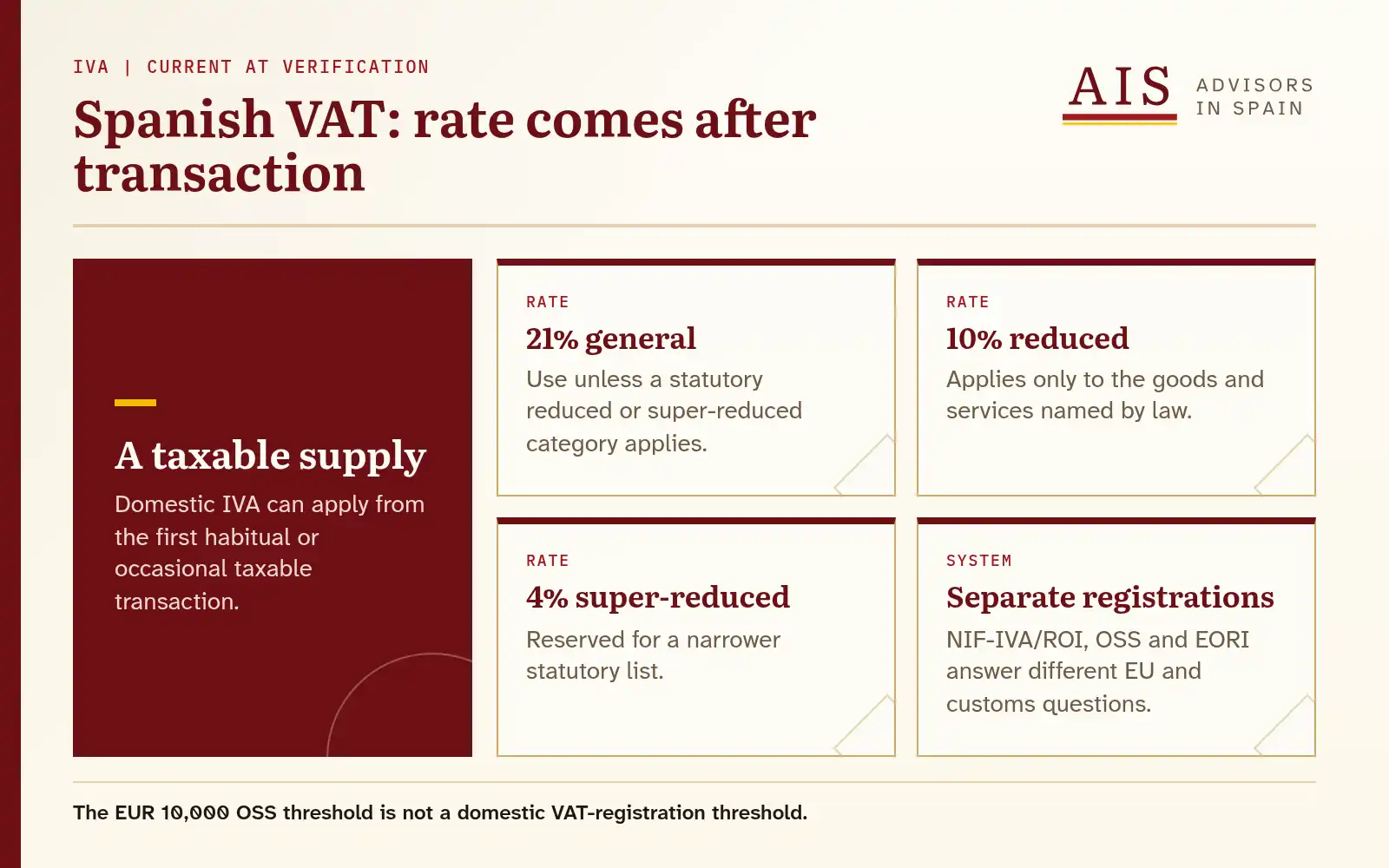
Diagram text version
Spanish VAT has a 21 percent general, 10 percent reduced and 4 percent super-reduced rate. Lower rates apply only to statutory categories. Domestic registration, the EU VAT register, OSS and customs EORI registration are separate questions; the 10,000-euro OSS threshold does not exempt domestic taxable activity.
Spain’s VAT, called IVA, applies at three rates depending on what a business sells. This guide explains what IVA is, its three rate bands, how the charge-and-reclaim mechanism works day to day, and how it differs from VAT or sales tax elsewhere. It closes with the point at which registering becomes urgent, then covers what a tax advisor handles for the registration process itself.
What is VAT (IVA) in Spain?
IVA is Spain’s value-added tax, charged on taxable supplies at one of three rates. Exemptions and place-of-supply rules can change whether Spanish IVA applies. Registered businesses charge IVA on taxable sales, reclaim it on qualifying purchases, and pay the difference to Agencia Tributaria each quarter.
IVA stands for Impuesto sobre el Valor Anadido, Spain’s name for value-added tax, and it is not one flat rate. Ley 37/1992 sets a general rate under article 90 and two separate reduced rates under article 91, one for a defined list of goods and services and a lower “super-reduced” rate for a narrower list, according to BOE.
For a taxable supply in Spanish VAT territory, the empresario or profesional selling it adds the applicable tax to the invoice, collects it from the customer, and remits it to Agencia Tributaria. Exemptions and place-of-supply rules can change that treatment. The next section sets out the figures for each rate band.
What are Spain’s VAT rates?
Spain applies three IVA rates for 2026: 21% general, 10% reduced and 4% super-reduced, according to Agencia Tributaria’s own 2026 rate table. The general rate, set by article 90.Uno, is the default; it applies to anything not specifically listed under one of the two lower bands.
| Band | Rate | Example categories |
|---|---|---|
| General (art. 90.Uno) | 21% | The default rate; also applies to business premises, tobacco, alcoholic drinks and sugared soft drinks even though those sit inside categories that otherwise carry a lower rate |
| Reduced (art. 91.Uno) | 10% | Basic foodstuffs, agricultural inputs, water for human/animal consumption or irrigation, veterinary medicines, passenger transport, hospitality and restaurant services, housing sold by its promoter (business premises excluded), cultural-event admission |
| Super-reduced (art. 91.Dos) | 4% | Common bread and bread-making flours, milk, cheese, eggs, fruit and vegetables, olive oils, books and newspapers (non-advertising), human medicines, mobility-reduction vehicles and wheelchairs, menstrual and contraceptive products |
Ley 37/1992 articles 90 and 91, with 2026 rates from Agencia Tributaria's rate table.
The default is 21%: most goods and services that are not on one of the two named lists fall there by definition. A separate 0% rate applies only to specific donations of listed goods, food, certain medical articles, books, water supply, solar panels, to entities that qualify under Spain’s mecenazgo rules, according to Agencia Tributaria.
How does VAT work in practice for a business in Spain?
A VAT-registered business charges IVA on what it sells, called output VAT, and reclaims the IVA it paid on business purchases, called input VAT, then pays Agencia Tributaria the difference each quarter. That deduction right is not automatic for every purchase: under Ley 37/1992 articles 92 and 93, input VAT is only recoverable to the extent the goods or services bought are actually used in transactions that themselves qualify for deduction, so a purchase for a non-qualifying use does not generate a reclaim just because IVA was paid on it.
A business carrying out intra-Community operations with counterparties in other EU countries must register for a NIF-IVA, the ROI-activated form of its general NIF, via Modelo 036, according to Agencia Tributaria. Once registered, that NIF-IVA status can be verified in real time through VIES, the EU’s VAT Information Exchange System.
A separate rule, the reverse charge, can shift who accounts for the tax entirely. Under Ley 37/1992 article 84.Uno.2º, when a supply is made by a person or entity not established in Spanish VAT territory, the Spanish business receiving the supply becomes the one who accounts for the IVA, subject to five named exceptions. The rule turns on where the supplier is established. It does not require the transaction to be intra-EU, so it can also reach a supply from outside the EU.
Who has to register for VAT in Spain?
A business making taxable supplies in Spain can fall within IVA from its first transaction, with no minimum-turnover threshold in the rule cited here. Ley 37/1992 article 4.Uno covers supplies made by an empresario or profesional “con caracter habitual u ocasional,” habitually or occasionally. The census-registration process and its timing are covered on VAT registration in Spain.
An autonomo and an SL register separately, even where one person runs both: each files its own Modelo 036 census declaration and gets its own NIF-IVA. This guide covers the summary rule only; the process itself, the documents behind it and what an advisor files, lives on VAT registration in Spain. The separate question of whether to trade as an autonomo or form an SL is covered on autonomo vs SL.
How is Spanish VAT different from VAT or sales tax elsewhere?
Spain’s IVA is a national tax administered by Agencia Tributaria under Ley 37/1992; a business selling into Spain follows Spain’s own IVA rules for that trade, whatever VAT or sales tax regime applies in its home country. There is no comunidad-level variation to account for, since IVA sits at the state layer.
For a US-market reader, the comparison point is structural: the US has no federal-level VAT, only state-level sales tax collected once, at the final sale to the end consumer. IVA works differently at every step. A business charges it on what it sells and reclaims it on what it buys, so the tax is charged and reclaimed repeatedly across a supply chain. US sales tax stops at a single collection point, the checkout. That charge-and-reclaim mechanism is the central structural difference.
How do you file VAT returns in Spain?
Modelo 303 is the quarterly IVA return; Modelo 390 is the annual summary. Modelo 303 falls due 1-20 of the month following each quarter, April, July and October, except the fourth quarter, which runs 1-30 January of the following year, according to Agencia Tributaria’s own filing calendar. A business in the Monthly Refund Register files monthly instead, on the 1st-30th of the month following each period. Modelo 390, the annual summary, is purely informative, no payment is due on it, and it is filed in the same 1-30 January window as the year’s last Modelo 303.
VAT (IVA) is a separate obligation from corporate tax, Impuesto de Sociedades: IVA taxes transactions every quarter regardless of profit, while corporate tax taxes yearly profit on its own return. Corporate tax in Spain covers the profit-tax side. Setting up a filing calendar correctly the first time is one of the things an adviser handles once a NIF-IVA is active, covered in full on VAT registration in Spain.
What VAT mistakes do businesses make in Spain?
These VAT errors can lead to a wrong invoice or filing:
- Invoicing an EU counterparty without a valid NIF-IVA shown. VIES cannot verify the transaction without it, which can put the VAT-exempt treatment of the sale at risk.
- Confusing IVA with corporate tax. They are two separate obligations on two separate calendars, covered above.
- Missing a quarterly Modelo 303 deadline. Late filing before Agencia Tributaria acts still carries a surcharge, separate from any late-payment penalty.
- Misapplying the reverse charge. The rule keys on where the supplier is established. It does not require the transaction to be intra-EU, so treating it as an “EU-only” rule leads to a wrong invoice on both ends.
When does VAT registration become urgent?
Three moments require a registration check: when a business begins making taxable supplies, when an EU distance-seller crosses the €10,000 OSS threshold, and when a business starts importing or exporting and needs a separate EORI number alongside its VAT number.
The first moment is Spain’s own no-threshold rule, covered above: a taxable activity can fall within IVA even when the first transaction is small. The second is a different, EU-wide rule: once the combined value of a business’s intra-EU distance sales and electronically-supplied services across the whole EU exceeds €10,000 in the current or preceding year, those sales become taxable in the customer’s own country, and the One-Stop Shop (OSS) regime lets the business declare that VAT through a single return, filed in its own member state, without a separate registration in every destination country, according to Agencia Tributaria’s OSS guidance. That €10,000 EU-wide threshold is separate from Spain’s own no-threshold domestic rule; the two answer different questions. The third is EORI: a separate customs registration from the VAT number, required for any business that imports or exports goods, even though the two numbers share the same composition for a Spain-established operator, according to Agencia Tributaria.
Each of these moments has different paperwork behind it. Spanish company register covers confirming a company’s own registration before it registers for VAT, and autonomo vs SL covers the structure question for anyone not yet incorporated.
The registration itself and the documents behind it are covered on VAT registration in Spain, whichever moment applies.
Talk to a tax advisor for VAT registration
Advisors in Spain handles VAT registration for businesses.
This guide covers what IVA is, its three rate bands, how the charge-and-reclaim mechanism and the reverse charge work, and when registration becomes urgent. It does not cover the registration process itself.
Register for VAT in Spain
A tax advisor handles your NIF-IVA registration, checks whether OSS or a fiscal representative applies to your business, and sets up your quarterly filing calendar.
Questions
Common questions
What is the VAT rate in Spain?
What does 10% IVA mean in Spain?
What happens if a business in Spain doesn't register for VAT when it should?
Does it cost money just to register for VAT in Spain?
Do autonomos (freelancers) in Spain have to charge VAT too?
What is the reverse charge, and when does it apply?
Is VAT the same thing as sales tax in the US?
VAT registration
Your request is in
Your enquiry is with Advisors in Spain. We assess your requirements and reply by email with the appropriate next steps.
We review your enquiry today. If you have not heard back within two working days, write to us and we chase it the same day.
Our guides are prepared in accordance with our Editorial Standards.