How to Get an NIE Number in Spain
This guide sets out how to apply for a Spanish NIE number on Form EX-15, in Spain, at a consulate abroad, or through a representative holding power of attorney. It covers the two eligibility conditions, the documents, the 9.84 euro fee, and what the Policia Nacional publishes about timing.

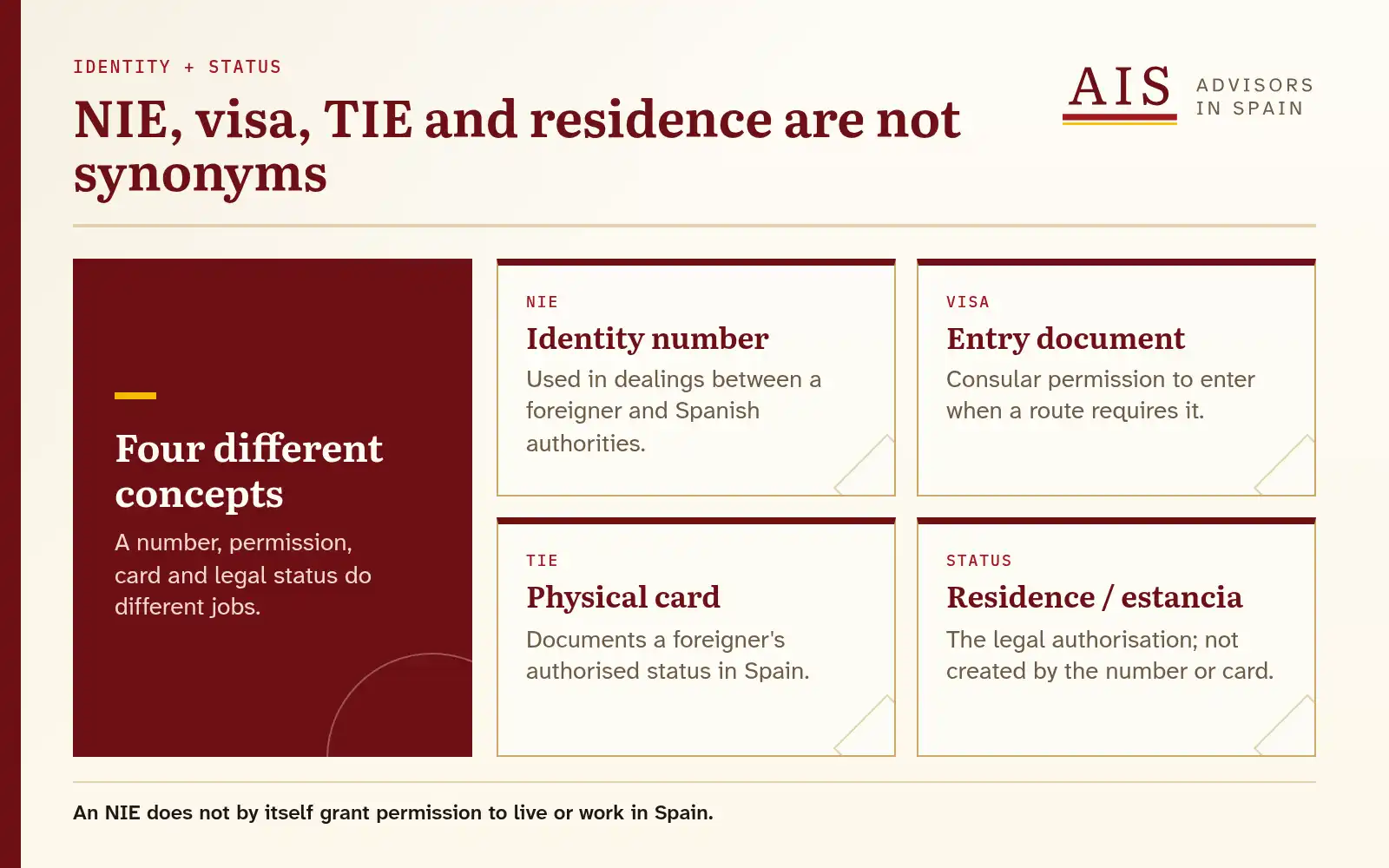
Diagram text version
The NIE is an identification number. A visa is an entry document when consular permission is required. The TIE is a physical identity card documenting an authorised status. Residence or estancia is the underlying legal status. An NIE alone does not grant a right to live or work in Spain.
An NIE number is Spain’s foreigner identity number, applied for on Form EX-15 at the Direccion General de la Policia, an Oficina de Extranjeria or a Comisaria de Policia in Spain, at a Spanish consulate abroad, or through a representative. This guide covers all three routes, the documents each one takes, the 9.84 euro Modelo 790 fee, and what Spain actually publishes about timing. It also covers what a lawyer already acting on your purchase or visa case can file for you.
What Is an NIE Number in Spain?
An NIE, Numero de Identidad de Extranjero, is the identity number Spain assigns to foreigners connected to the country by economic, professional or social interests. You apply on Form EX-15, and the Policia Nacional charges 9.84 euros for the assignment.
Foreigners connected to Spain by economic, professional or social interests must apply for assignment of the number from the Direccion General de la Policia. The same page sets two conditions: the applicant must not be in an irregular situation in Spain, and the reasons for the request must be communicated.
The number and the paper document are separate. Form EX-15 asks which you are requesting: the NIE itself, or a certificate of resident or non-resident status, valid for three months from issuance. Opening a Spanish bank account is covered separately.
Article 4.2 of Ley Organica 4/2000 and article 209 of Real Decreto 1155/2024 cover a second document, the tarjeta de identidad de extranjero. A foreign national issued a visa or an authorisation to remain in Spain for more than six months generally has the right and duty to obtain that TIE card. Holders of seasonal residence-and-work visas are the statutory exception. The application is made in person within one month of entry into Spain, of the authorisation being granted, or of it taking effect.
Can a Lawyer Handle Your NIE Application for You?
Yes. Spain’s consular service describes Form EX-15 as submitted in original and one copy, completed and signed by the applicant or their representative. A lawyer already instructed on your purchase or your immigration case can file the NIE application under a power of attorney.
An immigration advisor already handling your visa case can add this step to work they are doing anyway. British buyers who instruct a solicitor on a purchase can ask their solicitor the same question, since a Spanish property lawyer already covers the purchase side. Fees are set case by case, and you get a quote in writing before any work starts.
Does the NIE sit inside a wider visa or residency case?
The immigration service covers an NIE application when it forms part of a wider visa or residency filing. A straightforward property-purchase NIE is usually self-service or part of the property engagement.
How Do You Apply for an NIE Number?
You apply for an NIE by filing Form EX-15 with the Direccion General de la Policia and paying the Modelo 790, codigo 012, fee. The three routes share the first three steps.
- Check the two conditions. The Policia Nacional requires that you not be in an irregular situation in Spain and that you state the reasons for the request.
- Fill in Form EX-15 and copy it. The current edition says the original and a copy will be submitted. Section 4.2, MOTIVOS, offers economic, professional and social interests, and a box for other grounds.
- Pay the Modelo 790, codigo 012. The Policia Nacional’s extranjeria fee schedule lists 9.84 euros for assignment of an NIE on request.
- File it in Spain. The application goes to the Direccion General de la Policia, directly or through an Oficina de Extranjeria, the immigration office, or a Comisaria de Policia, a national police station.
- Or file it from abroad. Applicants outside Spain apply through Spanish consular offices, and each post sets its own fee: the Miami consulate states 12 US dollars, paid by money order.
- Or send a representative. Form EX-15 can be signed by the applicant or their representative. A power of attorney granted before a foreign notary needs legalisation or an apostille, depending on the applicable convention and authentication route.
What Documents Do You Need for an NIE Application?
The items below are each named by the source cited beside them. Confirm anything beyond them with the office or the consulate where you file, before you go.
- Form EX-15, the original and one copy. The form’s completion instructions say that the original and a copy of it will be submitted.
- A valid passport, original and a copy of the biographical data page. Spain’s consular service names the original of the applicant’s valid passport and a copy of its biographical data page. EU nationals can present their national ID document instead, original and a copy of both sides.
- A completed Modelo 790, codigo 012, with the fee paid. Spain’s consular service names form 790, code 12, completed and the fee paid, alongside the application form.
- Your reasons for requesting the number. The Policia Nacional’s conditions require that those reasons be communicated, and section 4.2 of Form EX-15 is where you check economic, professional or social interests, or specify other grounds.
- A power of attorney, where a representative files for you. Spain’s consular service requires the representative’s own ID document or passport, original and a copy, plus a power that expressly states they are empowered to submit the NIE application. A power granted before a foreign notary also needs legalizacion or an apostille.
Can You Apply for an NIE Number Without a Lawyer?
Yes. The duty to apply falls on the applicant, and the Policia Nacional publishes the conditions, the form and the offices that take it. Three situations put the application past form-filling.
- You cannot attend in person. A representative can complete and sign the form, and a power of attorney granted before a foreign notary has to carry legalizacion or an apostille.
- You are in an irregular situation in Spain. The Policia Nacional’s conditions for assignment at the interested party’s request exclude that case. What to do next is an immigration question, and the form does not answer it.
- Five days pass with no answer. The procedure sets a maximum of five days to resolve an application from its entry into the register, and records the effect of no resolution in that period as denial.
How Long Does It Take to Get an NIE Number?
It takes a maximum of five days for the application itself to be resolved. The Policia Nacional’s NIE assignment procedure counts that deadline from the entry of the application into the register of the competent body.
Two other waits sit outside that figure. Appointment availability varies by province and consulate because slots are allocated per office. Booking an NIE appointment covers the booking side.
The Policia Nacional pages covering NIE assignment and the two residence certificates do not state when the certificate is handed over. Consulates publish figures about their own offices. Spain’s consular service in the Netherlands states that on average the NIE is issued within two weeks. The Consulate General in Miami states a minimum of four weeks because of an increase in requests.
What Mistakes Delay an NIE Application?
Six points in the published procedure are worth checking before you file.
- An irregular situation in Spain. The Policia Nacional’s conditions for NIE assignment require that the applicant not be in one.
- No reason given for the request. The same conditions require that the reasons be communicated. Section 4.2 of Form EX-15 is where you set them out.
- The form filed without its copy. Form EX-15’s instructions say that the original and a copy of the form will be submitted.
- A power of attorney granted before a foreign notary without its apostille. A power granted before a foreign notary needs legalizacion or an apostille, according to the Consejo General del Notariado.
- The wrong office for where you are. In-Spain applications go to the Direccion General de la Policia, an Oficina de Extranjeria or a Comisaria de Policia. Applicants abroad go through consular offices.
- An old copy of the form. Two editions of EX-15 are live on government addresses, and the legacy one still prints “(LO 4/2000 y RD 557/2011)” on its title block. Real Decreto 1155/2024 repealed RD 557/2011 and took effect six months after its 20 November 2024 publication.
A local specialist handles your NIE application in English or Spanish, whichever you are more comfortable in.
Questions
Common questions
How do I get a NIE number in Spain?
How much does it cost to get a NIE number in Spain?
Can I get an NIE number without going to Spain?
Can anyone get a NIE number in Spain?
How long does it take to get an NIE approved in Spain?
Can a lawyer apply for my NIE on my behalf?
What is the difference between an NIE and a TIE?
Does an NIE number expire?
What do I do if I lose my NIE certificate?
What happens if nobody answers my NIE application?
Related
Start here
Your request is in
Your enquiry is with Advisors in Spain. We assess your requirements and reply by email with the appropriate next steps.
We review your enquiry today. If you have not heard back within two working days, write to us and we chase it the same day.
Our guides are prepared in accordance with our Editorial Standards.