Register a Company in Spain
Advisors in Spain handles company formation in Spain: structure advice, the negative certification, notary deed, company NIF and Registro Mercantil filing for a Spanish SL, plus autonomo registration for sole traders.
Most founders setting up a company in Spain choose between two routes: autonomo self-employment, or a sociedad limitada (SL), the Spanish equivalent of a private limited company. A non-resident founder or a foreign company setting up a Spanish subsidiary follows the same SL route, with extra steps for a foreign-company NIF and, for some structures, a Spanish legal representative.
Every case starts with the form below. Describe your situation, and a specialist who handles company formation work takes your case directly, whether you want to open a company as an SL or register as autonomo, filing with the notary and the Registro Mercantil along the way.
First conversation free Reply within one business day

Who Needs to Register a Company in Spain
- You need to register a company in Spain if you are hiring, raising outside capital, or want your liability limited to the business; a solo freelancer with modest turnover can often register as autonomo instead.
- Autonomo, a sole-trader registration, suits a solo freelancer with modest turnover and no need to shield personal assets from the business.
- An SL, a sociedad limitada, is a limited company in Spain: it suits anyone hiring, raising outside capital, or wanting liability limited to the company. British founders often call this step company incorporation, Americans call it company formation, and the process is the same either way.
- A non-resident founder or a foreign company setting up a Spanish subsidiary or branch follows the same SL route, with extra steps for a foreign-company NIF and, for some structures, a Spanish legal representative.
A solo freelancer who does not plan to hire, raise outside capital or shield personal assets from the business is often better served registering as autonomo alone; see our guide on autonomo vs SL for the self-registration steps.
What's Included When You Work With a Company Formation Specialist
The specialist you work with handles every step below directly, from structure advice to the Registro Mercantil filing.
- Structure advice. The specialist confirms whether autonomo, a standard SL, or a foreign-owned SL fits your plans, before any paperwork starts. Ask which structure fits your case.
- Negative certification and name reservation. The specialist requests the certificacion negativa from the Registro Mercantil Central, submitting 2-3 proposed names in priority order so a rejected first choice does not stall the filing. Have the specialist reserve your company name.
- Capital-deposit account and bank certificate. The specialist coordinates opening the account that receives the share capital and obtaining the bank certificate the notary requires before signing the deed. Get help opening the capital-deposit account.
- Notary deed drafting and signing. The specialist drafts the escritura de constitucion and attends the notary appointment with you, or on your behalf under a power of attorney. Have the specialist handle your notary appointment.
- Company NIF application. The specialist files Modelo 036 with the Agencia Tributaria for the company's own tax ID, provisional at first and converted to definitive once the Registro Mercantil inscription lands. Ask the specialist to file your company NIF.
- Registro Mercantil filing. The specialist files the signed deed at the Registro Mercantil, the step that gives the company its legal existence. VAT and IAE registration, and payroll or hiring, are separate specialist services, each with its own page and form; see VAT registration in Spain and payroll services in Spain. Have the specialist file at the Registro Mercantil.
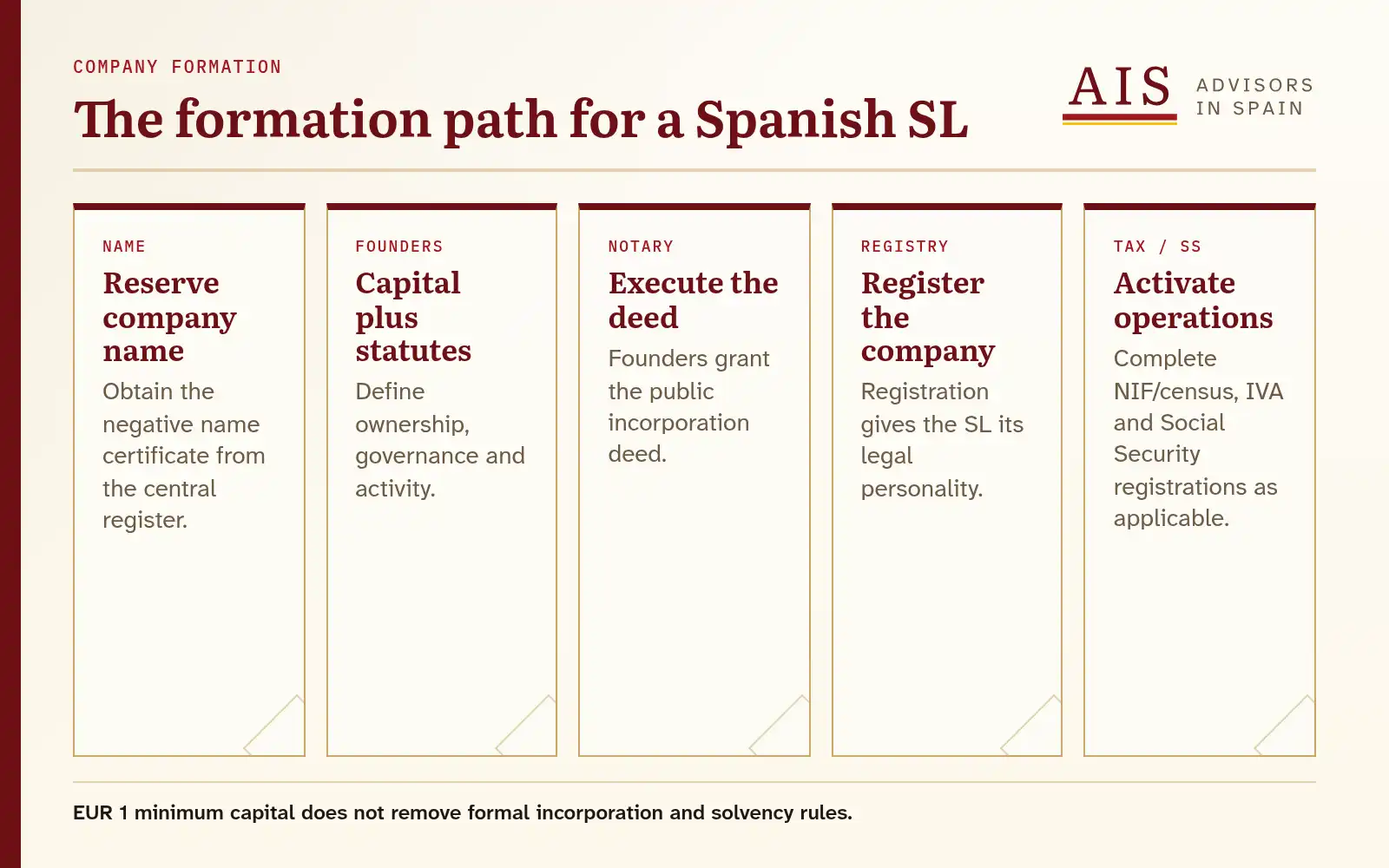
Diagram text version
Reserve a company name, settle ownership, capital, statutes and governance, execute the incorporation deed before a notary, register the deed with the provincial Registro Mercantil, then complete NIF, census, VAT and applicable Social Security registrations. Registration gives the SL legal personality.
What You'll Need to Provide
- Passport or NIE
- A valid passport for each shareholder and director; a NIE, or proof that a NIE application has been filed, is needed for the company NIF and notary steps.
- 2-3 proposed company names
- Submitted in priority order to the Registro Mercantil Central for the negative certification, so a rejected first choice does not stall the filing while a second and third option are already queued.
- Minimum share capital
- €1 for a standard SL under Ley 18/2022, though capital below €3,000 carries two conditions: 20% of profit goes to the legal reserve until capital plus reserve reach €3,000, and on liquidation the shareholders answer jointly for the shortfall between €3,000 and the capital subscribed. See the cost question in the FAQ below.
- A registered address in Spain
- The company's domicilio social, the address the Registro Mercantil and the Agencia Tributaria hold on file for notifications.
- Foreign-owned SL: apostilled incorporation documents
- The foreign parent company's own incorporation documents, apostilled and translated into Spanish, before the notary or the Registro Mercantil will accept them; see buying property in Spain through a company for a worked example of the same apostille mechanics.
- Foreign-owned SL: a company NIF for the parent
- A separate NIF for the foreign parent itself, requested from the Agencia Tributaria alongside the new Spanish company's own NIF.
- Foreign-owned SL: a Spanish legal representative
- Spanish tax law requires a representative resident in Spain where the foreign parent goes on to operate here through a permanent establishment, most often a registered branch. A parent resident in an EU or EEA state with mutual assistance on tax information is exempt, and the Agencia Tributaria asks for the representative's details on the NIF application where one exists.
How Company Registration in Spain Works
-
Choose the structure
Autonomo or an SL, or a foreign-owned SL where the founder is a company; the specialist confirms which fits before anything is filed.
-
Apply for the negative certification
The Registro Mercantil Central checks 2-3 proposed names in priority order and issues the certificacion negativa reserving the first available one.
-
Open the capital-deposit account
The share capital is deposited and the bank issues the certificate the notary needs to sign the deed.
-
Sign the notary deed
The escritura de constitucion is drafted and signed before a notary, setting out the company's statutes, shareholders and administrators.
-
Apply for the company NIF
Modelo 036 goes to the Agencia Tributaria for the company's own tax ID, provisional until the Registro Mercantil inscription is complete.
-
File at the Registro Mercantil
The signed deed is filed for inscription, the step that gives the company its legal existence.
-
Register for VAT/IAE and, if hiring, as an employer
Tax and activity registration follow immediately after incorporation; hiring staff adds an employer registration with Social Security, covered on our payroll services page.
Timing: What to Expect and What Causes Delays
1 to 10 days
Spain's official CIRCE/PAE telematic system, run by the Ministry of Industry and Tourism, states this range for a filing made through the platform, depending on whether standardized bylaws and deed templates are used.
What delays it
A rejected or already-taken name at the negative certification stage, a hard-to-book notary appointment, an incomplete document set for a foreign-owned company, or apostille turnaround on foreign paperwork each push a filing back further. A bespoke notary deed, the common case for a foreign-owned SL, generally takes longer than the standardized-bylaws route the CIRCE range assumes.
What to prepare now
Have 2-3 proposed company names ready in priority order, your passport or NIE, and, for a foreign parent company, the apostilled incorporation documents translated into Spanish, before the qualification form goes in.
Beyond incorporation
Ongoing Obligations and Tax Considerations
Once the company exists, three obligations sit on the calendar that the incorporation itself does not cover: company secretarial support, annual accounts, and, for some foreign parents, a branch or a second NIF.
Company secretarial, annual accounts and branch registration. An SL keeps minute-books and files board and shareholder resolutions at the Registro Mercantil as they happen, not only at incorporation. Annual accounts go to the same registry every year, and the deadline follows the company’s financial year-end. A foreign parent that wants a Spanish branch, not a subsidiary, registers the branch separately and requests its own company NIF from the Agencia Tributaria. Each is a compact service. Advisors in Spain handles them within company formation and accounting work; ask the specialist handling your case which of these your structure needs.
Company tax filings. Corporate tax follows a fixed filing calendar tied to the SL’s financial year; see corporate tax in Spain for the rates, deadlines and forms.
Hiring staff. Running monthly payroll, registering as an employer with Social Security, and weighing whether an Employer of Record arrangement is even legal in Spain are covered on payroll services in Spain, not repeated here.
Formation costs, capital rules and the sourced timing figures on this page are current as of August 20, 2026, and are reviewed every six months against BOE, Agencia Tributaria and Registro Mercantil Central guidance.
Get your paperwork checked before you file
Tell us your structure and timeline, and a specialist who checks your company names and documents takes your case before anything goes to the notary or the Registro Mercantil.
Common questions
What's the difference between an autonomo and an SL in Spain?
How do I register a company in Spain?
How much does it cost to register a company in Spain?
What is an LLC called in Spain?
How long does it take to register a company in Spain?
Can a foreign national own 100% of a company in Spain?
Do I need a lawyer, gestor or accountant to register a company in Spain?
Do I need a Spanish bank account to register a company?
Is an Employer of Record arrangement legal in Spain?
Why Work With Advisors in Spain
-
Every specialist meets the same standard before taking a case.
We do not take on a case we cannot handle well. Every specialist meets the same standard, and we say so if your structure is not something we handle.
-
Every specialist works in English or Spanish.
You explain your structure once, in English or Spanish, directly to the specialist who handles your filing.
-
Coordinated support for related matters.
Company formation, the VAT registration and payroll needs it raises, and whatever follows: we coordinate related requirements, with responsibility and scope agreed for each service.
Contact us
Your request is in
We read every request ourselves, assess the requirements and reply by email with the appropriate next steps.
We review your enquiry today. If you have not heard back within two working days, write to us and we chase it the same day.