Property Taxes in Spain: Rates by Region (2026)
Property taxes in Spain can arise when you buy, while you own, when you rent or use the property, and when you sell. This guide compares the purchase-tax rate in Andalucia, Cataluna and the Comunidad Valenciana, sets out the annual taxes, and closes with a worked example. A Spain-qualified specialist calculates the exact figure for a specific property.
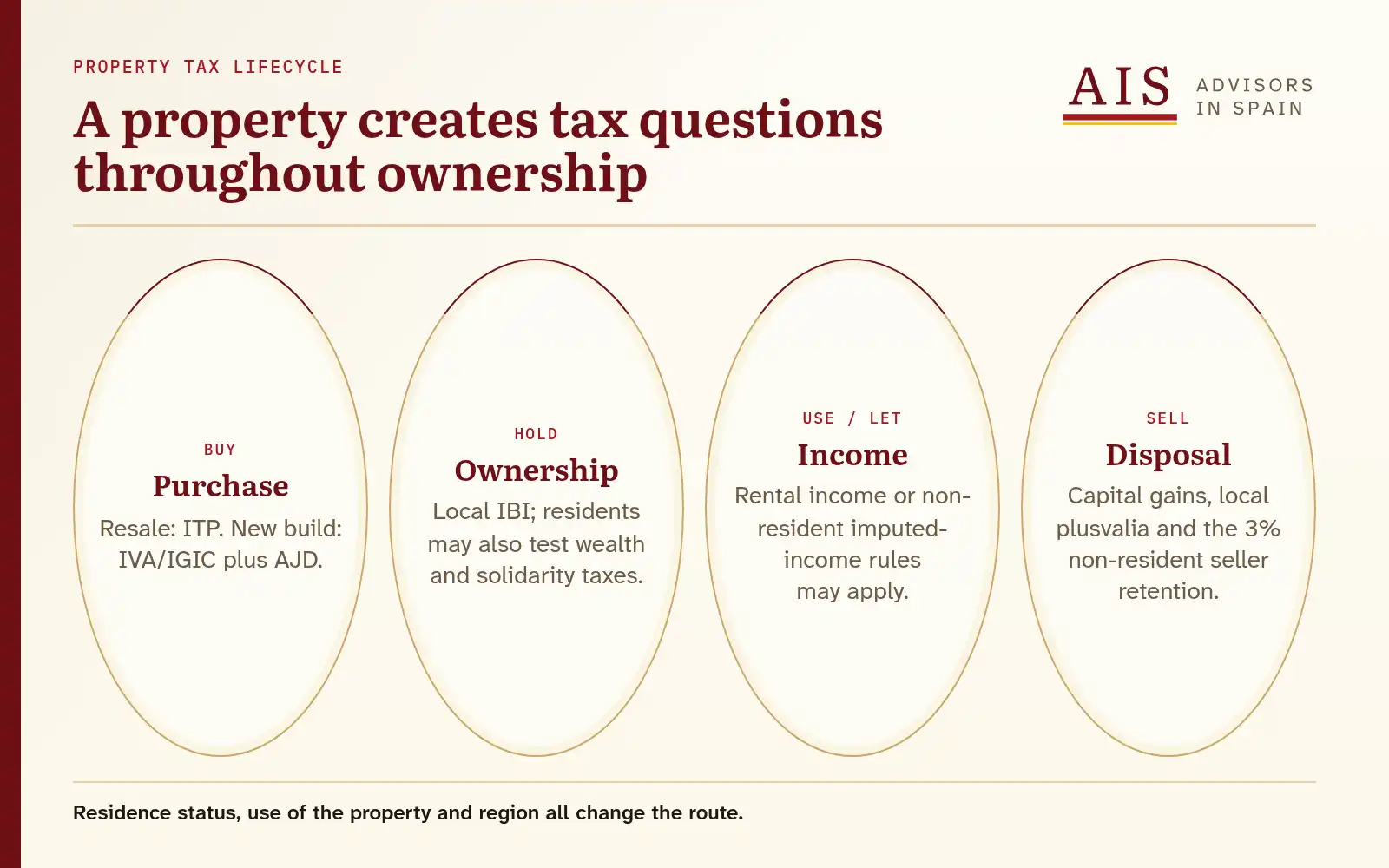
Diagram text version
At purchase, resale property enters ITP while new-build property enters IVA or IGIC plus AJD. During ownership, local IBI and potentially wealth-related taxes are checked. Rental or personal use can create income or imputed-income consequences. Sale can involve capital gains, local plusvalia and a three-percent retention when the seller is non-resident.
Property taxes can arise when you buy, while you own, when you rent or use the property, and when you sell. This guide separates purchase taxes from annual ownership taxes, compares the purchase-tax rate in Andalucia, Cataluna and the Comunidad Valenciana, and closes with a worked example. A Spain-qualified tax specialist can calculate the exact figure for a specific property.
What are the property taxes in Spain?
You pay one tax when you buy a resale property, ITP, at a rate set by your comunidad autonoma, then two annual taxes every year you own it: IBI, billed locally, and imputed income tax for non-residents.
A new-build purchase from a developer works differently: VAT (IVA) applies to the sale, with AJD charged alongside it on the notarial deed. AJD sits inside the same national framework law that sets ITP, and IVA sits outside it. Ownership then adds two further taxes every year the property stays yours. IBI, the Impuesto sobre Bienes Inmuebles, is billed by the local ayuntamiento on the property’s valor catastral, its cadastral value. A non-resident owner who does not let the property out also owes imputed income tax on it under LIRPF article 85, whether or not they set foot in Spain that year.
The sections below cover ITP, AJD and IBI in turn, compare the purchase-tax rate across three regions and close with a worked example.
What is ITP and when do you pay it?
ITP, Impuesto de Transmisiones Patrimoniales, is the tax due on a resale, or second-hand, property purchase, and the buyer pays it as the taxpayer of record.
The taxable base is the valor de referencia, the reference value the cadastral authority sets for the property, according to Real Decreto Legislativo 1/1993, articles 8.a and 10. The higher figure becomes the tax base whenever the price agreed between buyer and seller exceeds that reference value, so understating the price on the deed does not lower the tax.
ITP’s rate is set by each comunidad autonoma. The state sets no general rate of its own; a 6% rate applies only where a comunidad has not approved a rate of its own, under the same law’s articles 11.1.a and 31.2. Andalucia, Cataluna and the Comunidad Valenciana have approved their own rates. The regional table further down this page gives those three rates.
What is AJD and when do you pay it on a new-build purchase?
AJD, Actos Juridicos Documentados, is the stamp duty on notarised legal documents, and a resale purchase and a new-build purchase trigger it differently.
A resale purchase carries ITP. A new-build purchase from a developer falls outside ITP altogether and carries VAT plus AJD on the same deed. Confirm the applicable VAT rate with your adviser before budgeting a new-build purchase.
AJD can also apply a second time, separately from the purchase deed, whenever a mortgage is formalised. In the Comunidad Valenciana, for example, a first-copy deed formalising a mortgage loan is taxed at 2% under Ley 13/1997 article 14, where the lender is the taxpayer, a different figure from that region’s 1.4% general AJD rate.
Why does the ITP or AJD rate depend on which region you buy in?
Spain devolved the power to set ITP and AJD rates to its 17 comunidades autonomas inside one national framework law, so the same purchase price produces a different tax bill depending on where the property sits.
Real Decreto Legislativo 1/1993 fixes the tax’s structure, its taxable base and a fallback rate nationally, and leaves the actual percentage to each comunidad’s own legislature. Andalucia set its current rate in Ley 5/2021, the Comunidad Valenciana in Ley 13/1997, and Cataluna through its own tax agency’s published tariffs. All three have legislated their own ITP rate, so the 6% state fallback figure from the previous section applies to none of them.
The next section compares what Andalucia, Cataluna and the Comunidad Valenciana each charge.
What ITP or AJD rate do you pay in Andalucia, Cataluna and the Comunidad Valenciana?
Andalucia charges 7% ITP on a general resale purchase, under Ley 5/2021 as consolidated on BOE. Cataluna runs a banded average-rate scale that starts at 10% and reaches 13% on the highest band, according to the Agencia Tributaria de Catalunya. The Comunidad Valenciana charges 9% up to 1,000,000 euros and 11% above it, under Ley 13/1997 as consolidated on BOE. These three regions appear here because Advisors in Spain covers Costa del Sol, Barcelona and Valencia.
| Region | ITP, general rate | ITP, reduced rate | AJD, documentos notariales |
|---|---|---|---|
| Andalucia | 7% | 6% for a habitual home up to 150,000 euros; 3.5% for buyers under 35, a disability, a large family, a domestic-violence or terrorism victim, or a home in a depopulated municipality, each capped at 150,000 or 250,000 euros | 1.2% |
| Cataluna | 10% up to 600,000 euros, an average rate rising to 13% above 1,500,000 euros; 20% for a gran tenidor from 27 June 2025 | 5%, 4% or 3% for defined buyer profiles and rural municipalities | Confirm the applicable rate before budgeting |
| Comunidad Valenciana | 9% up to 1,000,000 euros, 11% above it | 8% for protected housing above 180,000 euros bought as a first habitual home, and for a first habitual home above 180,000 euros bought by a buyer under 35 meeting an income test | 1.4% general rate, the figure that applies to a new-build purchase; 0.1% on a habitual home’s own purchase deed; 2% on a transfer where the VAT exemption is waived, or on a mortgage deed where the lender is the taxpayer |
General rates only; each region also sets conditional reduced rates.
Calculate what you’ll actually owe on your purchase
A table gives you the headline percentage. It does not give you the figure you would owe on a specific purchase.
Reductions change the answer for some buyers. Andalucia cuts its rate to 6% for a habitual home valued at 150,000 euros or less, and to 3.5% for a buyer under 35, a buyer with a disability, a large family, a domestic-violence or terrorism victim, or a home in a depopulated municipality, each capped at 150,000 or 250,000 euros depending on the case. Whether the purchase is a resale or a new build changes which tax applies at all, and the price itself decides which band of a scaled region like Cataluna or the Comunidad Valenciana you land in.
Send the purchase price, the region and whether it’s a resale or a new build, and our team works out the actual figure.
For the full transactional cost breakdown, including notary and registry fees on top of the tax itself, see the full cost of buying, taxes included.
What annual tax do you pay just for owning property in Spain?
You pay IBI, the Impuesto sobre Bienes Inmuebles, every year you own property in common-regime Spain, whether or not you live there.
The local ayuntamiento bills IBI on the property’s valor catastral, the cadastral value the Direccion General del Catastro determines, notifies and keeps open to challenge, according to Real Decreto Legislativo 2/2004 article 65. In common-regime Spain, each ayuntamiento then sets its own rate inside a band: 0.4% to 1.10% of the cadastral value for urban property, and 0.3% to 0.90% for rustic property, under article 72.1. The foral territories of Pais Vasco and Navarra run their own regimes and sit outside this band. No single figure is the Spanish IBI rate; the actual bill is whatever the local ordinance sets inside that band.
In Alicante province, IBI and other local taxes are collected by Suma Gestion Tributaria, an organismo autonomo of the Diputacion Provincial de Alicante, according to the Ministerio de Hacienda’s own public-sector registry. Suma is a provincial collection body specific to Alicante, and its name is not a synonym for IBI anywhere else in Spain.
Do non-residents pay tax on a property they don’t rent out?
Yes. A non-resident owner who does not let the property out still owes imputed income tax on it every year, under LIRPF article 85, because Spain treats an unrented second home as producing a notional benefit.
The taxable amount is 2% of the property’s cadastral value generally, or 1.1% where the municipality’s cadastral values were revised within the last ten tax periods, according to BOE. That imputed income is then taxed at the standard non-resident rate under Real Decreto Legislativo 5/2004 article 25.1.a: 24% generally, or 19% for a taxpayer resident in another EU or EEA state with an effective exchange of tax information.
The income accrues on 31 December each year, and the return, Modelo 210, is filed and paid across the following calendar year, according to the Agencia Tributaria’s own Modelo 210 instructions. LIRPF article 85’s exemption for a habitual residence does not help here, because a Spanish holiday home is by definition not the owner’s habitual residence, so it stays taxable. Filing your Modelo 210 return covers the deadlines and the mechanics in full.
What if you rent the property out instead?
Letting the property replaces the imputed-income calculation with ordinary rental income tax for the months it is let.
Rental income from Spanish property is Spain-sourced income under Real Decreto Legislativo 5/2004 article 13.1.g, whatever the landlord’s own country of residence. The tax then splits by residence: a landlord resident outside the EU or EEA is taxed on the gross rent with no expense deduction, under article 24.1, at the 24% rate set by article 25.1.a, while a landlord resident in the EU, or in the EEA with an effective exchange of tax information, may deduct expenses directly linked to the Spanish letting under article 24.6, and pays the 19% rate the same article 25.1.a sets for that case, on the net figure. A single rental income tax rate does not exist here; the two figures above are genuinely different depending on where the landlord lives.
A holiday let can also need a tourist licence before it goes on the market, a separate requirement from the tax itself. Getting a tourist licence before you let it out covers what that involves.
Do you pay property tax when you sell?
Selling a Spanish property can trigger plusvalia municipal, a tax separate from ITP, AJD, IBI and imputed income tax. Other transfers of urban land or qualifying rights can also trigger it.
Plusvalia municipal, formally the Impuesto sobre el Incremento de Valor de los Terrenos de Naturaleza Urbana, is a municipal tax on the increase in the land’s value, charged on transfer, according to Real Decreto Legislativo 2/2004. On an ordinary sale the seller is the taxpayer. The buyer takes the seller’s place as substitute taxpayer whenever the seller is a non-resident individual. Not every town charges it: it is an optional tax that binds only a municipality that has adopted it by ordinance, and it does not reach the foral territories of the Pais Vasco and Navarra.
Capital gains tax applies to the sale as well, on a separate calculation. How plusvalia municipal is calculated and the full tax due when you sell, capital gains included cover the mechanics for both.
What would you actually pay? A worked example
This example is hypothetical and describes no real property or real buyer.
Take a non-resident buyer purchasing a resale apartment in Andalucia for 300,000 euros, with no reduced rate applying. Assume the property’s reference value does not exceed the purchase price, so the 300,000 euro price is the ITP base. ITP falls due once, at completion, at Andalucia’s general 7% rate: 300,000 euros multiplied by 7% comes to 21,000 euros. Ownership then adds two annual figures on top of that one-off tax. Assume the town’s own IBI ordinance sets the statutory minimum urban rate of 0.4%: on an assumed cadastral value of 120,000 euros, IBI comes to 480 euros a year. Assume the cadastral values do not qualify for the 1.1% branch. The same non-resident buyer, if the property is never let, then has imputed income of 2% of the 120,000 euro cadastral value, or 2,400 euros. Tax at the 24% non-resident rate comes to 576 euros a year.
| Step | Figure |
|---|---|
| Purchase price and assumed ITP base | 300,000 euros |
| ITP due once, at Andalucia’s 7% general rate | 21,000 euros |
| Assumed valor catastral | 120,000 euros |
| IBI a year, at the 0.4% statutory minimum urban rate | 480 euros |
| Imputed income, 2% of the valor catastral under the assumed branch | 2,400 euros |
| Imputed income tax a year, at the 24% non-resident rate | 576 euros |
Hypothetical. The 300,000 euro purchase price is at least the reference value. The property is a resale in Andalucia at the general 7% ITP rate, with an assumed 120,000 euro valor catastral, the statutory minimum 0.4% urban IBI rate, no qualifying cadastral revision for the 1.1% branch, and the 24% non-resident IRNR rate.
Swap in Cataluna or the Comunidad Valenciana’s own ITP rate and the one-off figure changes. Confirm the applicable rate before using the example for another comunidad.
What does property tax advice cost in Spain?
Professional service terms depend on the work required for the property and tax position.
Tell us about the property and the tax question you need help with.
Talk to a property tax specialist in Spain
The Advisors in Spain team handles Spanish property-tax work. A specialist reviews your situation and works out what you owe, at purchase or on the property you already hold.
Get the figure for your own property
The Spanish tax advisory service covers purchase-related tax questions and recurring filings for property you already own.
The regional rate is only the starting point
Tell us the region, the purchase type and your residency status, and a specialist calculates the figure.
Questions
Common questions
How much are the property taxes in Spain?
Do you pay stamp duty or transfer tax when buying a resale property in Spain?
Do you pay property tax every year in Spain?
Do you have to file Modelo 210 every year if the property sits empty?
How does Spanish property tax affect British owners?
What happens if you don't pay IBI?
Do you pay plusvalia when you buy, or only when you sell?
How is IBI different from community fees?
What is a valor catastral and why does it matter for property tax?
Related
Contact us
Your request is in
We have your details, and Advisors in Spain replies by email within one business day.
We review your enquiry today. If you have not heard back within two working days, write to us and we chase it the same day.
Our guides are prepared in accordance with our Editorial Standards.