Wealth Tax in Spain: Tax Year 2025, Filed 2026
This 2026 filing guide covers tax year 2025. Spain's wealth tax is a national tax devolved to the comunidades autonomas, so an identical net worth can produce different bills in Madrid, Andalucia and Cataluna. This guide sets out those three regional positions, the separate solidarity tax on large fortunes above its own threshold, and how to get your own figure calculated.

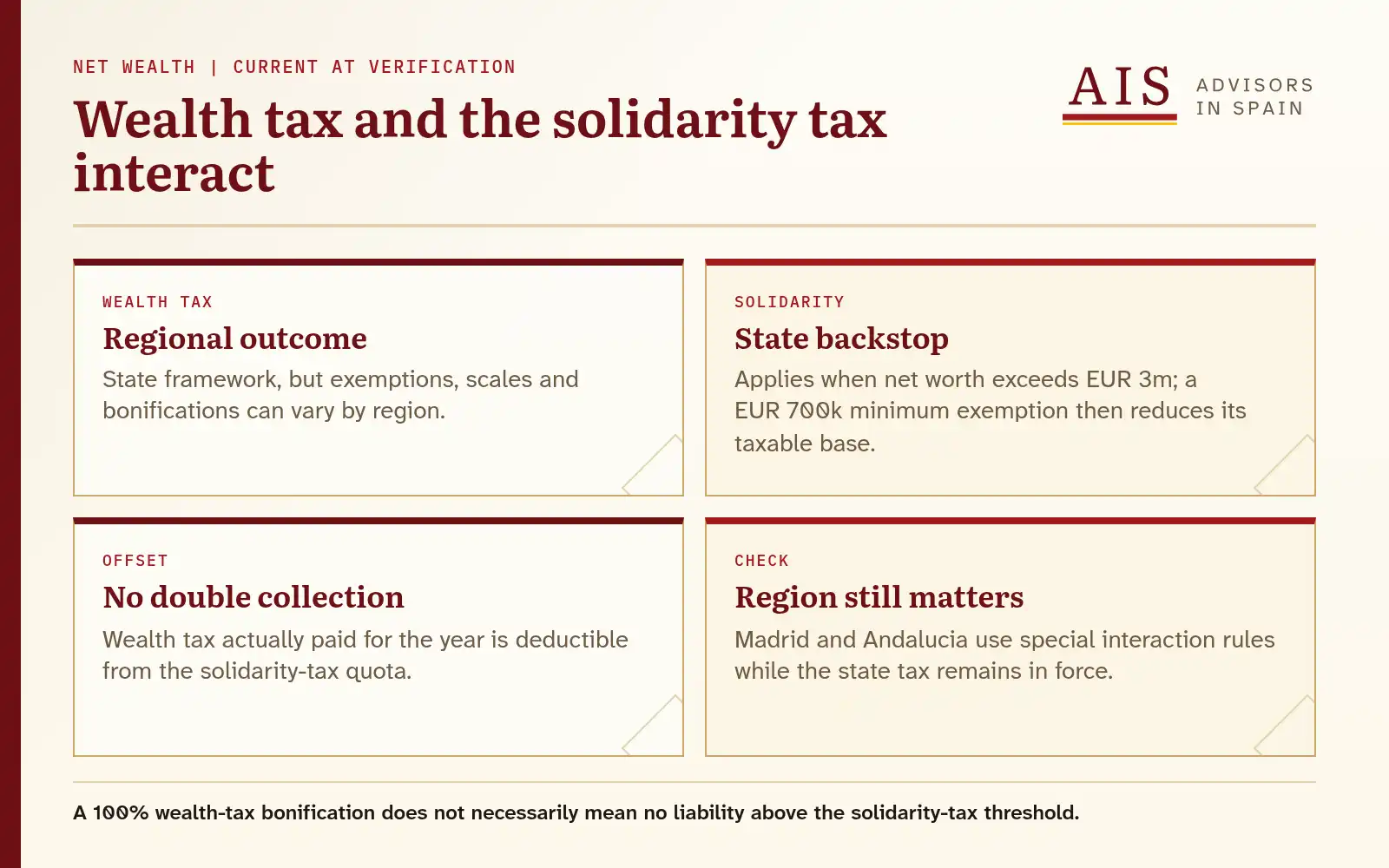
Diagram text version
Wealth tax begins with a state framework but regional rules may alter the result. Solidarity tax applies above its entry threshold and permits a deduction for wealth tax actually paid for the year. Regional interaction rules must be checked before assuming a bonification removes all liability.
This 2026 filing guide covers tax year 2025. Spain’s wealth tax is set nationally but devolved to the regions, and a national solidarity tax can undo a region’s rebate. This guide sets out how Spain’s national wealth tax interacts with regional allowances in Madrid, Andalucia and Cataluna, what the solidarity tax on large fortunes changes above its own threshold, and how the family-business exemption affects what a high-net-worth resident actually owes. It closes with a worked example. A Spain-qualified specialist calculates the exact liability for your case.
What is wealth tax in Spain?
Spain’s Impuesto sobre el Patrimonio (Ley 19/1991) is a national tax on net wealth. Each comunidad autonoma can set its own exempt minimum, scale or rebate, and a national solidarity tax can apply above its own threshold. This guide compares the rules sourced for Madrid, Andalucia and Cataluna for tax year 2025, filed in 2026.
The tax reduces a resident’s worldwide net wealth by a minimo exento, an exempt minimum, before any rate applies. Article 28 of Ley 19/1991 sets that minimum at 700,000 euros by default and lets a comunidad autonoma set its own figure instead. Article 30.2 applies a default eight-bracket scale running from 0.2% to 3.5% where a comunidad has not approved its own rate scale either.
That default describes only what happens when a region does nothing. Madrid, Andalucia and Cataluna have each legislated their own position, and this guide sets out what each one actually does before turning to the separate national solidarity tax that can apply on top.
Why does what you owe depend on which region you live in?
Spain writes this variation directly into the statute. Both the minimo exento and the default rate scale in Ley 19/1991 apply only “if the Comunidad Autonoma has not regulated” its own version, under article 28 and article 30.2. A comunidad autonoma can legislate its own exempt minimum, its own scale or a bonificacion on the resulting bill.
The result ranges widely. Madrid and Andalucia each apply a regional bonificacion. Cataluna applies no general bonificacion, sets its own lower minimo exento and taxes under its own scale. The next two sections cover each region in turn, and a separate national tax, the solidarity tax on large fortunes, can still apply above its own threshold no matter which region a resident lives in.
Do you pay wealth tax if you live in Madrid?
Not in practice, below the solidarity tax’s own threshold. Since 2008, the Comunidad de Madrid has run a 100% bonificacion on the Impuesto sobre el Patrimonio quota, under Ley 3/2008 and article 20 of the recast text approved by Decreto Legislativo 1/2010. A Madrid resident whose net wealth stays under the solidarity tax’s 3,000,000 euro threshold pays nothing under that bonificacion, and only has to file a return at all once their assets exceed 2,000,000 euros.
That changed for residents above the threshold. With effect from 1 January 2023, Ley 12/2023 stops the general 100% bonificacion applying while the national solidarity tax on large fortunes remains in force. In its place, the resident can apply a regional bonificacion equal to the difference between the wealth tax’s own quota and the solidarity tax’s own quota, both after their respective joint limits under article 31 of Ley 19/1991 and article 3.Doce of Ley 38/2022. A Madrid resident above the 3,000,000 euro threshold ends up paying an amount equal to the wealth-tax bill anyway. The region collects that amount, and the state does not.
What do residents pay in Andalucia and Cataluna?
Andalucia runs the same style of bonificacion as Madrid. Cataluna runs neither a bonificacion nor the state’s default scale. Andalucia introduced its own 100% regional bonificacion from 2022, under Decreto-ley 7/2022’s new article 25 bis in Ley 5/2021, more recently than Madrid’s. Cataluna applies no general bonificacion. Residents there get a lower minimo exento of 500,000 euros, against the 700,000 euro state default, and are taxed under Cataluna’s own scale, which tops out at 3.48%, close to the state default’s 3.5% top rate.
Andalucia’s 2022 bonificacion is also affected by the solidarity tax. For the 2024 and 2025 tax years, an Andalucia resident above the solidarity tax’s own 3,000,000 euro threshold applies an offset-style bonificacion in place of the flat article 25 bis rebate, so that resident never has to file the solidarity tax return at all. Below that threshold, an Andalucia resident still pays nothing.
Checking your own region against these three positions is the starting point, and it is not the end of the calculation: the exemptions covered below and the separate solidarity tax both still move the final figure.
| Region | General bonificacion | In force since |
|---|---|---|
| Madrid | 100% on the wealth-tax quota | 2008 |
| Andalucia | 100% on the wealth-tax quota | 2022 |
| Cataluna | None. Own scale, top rate 3.48%, minimo exento 500,000 euros | Scale in force 2022 to 2025 |
Tax year 2025, filed in 2026. The table compares the regional wealth-tax rules for Madrid, Andalucia and Cataluna.
What is the solidarity tax on large fortunes, and does it undo a region’s rebate?
The Impuesto Temporal de Solidaridad de las Grandes Fortunas, the Temporary Solidarity Tax on Large Fortunes (ITSGF), is a national tax on net worth above 3,000,000 euros, and it exists so a region’s wealth-tax rebate cannot eliminate tax on very large fortunes. Ley 38/2022, article 3 sets the taxable event at ownership of net worth exceeding 3,000,000 euros, reduces the taxable base by a minimo exento of 700,000 euros, and applies a four-bracket scale: 0% up to 3,000,000 euros, 1.7% on the remainder up to 5,347,998.03 euros, 2.1% on the remainder up to 10,695,996.06 euros, and 3.5% above that.
The offset mechanism is what protects a taxpayer from paying twice. Apartado Quince of article 3 lets the taxpayer deduct the wealth tax quota actually paid for the same year from the resulting ITSGF quota. That deduction is the mechanism behind Madrid’s and Andalucia’s 2023-onward rules above: the taxpayer pays the wealth-tax amount to the region, and the offset brings the ITSGF liability itself to zero.
The tax was framed as temporary when it was introduced. As of the current consolidated text, its application is extended for as long as a wider review of regional financing has not taken place, with no fixed end date, and it cannot be ceded to the comunidades autonomas: it stays a state tax by design.
Calculate what you’d actually owe
The regional table above and the solidarity-tax threshold cannot give an exact figure on their own. What each region’s bonificacion or scale actually produces moves with the asset mix, which exemptions apply, and whether assets are held individually or jointly with a spouse. The 3,000,000 euro solidarity-tax threshold is measured against net worth as a whole, so a mix of Spanish and worldwide holdings changes where a resident sits against it.
A specialist works these inputs against your actual region and asset mix and calculates the figure directly, including the offset between the two taxes.
Send the outline of your assets, and the specialist handling wealth tax cases calculates what you actually owe.
Are non-residents taxed the same way as residents?
No. Spanish tax residents are taxed under obligacion personal, on worldwide net wealth. The default for a non-resident is obligacion real, limited to assets situated in Spain. Article 5 of Ley 19/1991 creates a narrow exception: a person who was resident in Spain and then moves abroad can elect to continue under obligacion personal by filing on that basis in the first non-resident year. This is not a general worldwide-tax election for every non-resident. Article 28 confirms the same 700,000 euro default minimo exento, or a region’s own figure, applies under both liability routes.
Spanish tax residency decides which of the two obligations applies. Nationality and the length of a visa play no part in that decision. How Spanish tax residency is determined and how non-resident tax works in Spain cover that test in full, and a wealth tax specialist applies it to your own circumstances alongside the wealth-tax position covered here.
What assets are exempt from wealth tax?
Two exemptions can materially change the taxable base. Article 4.Nueve of Ley 19/1991 exempts the taxpayer’s habitual residence up to 300,000 euros, an allowance separate from and additional to the minimo exento covered above.
The family-business exemption, article 4.Ocho, reaches assets used in a business or professional activity the taxpayer carries out personally, and shareholdings in a company, subject to three conditions together: the company’s main activity is not managing a securities or property portfolio, the taxpayer holds at least 5% of the capital individually or 20% jointly with a spouse, ascendants, descendants or second-degree relatives, and the taxpayer actively manages the company and draws more than 50% of their business, professional and employment income from it. All three conditions have to hold together. A shareholding that fails any one of them is not exempt.
Pension rights and cryptocurrency need an asset-specific treatment and valuation check. Do not infer either result from the general net-wealth rule alone.
How do you calculate what you’ll actually owe? A worked example
This walkthrough is hypothetical. It uses the state default figures only, to show how the two taxes combine, and it does not represent what a Madrid, Andalucia or Cataluna resident actually owes: each of those three regions replaces this calculation with the position described above.
Take a Spanish tax resident with 4,000,000 euros in worldwide net assets, including a habitual residence worth 500,000 euros, living in a comunidad that has not set its own minimo exento or scale.
| Step | Figure |
|---|---|
| Gross worldwide net assets (obligacion personal) | 4,000,000.00 euros |
| Less the primary-residence exemption, capped at art. 4.Nueve’s 300,000 euros | -300,000.00 euros |
| Less the state default minimo exento, art. 28 | -700,000.00 euros |
| Base liquidable | 3,000,000.00 euros |
| Wealth-tax cuota under the state default scale, art. 30.2 | 31,446.37 euros |
| Solidarity-tax base (net worth less its own 700,000 euro minimo exento) | 3,300,000.00 euros |
| Solidarity-tax cuota before the offset | 5,100.00 euros |
| Solidarity-tax cuota after the art. 3.Quince offset | 0.00 euros |
Hypothetical. State default minimo exento and scale under Ley 19/1991 articles 4.Nueve, 28 and 30.2, and the solidarity-tax minimo exento, scale and offset under Ley 38/2022 article 3.
The primary-residence exemption caps at 300,000 euros, so 200,000 euros of the home’s value stays in the taxable base. The state default minimo exento of 700,000 euros then applies, leaving a base liquidable of 3,000,000 euros. Article 30.2’s default scale produces a wealth-tax cuota of 31,446.37 euros on that base.
The solidarity tax runs its own calculation on the same net worth. 4,000,000 euros minus its own 700,000 euro minimo exento gives a taxable base of 3,300,000 euros, which produces a solidarity-tax cuota of 5,100.00 euros before any offset. The wealth tax already paid, 31,446.37 euros, exceeds that figure, so the offset in article 3.Quince of Ley 38/2022 brings the solidarity-tax liability itself down to zero.
When do you have to file and pay?
Two forms cover tax year 2025. Modelo 714 declares the wealth tax and must be filed from 8 April through 30 June 2026 under Orden HAC/277/2026, article 7. Modelo 718 declares the solidarity tax on large fortunes and must be filed from 1 through 31 July 2026, according to Agencia Tributaria’s 2026 tax calendar.
The Comunidad de Madrid entry above does confirm one related figure: a Madrid resident only has to file at all once assets exceed 2,000,000 euros, separately from whether any tax is actually due. Filing can be required even when the calculated liability is zero, because that filing obligation turns on the return itself and applies regardless of the amount owed.
These are filing-year 2026 windows for tax year 2025.
Can wealth tax be reduced or planned around legally?
Yes, within limits. The family-business exemption covered above is the clearest sourced route: a taxpayer who genuinely runs the business, holds the required stake and draws the required share of income from it keeps those shares out of the taxable base entirely. Choosing where to establish Spanish tax residency before a move is a second real lever, because Madrid’s, Andalucia’s and Cataluna’s positions differ as sharply as the sections above show, though the solidarity tax narrows that lever considerably above its own 3,000,000 euro threshold.
Foreign trusts need a structure-specific wealth-tax analysis before any treatment is assumed.
Each planning route works differently: it can lower the taxable base, change the region’s rules that apply, or reduce the resulting quota.
What does wealth tax advice cost in Spain?
The scope depends on the asset mix, how many jurisdictions are involved, and whether the family-business exemption needs a separate analysis. Request a consultation with those details before deciding how to proceed.
Your case team gives you a quote on the assets you actually hold.
Talk to a Spain-qualified wealth tax specialist
Advisors in Spain handles Spanish wealth tax cases.
Get your wealth tax position calculated
An English-speaking, Spain-qualified advisor works out which region’s rules apply to you and checks the solidarity tax threshold.
Get your wealth tax position calculated
Send the outline of your assets and the region you live in, and a Spain-qualified specialist works out what you actually owe, including the solidarity tax.
Questions
Common questions
What is the wealth tax rate in Spain?
Where in Spain is there no wealth tax?
What is the 60% rule in Spain's wealth tax?
How can wealth tax be reduced or planned around legally in Spain?
Does Spain recognize a US or UK trust for wealth tax purposes?
Is the family-business exemption available to a UK or US owner of a Spanish company?
If you're tax resident in Spain, do you pay both wealth tax and the solidarity tax on the same assets?
What's the penalty for filing Modelo 714 late or not at all?
Does a Spanish tax attorney or a UK solicitor handle a wealth tax filing?
Are pension funds and pension rights included in the taxable base?
Is cryptocurrency included in the wealth tax taxable base?
Does holding a Golden Visa or a Non-Lucrative Visa change your wealth tax liability?
Related
Contact us
Your request is in
The specialist handling Spanish wealth tax cases has your details and replies to you directly by email.
We review your enquiry today. If you have not heard back within two working days, write to us and we chase it the same day.
Our guides are prepared in accordance with our Editorial Standards.