Inheritance Tax in Spain: Rates by Region (2026)
Inheritance tax in Spain is charged under one national law, Ley 29/1987, and Andalucia, Valencia and Murcia each cut the resulting tax quota by 99% for heirs in kinship Groups I and II. This guide sets out the three rules that decide which region's rules apply to an estate, what those three regions each allow, and how the full state calculation works.

On this page
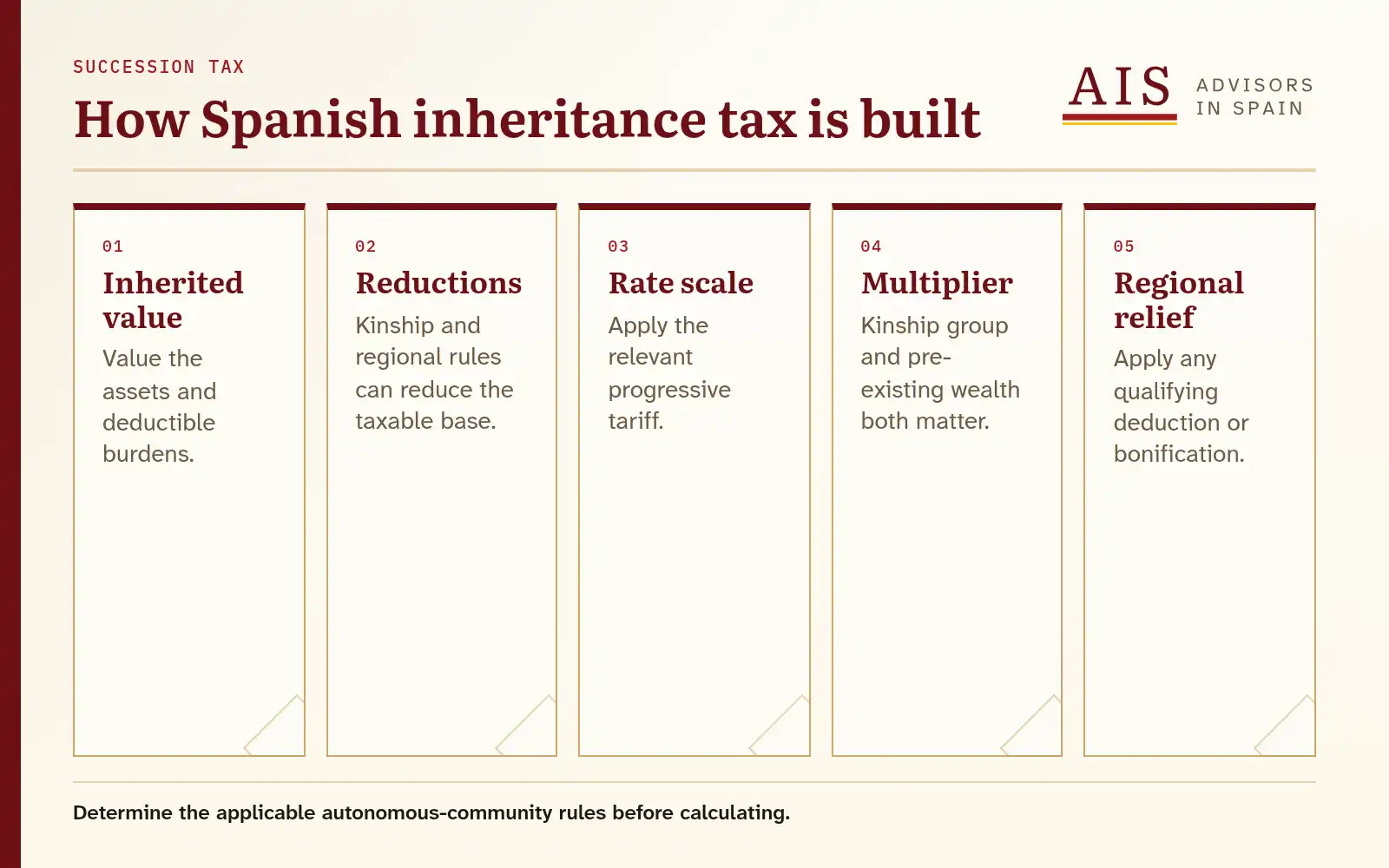
Diagram text version
Determine the applicable region, value the inherited assets and deductible burdens, subtract qualifying reductions, apply the progressive tariff, apply the coefficient based on kinship and pre-existing wealth, then apply qualifying regional relief.
Inheritance tax in Spain runs on one national law, and each comunidad autonoma sets allowances that change what the same estate owes. This guide sets out the three rules that decide which region applies, what Andalucia, Valencia and Murcia each allow, and how usufruct and forced heirship change what gets taxed. It closes with a worked example on the state scale and how to get your own liability calculated.
How much is inheritance tax in Spain?
What you owe depends on the region and your kinship group. The Impuesto sobre Sucesiones y Donaciones applies nationally under Ley 29/1987, and Andalucia, Valencia and Murcia each cut the tax quota by 99% for Groups I and II.
The state scale in article 21 of Ley 29/1987 runs across 16 brackets, from 7.65% on the first 7,993.46 euros of the base liquidable, the taxable amount left after reductions, to 34% on anything above 797,555.08 euros. That scale applies where a comunidad has not approved a scale of its own, or where its own rules do not apply to the taxpayer. Article 22 then multiplies the resulting quota by a coefficient set by two inputs together: the heir’s kinship group, and the band the heir’s own pre-existing wealth falls in. Those coefficients run from 1.0000 for the closest kinship at the lowest wealth band to 2.4000 for Group IV at the highest. Both steps move again once a comunidad’s own rules apply.
Why does the amount depend on which region you inherit in?
Spain charges one succession tax and lets each comunidad autonoma add rules on top. Ley 22/2009, the law funding the comunidades, decides which one an estate belongs to. Article 32.2.a sets the rule for a person who was resident in Spain when they died: the applicable comunidad is the one where the deceased had their habitual residence at the date of death. The heir’s own residence does not decide it in that case, and neither does the location of the assets.
Article 28 defines habitual residence for this purpose. It means the comunidad where the person spent the greater number of days across the five years ending the day before the tax accrues, counted date to date. Someone who moved region recently can still count as resident in the region they left.
Ley 29/1987 then sorts heirs into kinship Groups I to IV, and each comunidad can approve its own scale, its own coefficients and its own reductions.
What inheritance tax do you pay in Andalucia?
Heirs in Groups I and II can apply a 99% bonificacion on the tax quota, a 99% cut in the tax itself, for cases from 11 April 2019 onward, according to the Agencia Tributaria de Andalucia. Andalucia also reduces the taxable base by 1,000,000 euros for each heir or legatee in those two groups, for deaths from 1 January 2022 onward.
Groups I and II cover children and other descendants, spouses, and parents and other ascendants. The 99% quota bonificacion reaches those two groups only. The same page carries a separate base reduction of 10,000 euros for an heir or legatee in Group III, which covers a sibling, an aunt, an uncle, a nephew or a niece, and a 99% reduction on the deceased’s habitual residence for an heir in Groups I or II, or a collateral relative over 65 who had lived with the deceased for the two years before the death, where the heir keeps the property for three years.
Andalucia equates two further situations to the closest groups. A civil partnership registered in Andalucia’s Registro de Parejas de Hecho, or in an equivalent public register, is equated to a marriage. A person under permanent family foster care with a view to adoption is equated to an adopted child, under article 26 of Ley 5/2021.
What inheritance tax do you pay in Valencia?
Groups I and II get the same 99% bonificacion on the tax quota for mortis causa acquisitions, under article 12 bis of Ley 13/1997, the Comunidad Valenciana’s own tax law, cross-checked against the Generalitat Valenciana’s benefits page.
The base reduction sits at 100,000 euros for a descendant or adoptee of 21 or over, a spouse, and an ascendant or adoptant. A descendant or adoptee under 21 takes 100,000 euros plus 8,000 euros for each year under 21, and that reduction stops at 156,000 euros.
Ley 5/2025 adds a phased bonificacion for one part of Group III. Collateral relatives of the second or third degree by consanguinity, meaning siblings, blood aunts and uncles and blood nephews and nieces, get 25% of the proportional quota from 1 June 2026, and 50% from 1 June 2027. Relatives by affinity sit in Group III as well and take nothing under that rule.
What inheritance tax do you pay in Murcia?
Taxpayers in Groups I and II have the right to apply a 99% bonificacion on the tax quota for mortis causa acquisitions, according to the Agencia Tributaria de la Region de Murcia. The page cites article 20.2.a of Ley 29/1987 for the groups, and it does not address Group III for inheritances either way. That page does not confirm a base-reduction figure for Murcia.
The three regions compare like this on the points that decide a close family member’s bill.
| Region | Quota bonificacion, Groups I and II | Base reduction, Groups I and II | Group III position |
|---|---|---|---|
| Andalucia | 99% | 1,000,000 euros for each heir or legatee | No quota bonificacion, and a 10,000 euro base reduction |
| Valencia | 99% | 100,000 euros, and up to 156,000 euros for an heir under 21 | 25% from 1 June 2026 and 50% from 1 June 2027, for blood collaterals of the second or third degree |
| Murcia | 99% | No figure confirmed on the regional agency’s page | The regional agency’s page does not address it |
Mortis causa acquisitions only. Andalucia's bonificacion applies to cases from 11 April 2019 and its base reduction to deaths from 1 January 2022.
Get your Spanish inheritance tax liability calculated
Three separate rules decide which comunidad’s rules you use, and they turn on where the deceased lived, where the Spanish assets sit and where each heir lives. The quota then moves with your kinship group and with the band your own pre-existing wealth falls in, and the comunidad can replace the state scale and the state coefficients with its own. Those inputs come from the estate itself: the date of death, the region, the relationship, the value of each asset and each heir’s own position.
The specialist handling your case establishes which of the three connecting rules applies, works the reductions for that comunidad and files Modelo 650 on the outcome.
Send the estate’s outline, and the specialist handling your case calculates the liability on it.
Who pays Spanish inheritance tax if they do not live in Spain?
Someone who has never lived in Spain can still be a taxpayer for this tax. The second additional provision of Ley 29/1987 addresses non-resident taxpayers and gives them the right to apply a comunidad’s own rules.
The heirs may apply the rules of the comunidad holding the greatest value of the Spain-situated assets when the deceased was not resident in Spain. Each taxpayer applies the rules of the comunidad where that taxpayer resides when the deceased was not resident and left no Spain-situated assets. Non-resident heirs may apply a comunidad’s own rules when the deceased was resident in that comunidad. The text names non-resident taxpayers and sets no nationality condition.
An inheritance is declared on Modelo 650, and a lifetime gift goes on Modelo 651.
What is usufruct and how does it change what a surviving spouse owes?
Usufruct is the right to use an asset and take its income without owning it. Article 26.a of Ley 29/1987 values a lifetime usufruct at 70% of the asset’s total value when the usufructuary is under 20 years of age, reduces that by one percentage point for each additional year of age, and floors it at 10% of total value.
The age of the surviving spouse therefore sets the split. A younger spouse is assigned a usufruct value closer to 70%, and an older one is assigned a value closer to the 10% floor, because the valuation assumes the younger person holds the usufruct for longer.
That direction runs through both sides of the estate. A younger surviving spouse is taxed on a larger share of the estate’s value, and the bare owners, usually the children, are taxed on a correspondingly smaller share. The split matters most where a will leaves the spouse a lifetime usufruct over the family home and leaves the children the bare ownership, because each side is assessed on its own share.
Do Spain’s forced heirship rules limit who you can leave your estate to?
Spanish law reserves part of an estate for particular heirs. Article 806 of the Codigo Civil defines the legitima as the portion the testator cannot dispose of, because the law reserves it for forced heirs. Article 807 names them in order: children and other descendants; failing them, parents and other ascendants; then the surviving spouse in the form the Code sets.
Article 808 fixes the legitima of children and descendants at two-thirds of the estate. One third is divided equally among them, the testator may apply the second third as a mejora favouring one child, and the final third is freely disposable. Those articles govern common-law Spain. Catalonia, the Basque Country, Navarre, Galicia, Aragon and the Balearics each run their own foral succession rules.
A foreign national can elect a different law. Article 22 of EU Regulation 650/2012 lets a person choose the law of a State whose nationality they hold to govern their succession as a whole. The choice must be made expressly in the will, or be shown by the will’s own terms. The tax is unaffected: article 1(1) excludes revenue matters from the Regulation’s scope.
What allowances and reductions lower the amount owed?
Two things set an heir’s reduction: the kinship group, and the comunidad whose rules apply. Article 20.2.a of Ley 29/1987 sorts heirs into four groups.
- Group I. Descendants and adoptees under 21.
- Group II. Descendants and adoptees of 21 or over, spouses, ascendants and adoptants.
- Group III. Collaterals of the second and third degree, meaning siblings, aunts, uncles, nephews and nieces, together with ascendants and descendants by affinity, which is where an unadopted stepchild sits.
- Group IV. Collaterals of the fourth degree, more distant degrees and unrelated persons. The article allows them no reduction.
A main-residence reduction exists in Andalucia and in Valencia. Andalucia’s is the 99% reduction described above. Article 10.Uno.c of Ley 13/1997 cuts the value of the deceased’s habitual residence by 95%, capped at 150,000 euros per taxpayer. It reaches the spouse, ascendants and descendants, or a collateral relative over 65 who lived with the deceased for the two years before death, and it requires the property to be kept for five years after the death.
Can Spanish inheritance tax be reduced legally?
Yes. Reductions and bonificaciones can lower the taxable base or cut the quota. The comunidad whose rules apply, your kinship group and the conditions attached to each relief decide how far the liability falls. These rules do not provide a blanket route to remove the tax altogether.
Conditions travel with them. Valencia’s main-residence reduction requires the property to be held for five years after the death, and Andalucia’s largest reduction is scoped to Groups I and II.
A will does not change the tax by itself. The choice of law a will can carry runs under EU Regulation 650/2012, and article 1(1) puts revenue matters outside that Regulation’s scope. A lifetime gift is a separate transaction with its own return, Modelo 651, approved alongside Modelo 650 by Orden HAP/2488/2014.
How do you calculate what you will actually owe? A worked example
This walkthrough is hypothetical. It runs the state default figures and describes no real estate.
The order is fixed. The gross value of what the heir acquires, less the reductions in article 20 and any the comunidad adds, gives the base liquidable. The article 21 scale applies to that amount and produces the cuota integra. The article 22 coefficient applies to that quota and produces the tax due.
Take an heir in Group II with a base liquidable of 100,000 euros, whose own pre-existing wealth sits in the lowest band, from 0 to 402,678.11 euros.
| Step | Figure |
|---|---|
| Base liquidable | 100,000.00 euros |
| Cuota integra at the 79,880.52 euro bracket | 9,166.06 euros |
| 16.15% on the remaining 20,119.48 euros | 3,249.30 euros |
| Cuota integra | 12,415.36 euros |
| Article 22 coefficient, Group II, lowest wealth band | 1.0000 |
| Tax due | 12,415.36 euros |
Hypothetical. State default scale and coefficients under articles 21 and 22 of Ley 29/1987. A comunidad that has approved its own scale or coefficients replaces the corresponding step.
Two steps move that figure. A comunidad with its own approved scale replaces the article 21 step, and a comunidad with its own coefficients replaces the article 22 step. A bonificacion like the 99% in the three regions above applies last, to the quota.
When do you have to file and pay?
You have six months from the date of death. Article 67 of the Reglamento del Impuesto sobre Sucesiones y Donaciones sets that period for a mortis causa acquisition, and article 68 allows an extension of the same length again.
The request has to reach the competent tax office within the first five months of the original six. An extension cannot be granted on a request filed after those five months have passed. The office has one month to answer, and the extension counts as granted if no decision is notified inside that month.
The return itself is Modelo 650, approved together with Modelo 651 for gifts and Modelo 655 for the consolidation of ownership when a usufruct ends. What happens around the filing, from the death certificate to the deed of acceptance, belongs to the probate process itself.
What does inheritance tax advice cost in Spain?
The cost depends on the estate. What you are quoted moves with the case.
Foreign-issued documents may add formalities. The Agencia Tributaria requires a sworn translation of documentation issued abroad in a language other than Spanish, plus the Hague Apostille where a foreign official or authority issued it. Its filing-documentation answer for Modelo 650 also asks for each heir’s identity document, passport or NIE certificate. An estate with no valid will adds a notarial declaration of heirs.
Ask the specialist for a fixed quote first.
Tell us about the estate, and get a quote from the specialist handling your case.
Talk to a Spain-qualified inheritance tax specialist
Advisors in Spain handles Spanish inheritance tax cases. The specialist handling yours reads the estate, works out which comunidad’s rules govern it, and quotes you directly for the filing.
Get the figure for your own estate
The specialist handling your case covers the Spanish probate and the Modelo 650 filing together, in English or Spanish, from the deed of acceptance through to the tax paid and the property registered.
The filing deadline is six months from the date of death
Tell us when the death occurred, which region the Spanish assets sit in and how you were related, and the specialist handling your case files Modelo 650.
Questions
Common questions
How much inheritance tax will I pay in Spain?
Do I have to pay inheritance tax on my parents' house in Spain?
How do you avoid inheritance tax in Spain?
Is there a tax treaty between Spain and the UK or the US that prevents double taxation on inheritance?
Can you inherit debt as well as assets in Spain?
Do stepchildren or unmarried partners get the same allowances as spouses and children?
Is the tax based on where the deceased lived or where the heir lives?
Does Brexit change inheritance tax for British heirs?
How is inherited property in Spain valued for tax purposes?
Do I need a Spanish will to reduce inheritance tax?
What happens to US heirs of a Spanish estate?
Related
Contact us
Your request is in
We have your details, and the specialist who handles Spanish succession tax replies to you by email.
We review your enquiry today. If you have not heard back within two working days, write to us and we chase it the same day.
Our guides are prepared in accordance with our Editorial Standards.