Spain Tax Rates: Income Tax Bands by Region (2026)
Spain's common-regime IRPF combines a national scale with a regional scale, so the same income owes a different amount in Madrid than in Andalucia. Navarra and the Basque territories use their own foral IRPF systems. This guide sets out the common-regime scales, the separate savings-income scale, and how personal allowances and non-resident status change the figure.

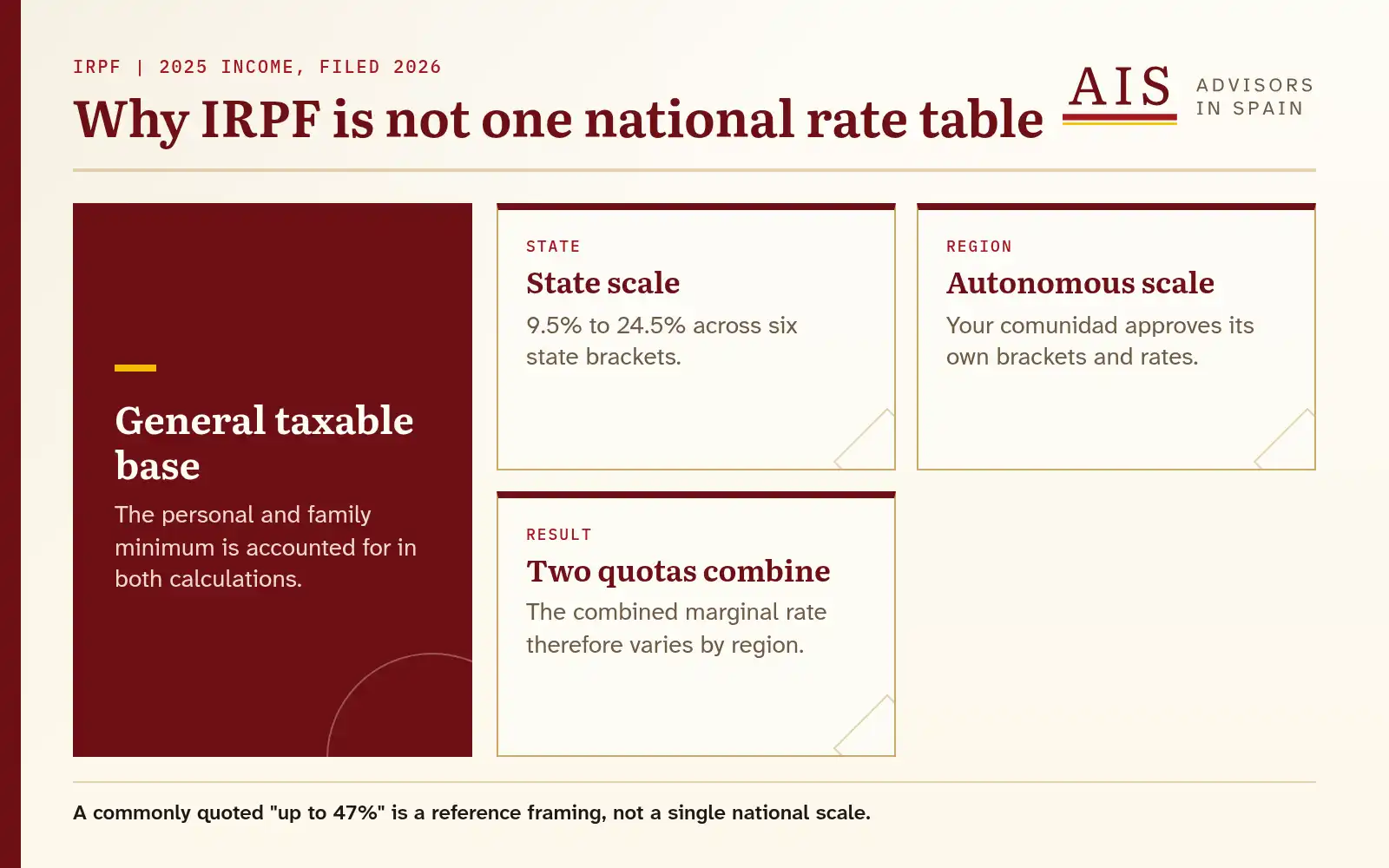
Diagram text version
For 2025 income filed in 2026, the state portion uses six brackets from 9.5 percent to 24.5 percent. A separate autonomous-community scale is applied. The resulting quotas combine, so Spain does not have one universal combined IRPF rate table.
Common-regime IRPF combines a national scale with a regional scale, so what you owe depends on your income and where you live. Navarra and the Basque territories use their own foral IRPF legislation and tax authorities. This guide sets out the common-regime national scale and the regional scales in Madrid and Andalucia, then explains the treatment of general and savings income. It closes with a worked example.
How much income tax do you pay in Spain?
What you pay depends on your income and your region. Common-regime IRPF applies a national scale plus a regional scale set by communities such as Madrid, Andalucia and Cataluna. Navarra and the Basque territories apply their own foral IRPF systems.
The IRPF general taxable base is taxed on the state half of the scale first. The tax attributable to the applicable personal and family minimum is then subtracted from that quota. LIRPF article 63 sets the state half, and a regional half is calculated separately under the common-regime rules covered in the next section.
| Taxable base up to | Tax on that band | Rate on the remainder up to |
|---|---|---|
| 0 euros | 0 euros | 9.5% up to 12,450 euros |
| 12,450 euros | 1,182.75 euros | 12% up to 20,200 euros |
| 20,200 euros | 2,112.75 euros | 15% up to 35,200 euros |
| 35,200 euros | 4,362.75 euros | 18.5% up to 60,000 euros |
| 60,000 euros | 8,950.75 euros | 22.5% up to 300,000 euros |
| 300,000 euros | 62,950.75 euros | 24.5% above that |
State half only. A regional half applies separately under the common-regime calculation.
This state half is never the whole bill. A comunidad autonoma sets the other half of the general-base scale, and the two halves together decide what a resident actually owes.
Why does your income tax bill depend on where you live in Spain?
Common-regime IRPF has a scale split into two halves. LIRPF article 74 sets the regional mechanism: the general taxable base is taxed at the rates of the “escala autonomica” approved under Ley 22/2009. Navarra and the Basque territories sit outside this mechanism and apply their own foral legislation.
Within the common regime, the state half from article 63 does not change by region. The regional half does, and a comunidad can also set its own additions to the personal and family minimum. That is why the same income can produce a different bill in Madrid and Andalucia.
The next three sections cover Madrid, Andalucia and Cataluna in turn.
What income tax do you pay in Madrid?
The Comunidad de Madrid’s own regional scale, published for tax year 2024, runs from 8.5% to 20.5%, according to the Comunidad de Madrid’s own tax pages.
| Taxable base up to | Tax on that band | Rate on the remainder up to |
|---|---|---|
| 0 euros | 0 euros | 8.5% up to 13,362.22 euros |
| 13,362.22 euros | 1,135.79 euros | 10.7% up to 19,004.63 euros |
| 19,004.63 euros | 1,739.53 euros | 12.8% up to 35,425.68 euros |
| 35,425.68 euros | 3,841.42 euros | 17.4% up to 57,320.40 euros |
| 57,320.40 euros | 7,651.10 euros | 20.5% above that |
Comunidad de Madrid's regional half of the general-base scale for tax year 2024. Check for a current-year update before relying on it for a later filing.
Adding Madrid’s regional table to the state table above, and setting neither figure aside, a resident’s combined marginal rate on income above 300,000 euros works out to 45%: the state’s top 24.5% plus Madrid’s top 20.5%. That 45% is a computed sum from the two published tables. Neither Madrid nor the state publishes it as a single figure.
What income tax do you pay in Andalucia?
Andalucia’s regional scale, in force since 2022, runs from 9.5% to 22.5%, according to the Junta de Andalucia.
| Taxable base up to | Tax on that band | Rate on the remainder up to |
|---|---|---|
| 0 euros | 0 euros | 9.5% up to 13,000 euros |
| 13,000 euros | 1,235 euros | 12% up to 21,100 euros |
| 21,100 euros | 2,207 euros | 15% up to 35,200 euros |
| 35,200 euros | 4,322 euros | 18.5% up to 60,000 euros |
| 60,000 euros | 8,910 euros | 22.5% above that |
Junta de Andalucia's regional half of the general-base scale, in force for 2022 and following tax years, introduced by Decreto-ley 7/2022.
Andalucia’s first five brackets sit at the same thresholds and the same rates as the state scale itself, up to 60,000 euros. Adding Andalucia’s regional table to the state table, a resident’s combined marginal rate on income above 300,000 euros works out to 47%: the state’s top 24.5% plus Andalucia’s flat 22.5% above 60,000 euros. That is a computed sum from the two tables. Confirm the applicable regional scale for the tax year being filed.
What income tax do you pay in Cataluna?
Cataluna sets its own regional scale on the same common-regime mechanism as Madrid and Andalucia: a state half plus a regional half the Generalitat de Catalunya approves as its own “escala autonomica” under LIRPF article 74.
The comparison below covers Madrid and Andalucia.
| Region | Bottom regional rate | Top regional rate | Top band starts at |
|---|---|---|---|
| Madrid | 8.5% | 20.5% | 57,320.40 euros |
| Andalucia | 9.5% | 22.5% | 60,000 euros |
Madrid and Andalucia regional scales.
Get your exact Spanish income tax liability calculated
Personal allowances, the type of income and the applicable regional or foral scale all affect the final figure.
The Spanish tax advisory service covers income-tax calculations and filing. For a quicker first pass, try the Spain tax calculator.
What’s the difference between general income and savings income for tax purposes?
Employment and business income is taxed differently from investment income.
In common-regime Spain, general income, meaning employment and business income, is taxed on the national-plus-regional scale set out above: the state half under LIRPF article 63 and the regional half under article 74. Savings income, meaning interest, dividends and capital gains on financial and most other assets, runs on a separate common-regime scale. LIRPF article 66 sets the state half of that savings scale: 9.5% up to 6,000 euros, 10.5% up to 50,000 euros, 11.5% up to 200,000 euros, 13.5% up to 300,000 euros and 15% above that. LIRPF article 76 prints the regional half at identical rates and thresholds. Navarra and the Basque territories apply their own foral rules.
Under the common-regime rules, the combined savings scale is 19% up to 6,000 euros, 21% up to 50,000 euros, 23% up to 200,000 euros, 27% up to 300,000 euros and 30% above that. The combined general-base scale uses a state half plus the regional half approved for the resident’s comunidad.
What personal and family allowances reduce what you owe?
The minimo personal y familiar reduces the quota. The applicable scale is first applied to the taxable base, then the quota produced by applying that scale to the minimum is subtracted. LIRPF article 57 sets the minimo del contribuyente, the taxpayer’s own share of it, at 5,550 euros a year generally, rising by 1,150 euros a year for a taxpayer over 65, and by a further 1,400 euros a year on top of that for a taxpayer over 75.
That 5,550 euro figure is only the base personal component. Separate additions exist for descendants, ascendants and disability. Article 56.3 then lets each common-regime comunidad increase or decrease the whole minimum for its regional-scale calculation, so the minimum used for the state half and the minimum used for the regional half can differ for the same taxpayer. Confirm the applicable regional adjustment before calculating the quota.
What tax rate do non-residents pay in Spain?
Non-residents are taxed under a separate regime, the Impuesto sobre la Renta de No Residentes (IRNR), and it runs on its own flat rates, separate from the progressive scale set out above. Non-resident tax in Spain owns the full treatment, including Modelo 210 and the EU/EEA versus non-EU distinction that changes what a non-resident can deduct.
On the sale of Spanish property by a non-resident seller, the buyer withholds 3% of the agreed price and pays it to the Agencia Tributaria under Real Decreto Legislativo 5/2004 article 25.2. The seller reclaims any excess on Modelo 210. That withholding rate is not the ongoing IRNR income tax rate, which the non-resident guide covers in full.
How do you calculate what you’ll actually owe? A worked example
This walkthrough is hypothetical. It runs the state scale and Madrid’s regional scale on a made-up figure, and it describes no real taxpayer.
Take a Madrid resident with a 40,000 euro general taxable base and a 5,550 euro personal minimum. This example uses the same minimum for the state and Madrid calculations. Each scale is applied to the full 40,000 euro base, then the quota produced by applying that scale to the 5,550 euro minimum is subtracted. The two net quotas are added together.
| Step | Figure |
|---|---|
| State quota on the 40,000 euro base | 5,250.75 euros |
| Less state quota on the 5,550 euro minimum | -527.25 euros |
| State half of the tax | 4,723.50 euros |
| Madrid quota on the 40,000 euro base | 4,637.35 euros |
| Less Madrid quota on the 5,550 euro minimum | -471.75 euros |
| Regional half of the tax | 4,165.60 euros |
| Total IRPF due | 8,889.10 euros |
Hypothetical. 40,000 euro general taxable base, Madrid resident, using the state scale and Madrid's regional scale. The same 5,550 euro personal minimum is used for both halves.
Swap in Andalucia’s table from the section above and the regional half changes. Another common-regime comunidad requires its own scale, while Navarra and the Basque territories require the applicable foral rules.
What other Spain tax rates should you know about?
Spain charges several other taxes, each covered in depth in its own guide.
Capital gains tax applies when property, shares or other assets sell at a profit, on a scale separate from the general income scale above. Capital gains tax in Spain covers the rates and the reductions that can apply.
Wealth tax (Impuesto sobre el Patrimonio) is a separate annual tax on net worth, with its own regional variation and its own interaction with the newer solidarity tax on large fortunes. Wealth tax in Spain covers both.
Companies pay corporate tax (Impuesto sobre Sociedades) on their profits, a different tax from the personal IRPF scales in this guide. Corporate tax in Spain covers company rates.
VAT (IVA) applies to most goods and services sold in Spain, and registering for it is a separate step from filing a personal return. VAT registration in Spain covers that process.
Property owners pay IBI, the annual municipal property tax billed by the town hall. Property taxes in Spain covers IBI alongside the other property-related taxes.
Qualifying newcomers can elect the special regime under LIRPF article 93, commonly known as the Beckham Law. Its 24% and 47% scale applies to the covered general base, while savings-type income retains its separate scale. The Beckham Law in Spain covers who qualifies and what changes.
When do you file and pay Spanish income tax?
You have from 8 April to 30 June 2026 to file the Renta return for the 2025 tax year, both dates inclusive, according to the Agencia Tributaria’s own Renta campaign page and Orden HAC/277/2026, article 7.
The return itself is Modelo 100. The order sets the same 8 April to 30 June 2026 window for Impuesto sobre el Patrimonio, the wealth tax return, filed on Modelo 714. A separate, earlier internal deadline applies where the taxpayer wants the full amount due direct-debited, under the order’s article 13.3; confirming or filing while direct-debiting only the second instalment stays open through 30 June. This window is set year by year under a fresh Orden HAC, so check the current year’s order before assuming the same dates repeat.
Talk to a Spain-qualified tax advisor about your exact number
This page gives the common-regime structure: the national scale, Madrid and Andalucia’s regional scales, the separate savings scale, and where Cataluna fits the same mechanism. A tax adviser can work out your personal figure or apply the relevant foral rules.
Get the number for your own income and region
The tax adviser handling your matter can work out what you actually owe under the rules for your region.
Questions
Common questions
Do income tax rates vary by region in Spain?
What's the difference between general income and savings income for tax purposes?
Are self-employed workers (autonomos) taxed at the same rates as employees?
How does Spain's income tax compare with the UK's and the US's?
What personal allowances reduce what you owe?
Can a tax advisor tell me my exact rate before I move to Spain?
What does a tax adviser do differently from a gestor in Spain?
When do you file and pay Spanish income tax?
Get your figure
Your request is in
Your enquiry is with Advisors in Spain. We assess your requirements and reply by email with the appropriate next steps.
We review your enquiry today. If you have not heard back within two working days, write to us and we chase it the same day.
Our guides are prepared in accordance with our Editorial Standards.