Beckham Law Spain
Beckham Law is Spain's special tax regime: qualifying newcomers pay a flat rate on Spanish income, not the ordinary progressive scale.
Article 93 of Spain's income tax law taxes qualifying newcomers as non-residents on employment income worldwide plus other Spanish-source income, at a flat 24% up to €600,000, for up to six tax years, on a six-month filing deadline.
Two routes qualify: a Spanish employment contract, or, since a 2023 reform, qualifying remote work for a non-Spanish employer, provided you clear the required look-back period abroad first. Eligibility and the filing deadline are both fixed by law, and missing either one closes the door on that route. Advisors in Spain handles each enquiry: a tax advisor confirms eligibility against the current rules and files the election before the deadline.
First conversation free Reply within one business day

Who the Beckham Law Regime Is For
- You may qualify for the Beckham Law if you are relocating to Spain on a Spanish employment contract or, since the 2023 reform, qualifying remote work, and you were not a Spanish tax resident in the five tax years before arriving.
- Route one is a Spanish employment contract or assignment that registers you with Spanish Social Security, including a qualifying directorship below the shareholding limit set out in Requirements below.
- Route two, added by Ley 28/2022, the 2023 Startup Law reform, covers qualifying remote work for a non-Spanish employer, your own entrepreneurial activity, or highly-qualified-professional work for an emerging company. The same reform let a spouse and children under 25 join the regime under their own eligibility.
- The core precondition applies to every route: you must not have been a Spanish tax resident in the five tax years before your move, reduced from ten years by the same reform, per Agencia Tributaria's current guidance.
Already a longtime Spanish tax resident with no gap abroad behind you, or filing under the special employment relationship Real Decreto 1006/1985 sets out for professional athletes? Neither fits this regime; see tax advisors in Spain for ordinary Spanish tax planning.
What's Included When You Work With a Tax Advisor
The tax advisor handling your case works through each step below, from confirming eligibility to filing your first annual return.
- Eligibility confirmed against the current rules. The advisor checks your employment route and residency history against Agencia Tributaria's current criteria before anything is filed. Have a specialist confirm this against the current rules.
- The election filed within the deadline. Modelo 149 goes to Agencia Tributaria within six months of your Spanish Social Security registration, the fixed window Article 116.1 of the income tax regulation sets. Have a specialist file this for you before the deadline.
- The annual return prepared for each qualifying year. Modelo 151 replaces the ordinary annual return for every year the regime applies, for up to six tax years. Have your advisor prepare this each year.
- Your home-country treaty position coordinated. A taxpayer under this regime is not treated as resident for double-tax-treaty purposes, which changes how a US filer's home-country reporting lines up. See US expat taxes in Spain, or have a specialist coordinate the treaty position.
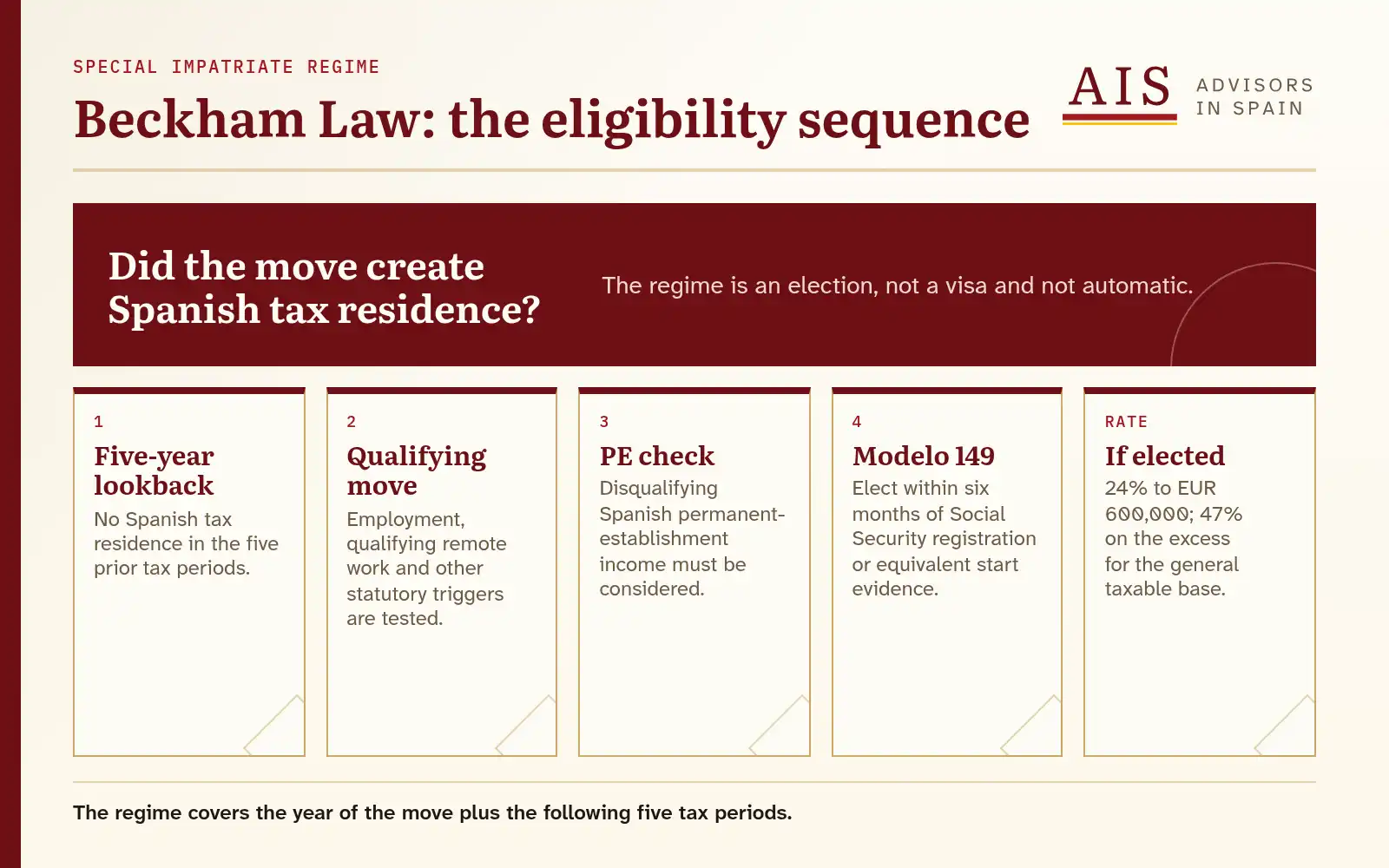
Diagram text version
Test the five-prior-period non-residence condition, the statutory reason for moving and permanent-establishment restrictions. Elect on Modelo 149 within six months of the relevant registration or equivalent activity-start evidence. The general base is taxed at 24 percent to 600,000 euros and 47 percent above it.
Requirements and Who Doesn't Qualify
- In short
- The regime is narrower than "anyone relocating to Spain for work." Three groups fall outside it even when the move itself qualifies: professional athletes, company directors above the shareholding limit, and anyone who fails the five-year look-back below. If none of the routes fit your situation, general Spanish tax questions belong on tax advisors in Spain, and US-specific treaty questions belong on US expat taxes in Spain.
- Professional athletes excluded
- Agencia Tributaria's current guidance for the regime carves out anyone working under the special employment relationship for professional sportspeople defined by Real Decreto 1006/1985, per the Agencia Tributaria's own regime guidance. That carve-out sits inside the same Article 93 that gave the regime its popular name.
- Directors above the shareholding limit
- An administrator whose own stake would make the company a related party under Article 18 of Spain's Corporate Tax Law falls outside the employment route. The entrepreneur and highly-qualified-professional routes the 2023 reform added carry their own separate conditions.
- The five-year look-back
- You must not have been a Spanish tax resident in the five tax years before your move, reduced from ten years by Ley 28/2022, the 2023 Startup Law reform. Fall short of that gap and none of the qualifying routes apply.
Step-by-Step: How to Apply for the Beckham Law
-
Arrive and register
Register with Spanish Social Security under a qualifying employment contract, or start the qualifying remote-work arrangement the 2023 reform added. The registration date starts the filing clock.
-
Confirm eligibility
A tax advisor checks your residency history and employment route against Agencia Tributaria's current criteria before anything is filed.
-
File the election with AEAT
Modelo 149 goes in within six months of the Social Security registration date, under Article 116.1 of the income tax regulation. Agencia Tributaria treats the window as non-extendable.
-
Receive confirmation
Agencia Tributaria processes the election. Once confirmed, your Spanish payroll is withheld at the regime's flat 24% rate up to €600,000 a year, and the ordinary progressive scale stops applying to you.
-
File the annual return each qualifying year
Modelo 151 replaces the ordinary annual return for every year the regime applies, for up to six tax years from the year of the move.
-
The regime ends and ordinary tax applies
Once the sixth qualifying year closes, worldwide income moves onto Spain's ordinary progressive scale from the following tax year.
Timing: The Application Deadline and What Causes Delays
Six months from Social Security registration
The fixed window Article 116.1 of the income tax regulation sets for filing Modelo 149. Agencia Tributaria treats it as non-extendable, and missing it forfeits the regime for the whole period it could have covered, not only the current tax year.
What delays it
A missing NIE or Social Security number, an employer or company not yet correctly registered, and incomplete prior-residency documentation each push the filing date back, and the six-month window itself does not move to accommodate any of them.
What to prepare now
Gather your passport, Spanish employment contract or remote-work agreement, and proof of your residency history abroad before the Social Security registration date starts the six-month clock.
The flat rate compared
How the Beckham Law Flat Rate Compares to Ordinary Tax
The Flat Rate and Its Income Threshold
Under the special regime, employment income is taxed at a flat 24% up to €600,000 a year and at 47% on the excess, per Agencia Tributaria’s own regime guidance. The ordinary IRPF scale works differently on both counts: it applies progressive rates that climb with each band, and it applies them to your worldwide income of every kind. The special regime holds the rate flat and narrows what Spain taxes, and it runs for up to six tax years, the year of the move plus five more, per Agencia Tributaria’s regime overview.
Income the Beckham Law Taxes in Spain
Agencia Tributaria taxes a taxpayer under this option on income obtained from sources located in Spain, and its guidance writes one wide rule into that test: the whole of your employment income earned while the regime applies counts as obtained in Spanish territory. A salary paid by a US or UK employer to a qualifying remote worker in Madrid therefore sits inside the 24% band. Read the regime as flat-rating your employment income wherever it comes from, then taxing everything else only where Spain is the source.
Outside employment, the source test does the work. It keeps most non-Spanish investment income and capital gains out of scope entirely, a dividend from a foreign brokerage, interest on an account held abroad, a gain on the sale of an asset outside Spain; the tax is neither deferred nor credited, and the income simply falls outside what the regime reaches. Foreign assets are not exempt across the board either: income and gains sourced in Spain, a Spanish rental property or a Spanish brokerage account, stay inside the regime and are taxed at the applicable rate.
The option carries a cost the ordinary scale does not: Agencia Tributaria’s own guidance states that a taxpayer under this regime is not considered resident for the purposes of a double-taxation treaty, so some treaty relief a home tax authority would otherwise grant does not apply the same way. See US expat taxes in Spain for how that interacts with US filing obligations specifically.
When the Ordinary Tax Regime Returns
The regime runs on a fixed clock. Once the sixth qualifying tax year closes, worldwide income moves onto Spain’s ordinary progressive scale from the following year, the same scale tax advisors in Spain work with for every Spanish tax resident outside this special option. For an estimate of what the ordinary scale would cost against the flat rate for your own numbers, the Spain tax calculator runs both side by side.
The 24% and 47% rates, the €600,000 threshold, the six-year period, the five-year look-back and the six-month filing deadline on this page are current as of August 20, 2026, and are reviewed every January against Agencia Tributaria and BOE guidance.
The filing window doesn't wait for you to be sure
File Modelo 149 within six months of your Social Security registration and the flat rate runs for up to six years. Agencia Tributaria treats the window as non-extendable: miss it and the regime is closed to you for good, not just for this tax year.
Common questions
How much does a Beckham Law tax advisor cost?
Do I qualify for the Beckham Law?
Who is eligible to apply for the Beckham Law in Spain?
What are the disadvantages of the Beckham Law?
What is the David Beckham Rule?
Why is it called the Beckham Law in Spain?
Who handles Beckham Law eligibility and filing work?
What happens if I miss the six-month filing deadline?
Why Work With Advisors in Spain
The advisor handling your case confirms your eligibility and files it.
-
Every advisor who works on a case meets the same standard.
We don't take on a case we can't do properly, and we say so plainly if your case is not something we handle.
-
Every tax advisor works in English or Spanish.
You explain your situation once, in English or Spanish, to the tax advisor handling your Beckham Law case.
-
Coordinated support for related matters.
The eligibility check, the Modelo 149 filing and any related Spanish tax work: we coordinate related requirements, with responsibility and scope agreed for each service.
Contact us
Your request is in
We read every request ourselves, assess the requirements and reply by email with the appropriate next steps.
We review your enquiry today. If you have not heard back within two working days, write to us and we chase it the same day.