Corporate Tax in Spain: Rates, Filing & Deadlines (2026)
Spain taxes company profits under Impuesto sobre Sociedades at a general rate of 25%, with lower rates for newly created companies, for companies below a turnover threshold, and separate rates the Basque Country and Navarra set through their own foral tax authorities. This guide sets out the standard, new-company and small-company rates, the foral regimes, and what Modelo 200 and Modelo 202 require and when.

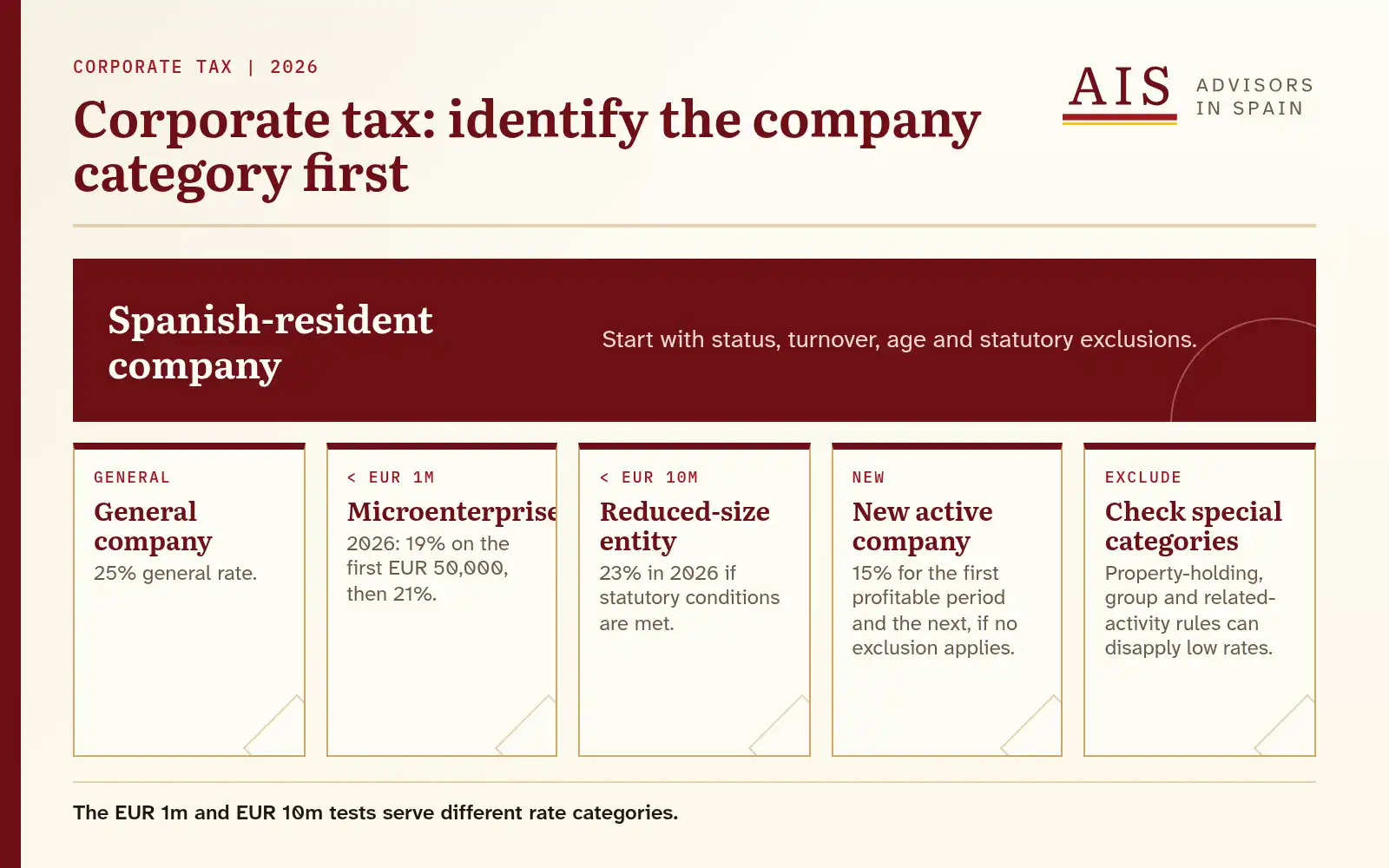
Diagram text version
For 2026, the general corporate tax rate is 25 percent. A qualifying microenterprise uses 19 percent on the first 50,000 euros of taxable base and 21 percent above. Qualifying reduced-size entities use 23 percent. A genuinely new active company may use 15 percent for its first profitable period and the following period, subject to exclusions.
Spain taxes company profits under Impuesto sobre Sociedades (IS) at a general rate of 25%, with lower rates for newly created companies, for companies below a turnover threshold, and separate rates the Basque Country and Navarra set through their own foral tax authorities. This guide sets out the standard, new-company and small-company rates under Ley 27/2014, how the foral regimes differ, and what Modelo 200 and Modelo 202 actually require and when. It closes with the fees an accountant charges to handle the filing and how to reach a Spain-qualified accountant who can calculate the exact liability on a specific company.
How much is corporate tax in Spain?
Spain’s standard corporate tax rate is 25% on company profit under Ley 27/2014 article 29.1. Two things move a specific company off that rate. Age matters: a newly created company pays 15% in its first profitable tax period and the following one. Turnover matters too: a company with net turnover under €1 million in the prior tax period applies a reduced scale on its taxable base, set at 21%/22% for 2025 and 19%/21% for 2026 under a transitional schedule Congress set through 2028; the schedule’s later 2027 and 2028 steps apply to the separate empresas-de-reducida-dimension rate, not to this scale.
Neither reduced rate is available to a company classed as an entidad patrimonial, a holding company whose assets are mostly securities or sit outside an economic activity, which includes a company that holds a single unlet property. The next sections work through each rate in turn, then compare all of them side by side.
What is the standard corporate tax rate?
The standard rate is 25% of taxable profit, set by Ley 27/2014 article 29.1, the state-level law governing Impuesto sobre Sociedades. It is the default rate for any company that does not qualify for one of the reduced tracks below, and the only rate that applies regardless of turnover to a company classed as an entidad patrimonial.
Who owes it turns on residency. A company is a Spanish tax resident if it meets any one of three tests under Ley 27/2014 article 8.1: incorporation under Spanish law, a registered office in Spain, or its effective management located in Spain. A resident company owes Impuesto sobre Sociedades on its worldwide profit. A non-resident company without a permanent establishment can owe IRNR on qualifying Spanish-source income. A non-resident company with a permanent establishment follows the IRNR rules for income attributable to that establishment. The foreign-company section further down explains the permanent-establishment test.
Do newly formed companies pay a lower rate?
Yes. A newly created company pays 15% in the first tax period it posts a positive taxable base from an economic activity, and in the tax period immediately after, under Ley 27/2014 article 29.1.
That rate does not apply automatically to every new SL. It is unavailable to any company classed as an entidad patrimonial, a holding company whose assets are mostly securities or are not employed in an economic activity. It is also unavailable where the new company took over an activity a related party already carried on, where it continues an activity a majority individual shareholder already ran in the year before incorporation, or where the company forms part of a group under article 42 of the Codigo de Comercio, regardless of where the group is resident or whether it must file consolidated accounts. A foreign parent forming a Spanish subsidiary fails that last test on its face. Company formation in Spain covers forming the SL itself; this page covers what the company owes once it exists.
Do small companies pay a lower rate?
Yes, provided net turnover in the prior tax period was below €1 million: the qualifying figures are a two-band scale, 19% on the first €50,000 of taxable base and 21% on the remainder, for tax periods beginning in 2026, under article 29.1 as adjusted for 2026 by disposicion transitoria cuadragesima cuarta of Ley 27/2014. The condition is turnover, and it has nothing to do with company size in the everyday sense.
A separate flat rate of 23% for 2026 applies instead to a company that meets article 101’s own empresas de reducida dimension test: prior-year net turnover under €10 million, a different and considerably higher threshold from the €1 million scale above, so the two are not interchangeable. A company can be newly created, fall under one of the two turnover scales, several of those at once, or none of them; each track has its own condition, and none of the reduced tracks reaches an entidad patrimonial.
Which corporate tax rate applies to your company?
Four different rates can apply to the same company, and turnover, age and legal status decide which one actually governs a given tax period.
| Rate track | Rate | Who qualifies |
|---|---|---|
| Standard rate | 25% | Prior-year turnover of €10 million or more, and any entidad patrimonial regardless of turnover |
| Reduced scale, turnover under €1 million | 19% / 21% | Prior-year net turnover below €1 million; 19% on the first €50,000 of taxable base, 21% above; not an entidad patrimonial |
| Empresas de reducida dimension, article 101 | 23% | Prior-year net turnover under €10 million, a separate and higher threshold than the €1 million scale above; not an entidad patrimonial |
| Newly created company | 15% | First tax period with a positive taxable base from an economic activity, and the one after; not an entidad patrimonial |
Ley 27/2014 articles 29.1 and 101, read with disposicion transitoria cuadragesima cuarta, checked against BOE 25 August 2026. The transitional figures shown are specific to 2026: the reduced-scale bands were 21%/22% for 2025 and the article-101 rate steps down to 22% for 2027 and 21% for 2028, after which article 29.1's own steady-state figures apply.
The 19%/21% figures are themselves temporary. They apply only to tax periods beginning in 2026; the same reduced scale ran at 21%/22% for periods beginning in 2025, and article 29.1’s own steady-state text, 17%/20%, only takes effect once the transitional schedule finishes. A rate lookup from a prior year, or from the statute’s plain text without the transitional override, will not match what a 2026 filing owes.
One further jurisdiction override sits outside this table entirely: the Basque Country and Navarra.
Do the Basque Country and Navarra have their own corporate tax rates?
Yes. The Basque Country’s three foral Diputaciones (Alava/Araba, Bizkaia and Gipuzkoa) and the Comunidad Foral de Navarra each administer their own Impuesto sobre Sociedades, under the Concierto Economico for the Basque Country and the Convenio Economico for Navarra, legislation separate from Ley 27/2014, according to Agencia Tributaria’s own guidance on the joint-taxation regime. A company taxed exclusively under one of those regimes does not use the common-territory scale in the table above at all.
A company can also owe tax jointly to the state and a foral authority. A company with its tax domicile in common territory that also operates in a foral territory is taxed jointly once its turnover in the prior year passed €10 million; a company domiciled in foral territory that also operates in common territory is taxed jointly under the same €10 million turnover test, provided at least 75% of its prior year’s operations sat in common territory, according to the same AEAT guidance for Navarra and the Basque Country. An accountant working in the applicable territory can confirm its current rate schedule.
Calculate what your company owes
A rate lookup, including the table above, only gets you to a range. It cannot account for the deductions and allowances covered next, group relationships, or a company’s actual taxable base once income and allowable costs are netted against each other. Two companies at the same headline rate can owe very different amounts once their own numbers go in.
Send your company’s turnover, age and structure, and the accountant handling your case works out the figure and files it.
What deductions and allowances reduce the amount owed?
Several deductions and one base-reducing allowance exist in current law, and none of them is worth inventing a figure for beyond what the statute states.
Research and development spend earns a deduction of 25% of the period’s qualifying R&D expenditure, rising to 42% on any excess over the average of the prior two years’ R&D spend, plus an additional 17% deduction on the personnel costs of researchers dedicated exclusively to R&D, and fixed-asset investment used exclusively for R&D earns a further 8%, all under Ley 27/2014 article 35. A separate technological-innovation deduction is 12% of qualifying innovation spend under the same article.
Ley 27/2014 also replaced the old reinvestment deductions entirely with the reserva de capitalizacion, so no separate reinvestment deduction exists any more. Under article 25, a company reduces its taxable base by 20% of the increase in its own funds, provided that increase is held for three years from the close of the period the reduction relates to and a matching reserve is booked separately on the balance sheet, undistributable for that same three-year period. Loss carryforward under article 26 has no statutory time limit, but the amount offset in any one period is capped at 70% of the taxable base before that reserve, except that up to €1 million of losses can always be offset regardless of the cap, and a newly created company is exempt from the 70% cap for its first three tax periods with a positive base.
How is a foreign-owned or non-resident company taxed?
A foreign company without a permanent establishment can owe IRNR on qualifying Spanish-source income. A foreign company with a permanent establishment follows the separate IRNR treatment for income attributable to that establishment. Under RDLeg 5/2004 article 13.1.a, a foreign company has one where it operates continuously, on any title, through a fixed installation or workplace at which it carries out its activity, or through an agent authorized to contract in its name who habitually exercises that power. The article names branches, offices, factories, workshops, warehouses and shops as examples, and it adds a construction, installation or assembly project specifically once that project runs past six months; that six-month figure attaches only to that kind of project and does not set a general test for presence in Spain. A tax treaty can narrow the domestic permanent-establishment test for a company resident in a treaty country, so check the applicable treaty as well.
A non-EU-resident taxpayer operating through a permanent establishment must also appoint a representative resident in Spain, before the end of the filing period, under RDLeg 5/2004 article 10.1. Owning Spanish property is a separate ground on which AEAT may require the same appointment; it is not an automatic trigger on its own.
What forms do you file and when?
Impuesto sobre Sociedades is filed on Modelo 200, the annual return, due within 25 calendar days of the 6 months following the close of the tax period, according to Agencia Tributaria’s own filing-deadline guidance. For a calendar-year company, that is 1 to 25 July of the following year; a company with a different financial year-end files on the equivalent window.
Alongside it, Modelo 202 carries three instalment payments toward the current year’s bill, due during the first 20 calendar days of April, October and December, according to Agencia Tributaria’s own filing-deadline guidance. The electronic filing window narrows to the 1st through the 15th of those same three months when the payment is direct-debited. A fiscal-consolidation group files the equivalent instalment on Modelo 222. Missing an instalment payment carries a surcharge, and the next section gives the actual recargo figures.
What happens if a company files or pays late?
A voluntary late self-assessment with an amount due, filed before AEAT has taken action, carries a recargo calculated on that amount under Ley General Tributaria article 27. It starts at 1% plus a further 1% for each complete month of delay. Past 12 months, it becomes 15%, and default interest runs from the day after that 12-month mark. Paying the recargo and underlying debt in full within the payment window cuts the recargo by 25%. A zero-payable late Modelo 200 does not generate that percentage recargo by itself, but late-filing consequences may still apply.
That self-correction regime and the ordinary penalty regime are mutually exclusive for the same lapse. LGT article 191 applies once AEAT has already acted before the company corrects itself, treating the shortfall as a tax infringement with a base penalty starting at 50% for the mildest case and rising for a more serious one.
What does corporate tax filing cost in Spain?
What a filing costs depends on the case. Filing complexity varies by company: routine bookkeeping, Modelo 200 at year-end and the Modelo 202 instalments in between is a different job from a foreign-owned SL, a group with more than one entity, or a company claiming R&D or capitalization-reserve deductions, and an accountant quotes based on which of those describes your company.
Tell us your company’s structure and an accountant quotes you directly on your actual filing.
Talk to an accountant about your company’s tax filing
The rate table cannot calculate your company’s liability. The accountant needs its taxable base, turnover, age, group relationships and available deductions.
Get your company's actual corporate tax liability calculated
Your accountant works out what your company owes, applies the deductions and reduced rates that fit your case, and files it.
Rates, allowances and filing deadlines on this page are current as of August 25, 2026.
Get your company's corporate tax filing handled
Tell us your company's turnover, age and structure, and an accountant calculates the liability and files it.
Questions
Common questions
What is the corporate tax rate in Spain?
What is Beckham's Law?
Is corporate tax the same as VAT in Spain?
Does an autonomo pay corporate tax?
Do companies pay corporate tax even if they make no profit?
What happens if a company misses the Modelo 200 deadline?
How is Spanish corporate tax different from corporation tax in the UK or corporate income tax in the US?
Is there a wealth tax on top of corporate tax for company owners?
Can research and development spending reduce Spanish corporate tax?
How does the Beckham Law affect a company director's own tax, separately from the company's?
What is the difference between an accountant, a gestor and a tax adviser in Spain?
Contact us
Your request is in
We have your details, and the accountant who handles Spanish corporate tax filings replies to you directly by email.
We review your enquiry today. If you have not heard back within two working days, write to us and we chase it the same day.
Our guides are prepared in accordance with our Editorial Standards.