Residency in Spain: Compare Every Legal Route
Residency in Spain runs through EU registration for EU, EEA and Swiss citizens and eight distinct routes for everyone else, from the non-lucrative visa to family reunification. This guide compares every route side by side and names what happens once you arrive. A Spain-qualified immigration attorney then weighs your own income, employment and family facts against the options.

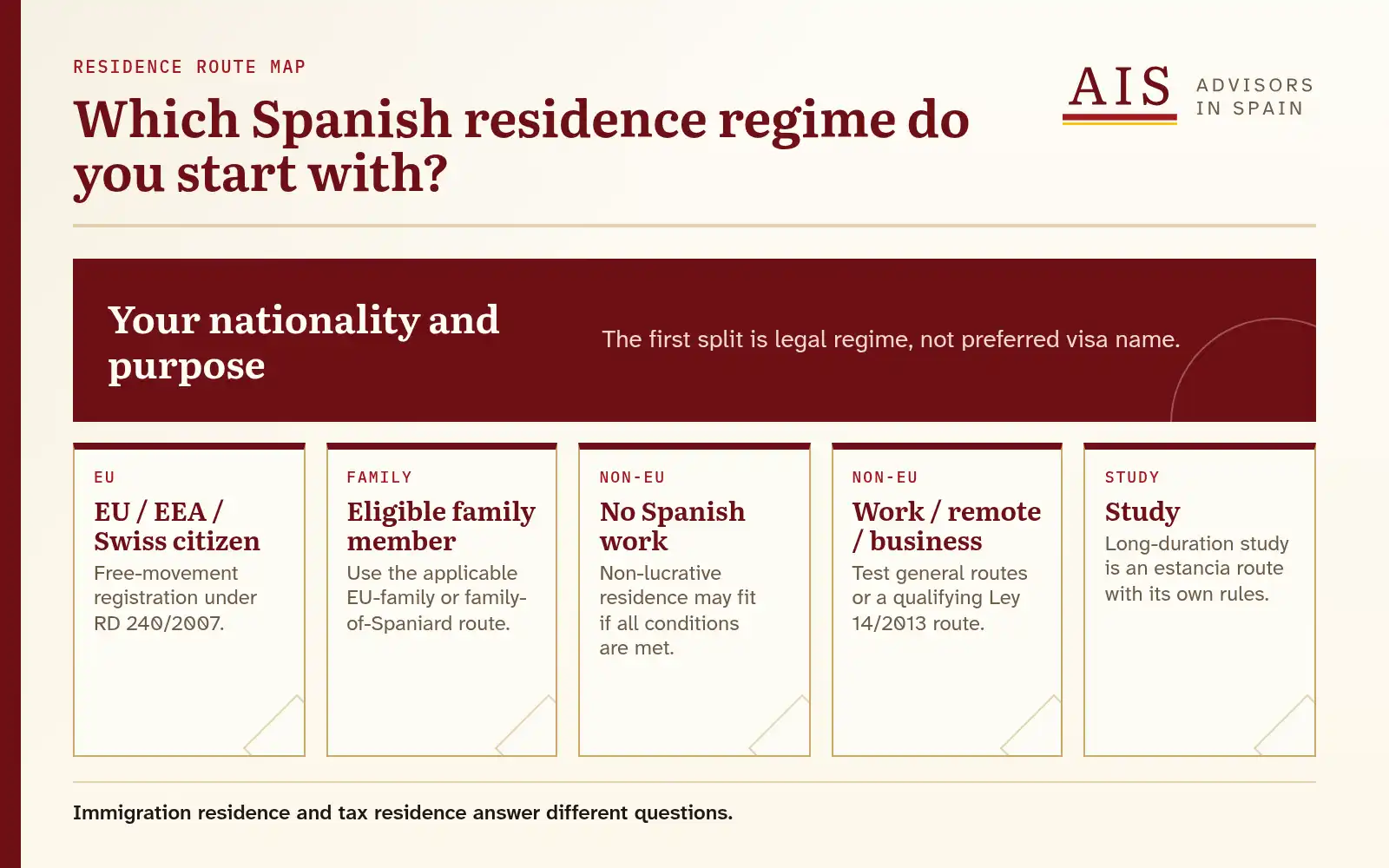
Diagram text version
EU, EEA and Swiss citizens begin under free movement. Eligible relatives use the relevant family regime. Other applicants distinguish non-working residence, work or business, qualifying special routes, and study. Study is legally estancia rather than ordinary residence, and immigration status does not by itself determine tax residence.
Spain has no single residency visa: EU citizens register locally, and everyone else qualifies through a route tied to their circumstances. This guide compares eight routes side by side, states what happened to the golden visa, and explains the main administrative steps after arrival. A Spain-qualified immigration attorney weighs your own facts against the options from there.
What Are Your Options for Getting Residency in Spain?
Residency in Spain runs on two tracks: EU, EEA and Swiss citizens register locally with no visa, while everyone else qualifies through a specific route, such as the non-lucrative, work, digital nomad, family or student visa.
Which track applies turns on nationality first, then on the qualifying basis: documented income or savings, an employment offer, enrollment at a Spanish institution, family ties to someone already resident, or, historically, an investment that no longer qualifies anyone. Each of those eight non-EU routes already has its own dedicated guide covering its full requirements; this page’s job is the layer above them, comparing all eight side by side so you can see which one to open next.
The comparison below sets out eight routes open to a non-EU applicant and states what happened to the investor route. Document requirements and after-arrival steps depend on the route and the applicant’s status. An immigration attorney can weigh a specific case against the options.
Do EU, EEA or Swiss Citizens Need a Visa to Live in Spain?
No. An EU, EEA or Swiss citizen registers with the Spanish immigration authorities; no visa applies to them at all. Real Decreto 240/2007 governs entry, exit, residence, permanent residence and work rights for citizens of those states under the “regimen comunitario,” and it extends the same protection to their family members, whatever nationality those family members hold.
A non-EU family member of an EU, EEA or Spanish citizen applies separately for a tarjeta de residencia de familiar de ciudadano de la Union, a residence card. That application is filed directly at the Oficina de Extranjeros; it skips the consulate stage entirely.
Registering does not end the paperwork. Every EU, EEA and Swiss citizen living in Spain still needs an NIE number and still has to register on the local padron, the municipal register of residents, once they have an address. The steps after arrival are covered in full further down this page.
Which Residency Route Fits Non-EU Citizens? Compare the Main Visas
A non-EU applicant qualifies through one of eight named routes, and each one gates on a different fact about the applicant’s own life. The table below names each route, who it fits, the one fact that decides eligibility, and the guide that carries its full requirements.
| Route | Who it fits | Guide |
|---|---|---|
| Non-lucrative visa | Passive income or savings, documented against an IPREM-linked test | Non-Lucrative Visa |
| Work visa | A job offer from a Spain-based employer that sponsors the application | Spain Work Visa |
| Digital nomad visa | Remote income from clients or an employer based outside Spain | Digital Nomad Visa |
| Self-employed (autonomo) visa | A freelance or self-employed business activity carried on in Spain | Self-Employed Visa |
| Entrepreneur visa | An innovative business project | Entrepreneur Visa |
| Student visa | Enrollment in an academic program at a Spanish institution | Student Visa |
| Family visa | A spouse or other close relative reunifying with someone already resident, or a relative of an EU or Spanish citizen | Family Visa |
| HQP permit / EU Blue Card | A skilled job offer meeting the route’s own qualification or salary test | HQP Visa and EU Blue Card |
Comparison only. Income thresholds, salary floors and document lists sit on each route's own guide.
The golden visa investor route is not on this list. It closed to new applicants in April 2025, covered next.
Which Residency Route Should You Apply For?
Route selection turns on facts a comparison table cannot weigh: a borderline income case, eligibility under two routes at once, or a mixed-nationality family where one member qualifies through the EU track and another does not. A generic guide cannot resolve those against your own numbers, and picking the wrong route wastes the time it takes to prepare a filing that never had a chance of approval.
An immigration attorney who reviews the actual income, employment and family facts can confirm which route fits, before any filing goes in. That review is what the form above this article collects.
Send your situation above and an immigration attorney reviews it against the current rules for each route.
What Happened to the Golden Visa, and What Replaces It?
Spain’s golden visa investor route ended on 3 April 2025. Articles 63 to 67 of Ley 14/2013 were left without content from that date, by disposicion final vigesimoprimera.1 of Ley Organica 1/2025, de 2 de enero. Every investment type that chapter covered, real estate, public debt, company shares, investment funds and bank deposits, closed together on the same date; no route from that chapter survived.
No new application under the golden visa is possible today. Golden visa alternatives sets out what an existing holder’s permit still allows and which of the live routes above may fit applicants who would previously have used it.
How Long Does It Take to Get Residency in Spain?
Timing has two separate stages. Consulate visa processing before arrival varies by route and by consulate. TIE-card issuance once you are in Spain is covered in full on the TIE card guide. Real Decreto 1155/2024 article 209 sets a one-month window for a non-EU national to file for the TIE once the residence authorization takes effect.
Residency itself keeps running once granted, and it converts to a stronger status over time. LOEX article 32 entitles anyone who has held temporary residence in Spain for five continuous years to long-duration residency, subject to the rules on qualifying absences.
What Documents Do You Need for a Residency Application?
Document requirements vary by route. The non-lucrative visa, for example, requires the following items alongside proof of its qualifying basis:
- A valid passport. Covering the intended period of residence.
- A criminal record certificate. Covering every country you have lived in during the five years before entering Spain.
- Proof of the qualifying basis. The non-lucrative route requires income or savings evidence. Other routes use their own document lists.
- Private health insurance. The non-lucrative visa’s national baseline requires cover from an insurer authorized to operate in Spain; consulates can apply a stricter standard of their own on top.
- Legalization and translation where required. Apostilles in Spain and sworn translators in Spain cover both processes.
What Happens After You Arrive? NIE, TIE and Registering Locally
The administrative steps after arrival depend on nationality and route.
The NIE number is the foreigner identification number and may already have been assigned before arrival. A non-EU national whose residence authorization has taken effect files for a TIE card, the physical identity card, inside the one-month window named above. An EU, EEA or Swiss citizen holds the registration certificate covered earlier and does not receive a TIE. Residents also register on the padron, the municipal register of residents, at the town hall covering their address.
How Much Does It Cost to Get Legal Help With Spanish Residency?
Professional service terms depend on the route and work required.
Send your situation so the team can identify the relevant residency route.
Talk to an Immigration Attorney About Your Residency Route
An immigration attorney can review your facts, confirm which route above fits, and assist with the filing.
Talk to an immigration attorney who can review your residency options
An English-speaking attorney reviews your case and handles the filing for the route that fits.
Not sure which route applies to you?
Tell us your nationality, your income or job situation and your timeline, and a Spain-qualified immigration attorney confirms which route fits your case.
Questions
Common questions
Is the golden visa still available in Spain?
Do I need a lawyer to apply for residency in Spain?
Can a US citizen get residency in Spain?
Is it difficult to get residency in Spain?
How much money do you need in the bank to emigrate to Spain?
Can you live in Spain with $2,000 a month?
Do I need a visa to live in Spain if I'm an EU citizen?
Can I include my spouse or children in my residency application?
How long does a Spanish residency application take?
Related
Contact us
Your request is in
We have your details, and Advisors in Spain replies by email within one business day.
We review your enquiry today. If you have not heard back within two working days, write to us and we chase it the same day.
Our guides are prepared in accordance with our Editorial Standards.