How to Get an Apostille for Spain
This guide names the right authority for an apostille by document type and by issuing country, from a US state office or the US Department of State to the UK's FCDO Legalisation Office. It explains that the receiving office sets the order for an apostille and a sworn Spanish translation, what the named offices publish about fees and timing, and where an immigration lawyer can review a document set already in hand.

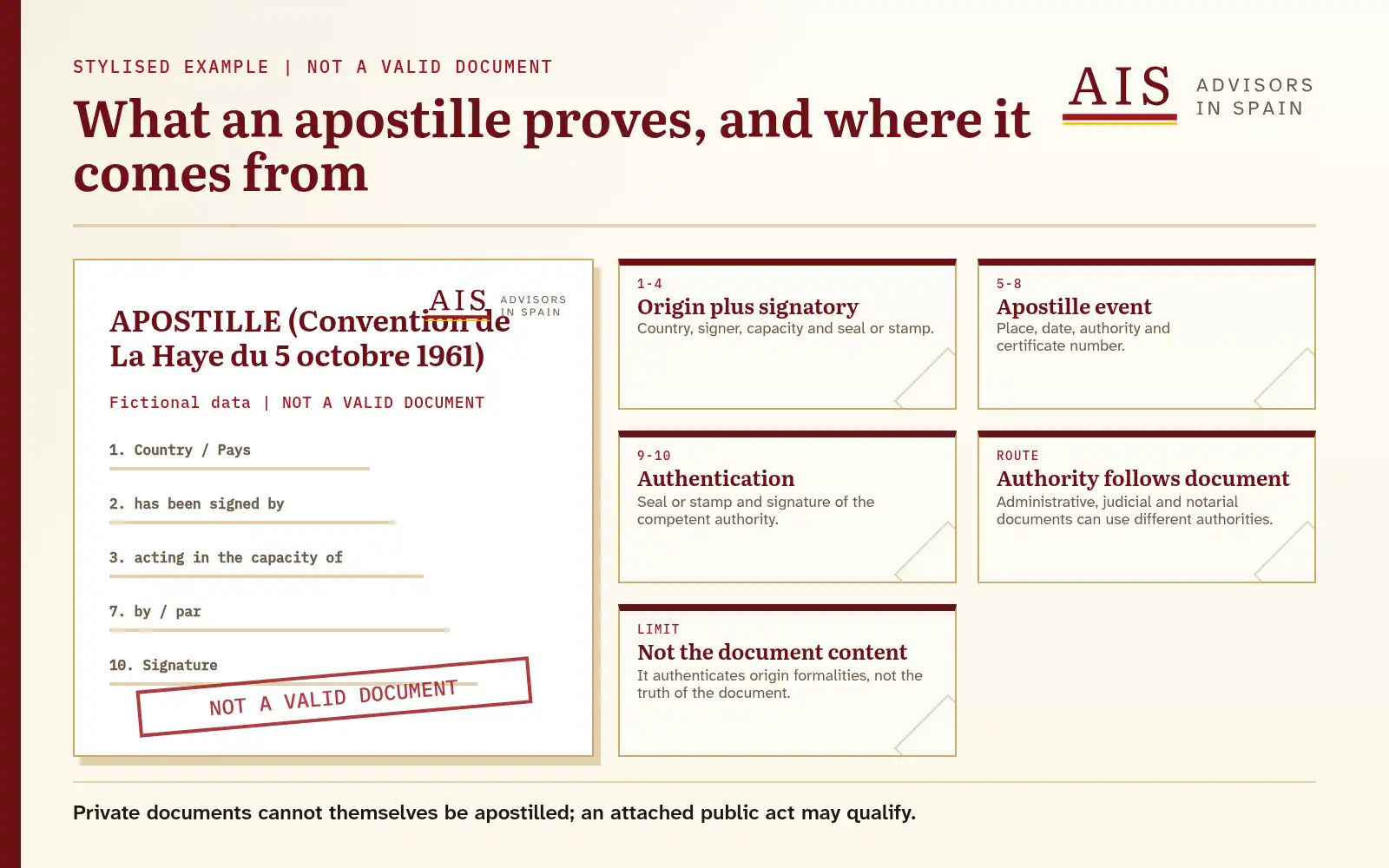
Diagram text version
The standard apostille records the country, signer, capacity, seal or stamp, place, date, issuing authority, certificate number, authentication seal and signature. The authority depends on whether the public document is administrative, judicial or notarial. The apostille does not validate the truth of the underlying document.
An apostille certifies a foreign public document for legal use in Spain. The Hague Apostille Convention makes it the only formality a receiving state may require, and the same article lets the receiving state’s own law abolish or simplify even that. This guide names the right authority by document type and by issuing country, from a US state office or the US Department of State to the UK’s FCDO Legalisation Office, where the standard service runs up to 25 working days. It also explains that the receiving office sets the order for an apostille and a sworn Spanish translation, and where an immigration lawyer can review a document set already in hand.
What Is an Apostille and Why Does Spain Require One?
An apostille is an official certification, issued by the document’s own country of origin, that authenticates a public document, such as a birth certificate or a criminal record check, for legal use in Spain under the Hague Convention.
Spain, the UK and the US are all contracting parties to the 1961 Hague Apostille Convention, and the Convention entered into force for Spain on 25 September 1978, according to the HCCH’s own status table for the treaty. A document from a country outside the Convention cannot be apostilled. It follows the authentication or consular legalization route required by the receiving procedure and the issuing country. For example, the Spanish Consulate General in Miami describes a foreign-ministry and Spanish-consulate chain for its own student visa applicants.
One narrower exemption sits alongside the apostille system. EU Regulation 2016/1191 removes the apostille requirement for thirteen listed categories of public document moving between EU member states, including a certificate of no criminal record issued to a citizen by their own country’s authorities. It reaches only those thirteen categories, and only a document moving between two EU member states. Since neither the UK nor the US is an EU member state, this exemption never reaches a UK or a US document.
Which Documents Commonly Need an Apostille for Spain?
Whether a document needs an apostille depends on its type. Four categories come up in the procedures this guide sources.
- Birth and marriage certificates. These sit among the document types the FCDO Legalisation Office legalizes directly, and a US-issued equivalent generally goes to the issuing state’s own authentications office.
- Criminal record or background checks. A US FBI Identity History Summary is a federal document, so it goes to the US Department of State’s Office of Authentications and not to a state office. A UK ACRO police certificate sits on the FCDO’s own list of documents excluded from its faster e-Apostille service, so it takes the standard paper route.
- Academic diplomas and transcripts. GOV.UK names a qualification certificate among the documents it will legalize once a UK notary or solicitor has certified it, which matters for a highly qualified professional visa application.
- Powers of attorney. A power of attorney executed abroad reaches the FCDO only after a UK notary or solicitor has certified it. California’s own Secretary of State, one worked state example, requires the same document to be signed by a public official or be an original notarized document before it apostilles it. A power of attorney executed in Spain, before a Spanish notary, works differently: only Spain’s Colegios Notariales, the notarial colleges, apostille a Spanish notarial document, and any of them can, regardless of which region of Spain issued it. Power of attorney in Spain covers how one is drawn up.
Each visa guide, including the non-lucrative visa’s own requirements, carries its own document checklist. This guide covers the authority and the order, not a master list.
Can Your Immigration Lawyer Coordinate Your Apostille and Translations?
Yes. A lawyer or advisor already handling your visa, citizenship or NIE case can review your document set as part of preparing that filing and confirm which items still need an apostille, a sworn Spanish translation, or both, before the file goes in. That review is one part of the wider case. Fees are set case by case, and you get a quote in writing before any work starts.
Already working with an immigration lawyer?
Advisors in Spain handles immigration cases, including apostille and translation coordination.
How Do You Get a Document Apostilled for Spain?
You get a document apostilled by finding the one authority with jurisdiction over it. The right office depends on both the document type and the country, state or region that issued it.
- Identify the competent authority. A US state-issued birth or marriage certificate generally goes to that state’s own Secretary of State or equivalent office, while a US federal document such as an FBI Identity History Summary goes to the US Department of State’s Office of Authentications. A UK-issued document goes to the FCDO Legalisation Office, the only authority the UK has designated for documents issued in England, Wales, Scotland and Northern Ireland. The UK Overseas Territories have their own designated authorities on the same HCCH record.
- Check what that office requires first. California’s Secretary of State, one worked state example, will not apostille a photocopy and asks for an original document signed by a public official, or an original notarized or certified document. The FCDO legalizes a power of attorney, a contract or a qualification certificate only once a UK notary or solicitor has certified it.
- Submit it through the service tier that office offers. GOV.UK lists four UK tiers by fee and speed, from a standard paper service to a same-day option restricted to registered businesses. California accepts a mailed request or an in-person visit to its Sacramento or Los Angeles office.
- Get the apostille attached to the document. Under the Hague Convention itself, the certificate is placed on the document itself or on an attached allonge, in the form set out in the Convention’s own annex.
- Have it translated into Spanish, after the apostille on the Miami consulate’s list. The Spanish Consulate General in Miami’s own student visa file asks for the apostilled criminal record certificate and its Spanish translation together, with the apostille named ahead of the translation in that instruction.
What Do You Need Before You Request an Apostille?
Gather these before you approach the competent authority.
- The original document, or an accepted certified copy. California’s Secretary of State states plainly that a photocopy is not acceptable.
- Confirmation of which office actually has jurisdiction. The US federal designation names the state Secretary of State’s office as “generally” the applicable one for a state-issued document, so check your own state’s page and do not assume it.
- The fee that office currently charges. Fees are set office by office and change. The US Department of State’s domestic authentication fee is $20 under 22 CFR 22.1, and the UK’s standard paper apostille is £45 plus courier costs, as published in August 2026. Check the current schedule before you pay.
- Any required notarization. A private document generally cannot be apostilled as it stands. Spanish law bars it outright for a document issued in Spain, and a power of attorney executed in the US or the UK reaches its own apostille or legalization authority only once a notary or solicitor has certified it, covered above. California’s own office states it performs no notarial service itself and expects the document notarized before the apostille request arrives.
Does the Apostilled Document Need to Be Translated Too?
Yes. A document written in a language other than Spanish generally needs an official Spanish translation before a Spanish office accepts it. RD 724/2020, article 17 sets out four kinds of translation that carry that official character in Spain, and the route this guide sends readers to is the most familiar of the four: a traductor jurado, a sworn translator appointed by Spain’s Ministerio de Asuntos Exteriores. Sworn translation in Spain covers how that process works and what it costs.
Get the document apostilled first if your receiving office sets out the order the way the Miami consulate does. The Miami consulate’s own student visa file asks for the criminal record certificate, its apostille and its Spanish translation together, with the apostille named ahead of the translation in that instruction. Ask the receiving office whether the translation must include the apostille certificate’s wording.
What If You Need an Apostille Before a Visa or NIE Deadline?
This section is for readers who are not already working with a lawyer and are running against a visa, citizenship or NIE deadline. Three situations turn a DIY apostille into something worth paying to fix: the competent authority’s own backlog runs for weeks, you are unsure which of two possible offices is the right one for your document, or a time-sensitive certificate, such as a criminal record check, has aged past the window the receiving office applies to it.
An immigration lawyer can confirm which office to use and get your documents moving again before the deadline passes.
How Long Does It Take to Get an Apostille for Spain?
GOV.UK publishes four UK tiers: the standard paper service usually takes up to 25 working days plus courier or postage time, the e-Apostille takes up to 2 working days, and the fastest paper tiers are restricted to registered businesses only.
Other authorities set their own processing times. Ask the office you are using for its current published time frame. The sworn Spanish translation runs on a separate timeline, which the sworn translation guide covers.
What Mistakes Delay Apostille and Translation for Spain?
Four points come up repeatedly in the sourced procedures.
- Translating the document before the apostille is attached, where the receiving office asks for the apostille first. The Miami consulate’s own instructions name the apostille step ahead of the translation step for the documents its own checklist covers.
- Requesting the apostille from the wrong authority. In the US this usually means confusing the state and federal routes: a state-issued document goes to that state’s own office, while a federal document such as an FBI check goes to the US Department of State instead.
- Letting a time-sensitive certificate age out before you submit it. The Miami consulate sets a six-month FBI certificate window for its student visa file. Other consulates and procedures set their own windows.
- Skipping a required notarization. A private document, including a power of attorney, generally cannot be apostilled as it stands. Spanish law bars it outright for a document issued in Spain, and California’s own apostille office states it performs no notarial service of its own.
A local specialist handles apostille and translation coordination for your case, in English or Spanish.
Fees and legal references on this page are current as of 24 August 2026.
Questions
Common questions
How much does an apostille cost?
Can your immigration lawyer or solicitor coordinate my apostille and translations?
Can I get an apostille myself, or do I need a lawyer?
Where can I get an apostille in the USA?
How quickly can I get an apostille?
Can any notary do an apostille?
Can I do my apostille online?
What happens if my background check expires before I submit my documents?
Can someone else get my documents apostilled for me while I'm in Spain?
Start here
Your request is in
Your enquiry is with Advisors in Spain. We assess your requirements and reply by email with the appropriate next steps.
We review your enquiry today. If you have not heard back within two working days, write to us and we chase it the same day.
Our guides are prepared in accordance with our Editorial Standards.