How to Buy Property in Spain
This guide sets out the 12 steps to buying property in Spain, from getting an NIE to completing at the notary, and names the transfer tax rate and the deposit rules where a figure is actually published. It closes with the pitfalls that come up most and a route to a property lawyer for any step.

On this page
- The 12 steps
- Do you need a lawyer?
- Getting an NIE
- A Spanish bank account
- Budgeting the extra cost
- Mortgages for non-residents
- The arras contract
- The nota simple
- Other legal checks
- Holiday lets
- Survey and valuation
- Buying remotely
- Completion day
- After completion
- Buying through a company
- How long it takes
- Pitfalls
- Your property lawyer
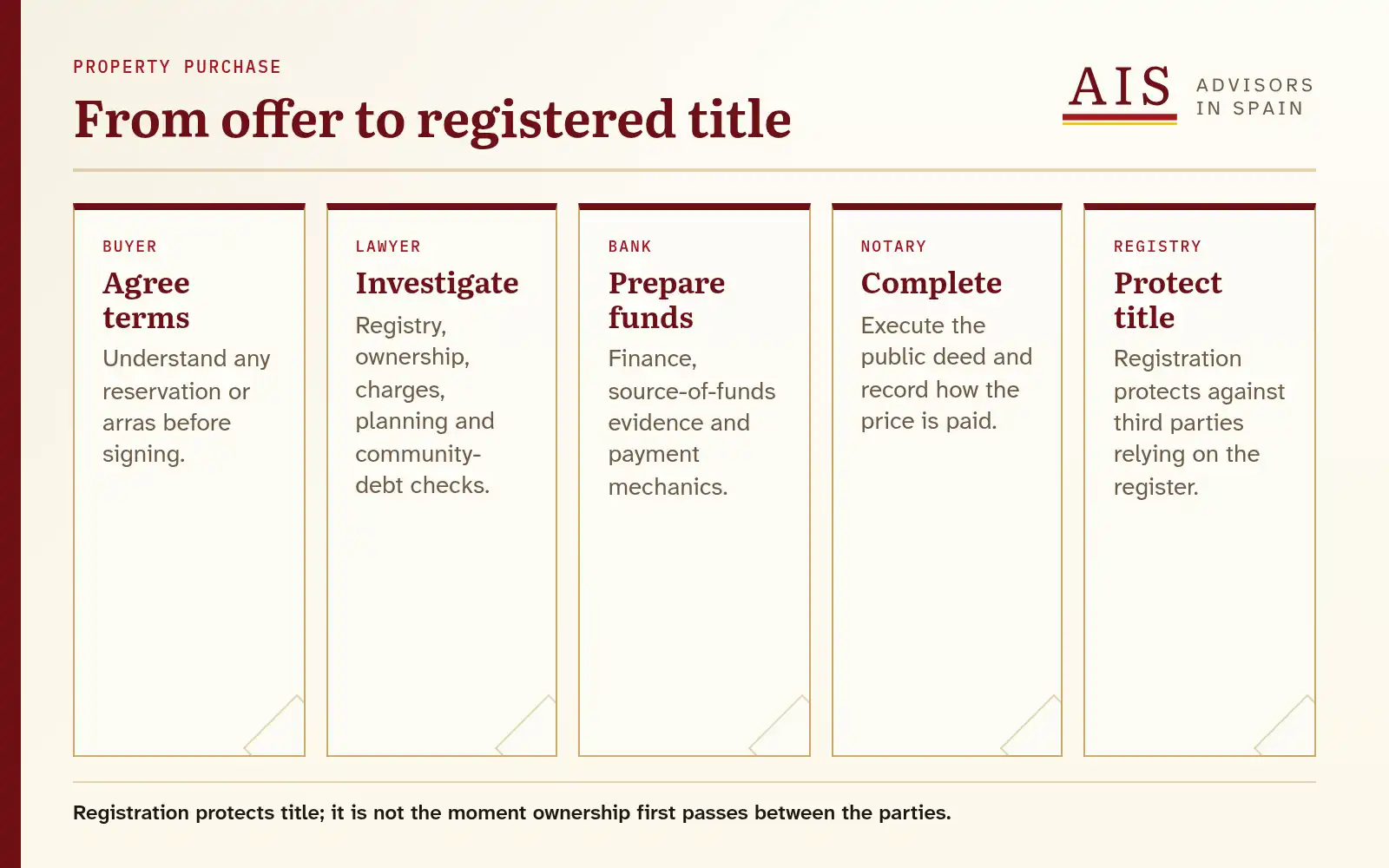
Diagram text version
The buyer agrees terms. Independent legal due diligence checks the title and matters outside the register. The bank handles finance and source-of-funds evidence. The deed is signed before a notary and presented to the land registry, where registration protects the buyer against third-party reliance.
Buying property in Spain runs through 12 steps, from an NIE and an arras contract to completion at the notary. This guide sets out each step in order, states the sourced figures for cost and timing where one exists, and names where the rules run by region and not nationally. It closes with the pitfalls that come up most and a route to a property lawyer for any step.
What Does Buying Property in Spain Involve?
Buying property in Spain runs through 12 steps: an NIE, a bank account, a reservation and arras contract, due diligence on the nota simple, and completion at the notary, on whatever deadline the arras contract sets. Each step below expands on one of these, in the order it actually happens.
- Get an NIE. You need this Spanish tax ID before you can complete, and a lawyer running your purchase can apply for it on your behalf.
- Confirm how the completion funds will move. Ask your lawyer and bank which account and payment method the completion will use, and complete the source-of-funds checks in time.
- Budget the full cost. Transfer tax, notary and registry fees, and your lawyer’s own fee sit on top of the price, and the tax rate differs by region.
- Arrange a mortgage, if you need one. A non-resident mortgage runs on its own approval timeline, separate from your arras deadline.
- Sign a reservation and an arras contract. A private deposit contract is binding once signed. Any exclusivity or market-removal effect depends on the contract’s terms.
- Check the nota simple. The land registry extract shows the registered owner, any mortgage or charge, and the rights registered over the property.
- Check planning and legal status. The ITE inspection status, tanteo y retracto rights and unpaid community debts all sit outside the nota simple itself.
- Arrange a survey and a valuation. A mortgage valuation and a structural survey are two different things. Confirm with the lender and your lawyer who arranges each one.
- Grant power of attorney, if you are buying remotely. A notarised, apostilled power of attorney lets your representative sign for you.
- Complete at the notary. You sign the escritura, the title deed, and the notary records how the price was paid. The buyer remains responsible for the applicable tax filings and payment.
- Register the deed and switch utilities. Registration is the step that protects your ownership against a later claim.
- Decide how you are buying: personally, through a Spanish SL, or through a foreign company. Each route carries its own extra registration and tax-ID steps.
Do You Need a Lawyer to Buy Property in Spain?
No, but the exposure without one falls mostly on non-resident, remote and first-time buyers. Spain sets no legal requirement to use a solicitor to complete a purchase. Article 1 of the Ley del Notariado states what a notary actually does: attest, under the law, to contracts and other extrajudicial acts. The article says nothing about checking title, debts, licences or planning status, and that gap is the whole argument for hiring your own lawyer. The Colegio Notarial de Andalucia itself describes the notary as an impartial professional, and impartial means nobody at the table works for you alone.
Anyone buying remotely, buying through a company, or trusting the notary to catch a title or planning problem is exposed without independent legal help.
Buying remotely, through a company, or relying on the notary to catch a problem?
Your property lawyer runs every check in this guide, from the arras contract to completion.
How Do You Get an NIE Before You Buy?
You get an NIE by filing an application before you complete at the notary. Getting an NIE covers the application routes and the documents each one takes.
Ask the property lawyer running your purchase whether the NIE application is within the written scope before you apply for it yourself.
Do You Need a Spanish Bank Account Before You Buy?
Confirm the completion account and payment method with your lawyer, bank and notary before the contractual deadline.
Ask whether account-opening work is within the lawyer’s written scope. Bank accounts in Spain covers the standalone route.
How Much Extra Should You Budget Beyond the Purchase Price?
Budget for transfer tax, notary fees, registry fees and your lawyer’s own fee on top of the price. Transfer tax, ITP on a resale property, has no single Spain-wide rate: each comunidad autonoma sets its own, and the state’s 6% fallback under Real Decreto Legislativo 1/1993 only applies where a comunidad has left the rate unset. Madrid charges 6% generally, Andalucia 7%, the Comunitat Valenciana 9% or 11% above one million euros, and Catalonia a banded 10% to 13%. Check the rate published by the comunidad where the property sits. ITP is charged on the cadastral valor de referencia, unless your agreed price is higher, in which case the higher figure becomes the base. Property purchase costs in Spain breaks the full cost down by line, with sources.
Do You Need a Mortgage as a Non-Resident Buyer?
No, a mortgage is only necessary if you are not paying in cash, and a non-resident mortgage runs on its own timeline separate from your arras deadline. Mortgages in Spain for non-residents covers the full process.
Before you sign anything, the UK government’s own guidance for buyers recommends checking with the Bank of Spain that your lender is authorised to operate in the country, and it warns that a Spanish lender can pursue assets held in the UK for a shortfall through a European Enforcement Order. It also states that once you have a binding mortgage offer, you have 10 working days to query the terms with the branch. A mortgage broker or financial adviser can compare non-resident terms across lenders before you commit to one.
What Is an Arras Contract?
An arras contract is the private deposit agreement buyers sign before the public deed of sale. Spain’s own notarial body, the Consejo General del Notariado, says the document is not compulsory, but the law treats it as binding from the moment you sign it.
Two types exist, and they carry different consequences. Confirmatorias are handed over as a sign the deal is agreed and count against the price; the Consejo General del Notariado calls this the most common type. Penitenciales carry the forfeit-and-double penalty, and only where the contract is drawn to create them: under Article 1454 of the Civil Code, a buyer who walks away forfeits the deposit, and a seller who walks away must repay double. One Mallorca estate agency’s own buyer guide takes the opposite view of which type is standard, stating penitenciales are what most agencies use as a matter of course. The two sources disagree, so have your property lawyer confirm which type your own contract creates before you sign it.
Deposits sit outside the law too. The same agency guide puts a smaller reservation deposit at 3,000 to 10,000 euros, rising to around 10% of the price at arras stage for most transactions it handles. These are the agency’s market observations, not statutory amounts.
How Do You Check a Property’s Legal Status? (Nota Simple)
You check it by reading the nota simple, the land registry extract, before you sign anything binding. Under the Ley Hipotecaria, it must show the registered owner, the extent, nature and limitations of the rights registered over the property, and any prohibition or restriction affecting them. The nota simple guide covers how to request one and read it in full.
Two limits matter. The document carries purely informative value: it does not attest to what it shows, and it covers only entries currently in force at the registry, so an unregistered planning breach or an unpaid community debt stays invisible on it.
What Other Legal Checks Does a Property Need Before You Buy?
Beyond the nota simple, four checks catch what the registry alone will not show. The ITE, the building inspection older properties need, has its qualifying age and inspection cycle set separately by each comunidad and town hall; the Constitutional Court struck down the national version of the rule in 2017, so no single national figure exists for either. Tanteo y retracto, a public body’s right to buy ahead of you or unwind a sale afterwards, applies to specific cases such as heritage-protected buildings under Article 38 of the Ley del Patrimonio Historico Espanol. Community debts, under the Ley de Propiedad Horizontal, follow the property itself for up to three calendar years before the purchase plus the current year, and the seller must produce a debt certificate at completion, which a buyer can waive at their own risk. Unpaid IBI, the municipal property tax, can also become collectible from the property on a subsidiary basis when the seller left it unpaid.
Your property lawyer reviews the ITE status, the community’s debt certificate and any tanteo y retracto exposure before the arras contract is signed.
Can You Run a Holiday Let From the Property You’re Buying?
The purchase itself does not decide whether a holiday let is permitted. Tourist licences in Spain covers the licensing process.
Who Arranges the Survey and Valuation?
A mortgage valuation and a structural survey are two different things. Confirm with the lender and your lawyer who arranges each one. The non-resident mortgage guide linked above covers the valuation a lender requires before it lends.
Do You Need a Power of Attorney to Buy Remotely?
Yes, by granting a power of attorney to your lawyer or another representative if you cannot attend completion in person. The representative signs the escritura on your behalf at the notary. A power of attorney signed before a notary outside Spain needs legalizacion or an apostille before a Spanish notary will accept it, according to the Consejo General del Notariado.
Your property lawyer drafts the power of attorney and confirms it carries the apostille or legalizacion a Spanish notary needs before completion.
What Happens on Completion Day at the Notary?
You and the seller sign the escritura, the title deed, in front of a notary you have chosen. Under Article 1462 of the Civil Code, granting that deed is equivalent to physically handing the property over unless the deed itself clearly says or implies otherwise. Registration then protects your ownership against a later claim.
Expect to prove where your money came from. Ley 10/2010 names notaries, lawyers and estate agents as obliged subjects under Spain’s anti-money-laundering rules, and the Ley del Notariado requires the notary to record how the price was paid, in cash, by cheque, or by bank transfer, and its exact amount. Paying in cash carries its own limit too: Spanish law caps a cash payment at 1,000 euros where either party acts as a business, a limit that rises to 10,000 euros only for a payer who is an individual, is not acting as a business, and proves they are not tax-resident in Spain.
The buyer must also check whether the 3% non-resident retention applies. It applies when the seller is a non-resident acting without a permanent establishment. No withholding or Modelo 211 is required if the seller proves Spanish IRPF or corporation-tax status with an Agencia Tributaria residence certificate, or if the property is contributed on the incorporation or capital increase of a Spanish-resident company.
What Happens After Completion?
Completion is not the end of the paperwork. Registration. Your lawyer registers the new deed at the land registry, the step that protects your ownership against a later claim. Community notification. The community of owners needs to know a new owner has taken over the property. Utilities and insurance. Utilities and home insurance both need switching into your name. IBI direct debit. Setting this up early matters, since Spanish law lets the town hall pursue the property itself, on a subsidiary basis, for a predecessor’s unpaid property tax. ITP settlement. Your lawyer coordinates payment of the transfer tax the purchase has triggered, at the rate set by the comunidad the property sits in.
Can You Buy Property in Spain Through a Company?
Yes, but a company purchase draws in more than one professional. Buying through a foreign company or a new Spanish SL pairs your property lawyer with an accountant or corporate-services team, since forming or registering the company sits outside a lawyer’s own work. A company purchase also draws closer anti-money-laundering scrutiny: under Ley 10/2010, the professionals involved must identify the individuals who ultimately hold more than 25% of the company’s own capital or voting rights behind it. Buying property in Spain through a company covers the full process, and company formation in Spain covers forming the Spanish SL itself.
How Long Does Buying Property in Spain Take?
The deadline is whatever the arras contract sets. It is a drafting decision, and no law fixes it. One buyer’s guide advises allowing 60 to 90 days where a mortgage is involved, because a non-resident mortgage takes a Spanish bank time to approve. Incomplete documents, a certificate waiting on a sworn translation, and a backlog at the notary or the land registry all push a completion date out. Sworn translators in Spain covers the translation step.
What Are the Biggest Pitfalls When Buying Property in Spain?
Five mistakes recur across the steps above. Skipping due diligence on an off-plan or rural property. The nota simple alone will not catch a planning breach or an unregistered extension. Assuming the arras double-penalty always applies. It attaches to arras penitenciales specifically, where the contract is drawn to create them. Buying without an NIE or a bank account arranged first. Both sit on the critical path to completion. Assuming the notary protects your interests. The notary is impartial by design and works for neither side. Underestimating the extra cost. Transfer tax is set by each comunidad and is the largest line after the price itself, and notary, registry and legal fees come on top of it. This guide gives the sourced rate for Madrid, Andalucia, Cataluna and the Comunitat Valenciana above. Check the rate published by the comunidad you are buying in before you budget.
Buying from the UK carries its own frictions on top of these: the time a currency transfer takes to clear before a deadline, and the distance from appointments that a remote buyer cannot simply drop into.
Your English-Speaking Property Lawyer
Your lawyer can run any step in this guide on your behalf: the arras contract, the nota simple and the other checks, power of attorney for a remote completion, and the filing that follows the notary.
The Spanish property legal service covers contract review, due diligence and completion across Spain.
Legal references and the sourced figures on this page are current as of 24 August 2026.
Questions
Common questions
What are the biggest pitfalls of buying property in Spain?
What are the rules for Brits buying property in Spain?
How much tax do you pay on buying a property in Spain?
Do I need a lawyer to buy property in Spain?
Do I need an NIE before I buy property in Spain?
What is an arras contract?
What happens if I withdraw after signing the arras contract?
What is a nota simple and why do I need one?
What checks should my nota simple or my lawyer catch before I buy?
How long does it take to buy property in Spain?
Can I buy property in Spain remotely, without travelling?
Can I buy Spanish property through a UK or US company?
Start here
Your request is in
Your enquiry is with Advisors in Spain. We assess your requirements and reply by email with the appropriate next steps.
We review your enquiry today. If you have not heard back within two working days, write to us and we chase it the same day.
Our guides are prepared in accordance with our Editorial Standards.