Nota Simple Spain: What It Is and How to Request One
A nota simple is the land-registry extract that shows a property's registered owner, mortgages and charges. This guide covers what it shows, how to request one online through the Colegio de Registradores, and where a solicitor's reading of it matters.

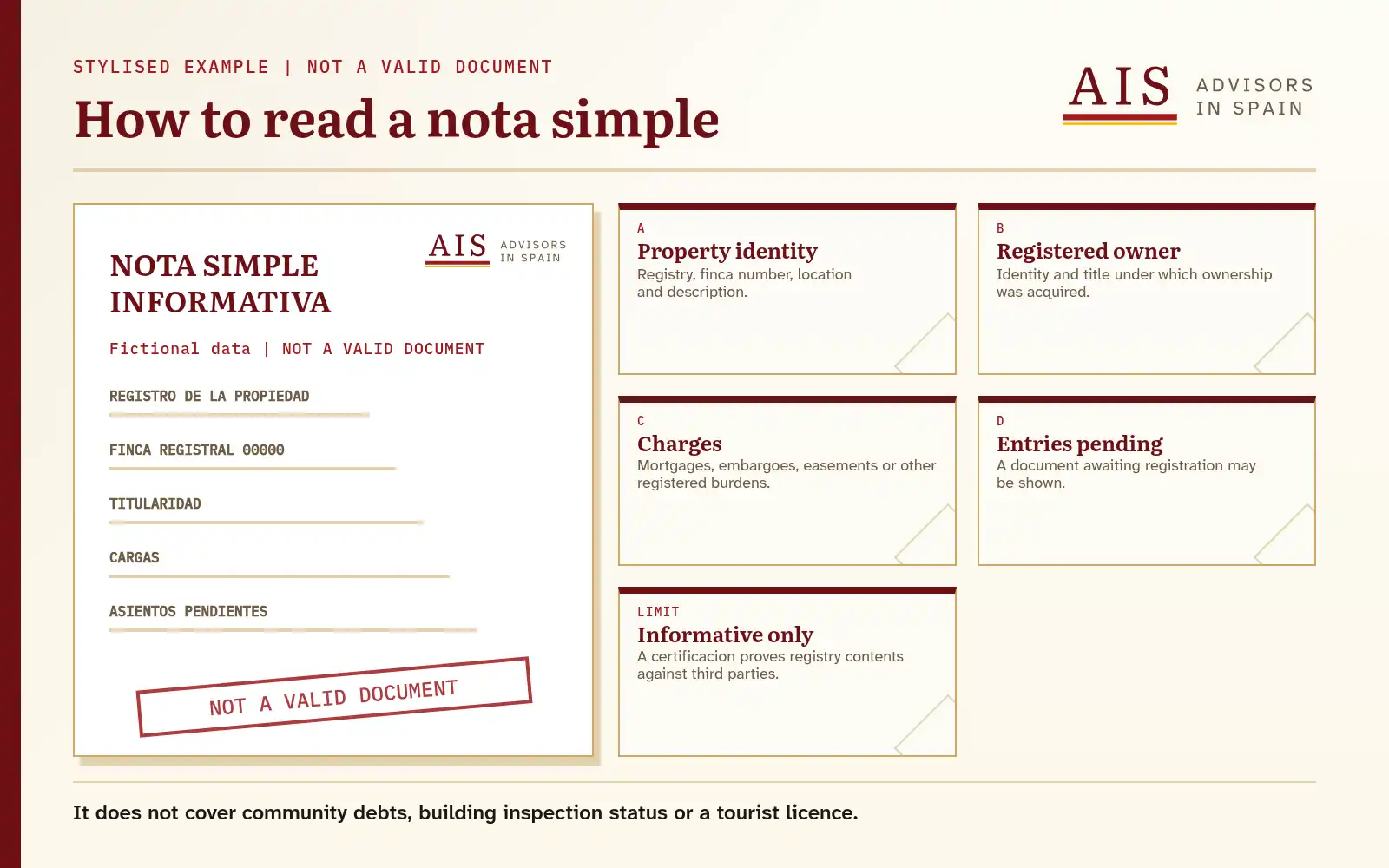
Diagram text version
A nota simple identifies the property and registered owner, lists registered charges, and may show pending entries. It is informative; a registry certification proves registry contents against third parties. Community debts, inspection status and tourist-licence status sit outside it.
A nota simple is Spain’s land-registry extract: registered owner, mortgages and charges, drawn from the Registro de la Propiedad. A requester states a legitimate interest and can obtain one in person or online through the Colegio de Registradores, for a fee of 9.02 euros per property plus tax. This guide covers what the extract shows, how the online request works, the real difference between a nota simple and a certificacion, and the mistakes that turn up when buyers read one.
What Is a Nota Simple in Spain?
A nota simple is an extract issued by the Registro de la Propiedad. It is distinct from a certified copy of the register, and it reproduces the entries in force on a property at the moment it is issued: the registered owner, any mortgages, charges or embargoes, and the property’s registry description.
The Colegio de Registradores’ own explainer puts it plainly: the nota simple “is purely informative”, letting the requester know the basic content of the registry as to owners, rights and charges in force at the moment of the request. It does not attest to that content the way a signed certificacion does, a distinction the next sections work through in full.
A buyer’s solicitor pulls this extract as one part of a wider due-diligence check inside a full purchase, alongside the ITE, community-debt and tanteo y retracto checks a nota simple does not carry.
Can a Lawyer Pull and Translate My Nota Simple for Me?
Yes. A solicitor obtains the nota simple, reads the legal Spanish, flags any charge or embargo it records, and can arrange a translation, as part of a standard conveyancing engagement.
The registry check is a core, paid task inside that engagement, the same one the property lawyers page describes as pulling the extract and reading it for the seller’s title, any mortgage still registered, and any embargo that would pass to the buyer at completion. A translation is available too: the Colegio de Registradores itself will translate the information into English for 30 euros plus tax, on top of the nota simple fee, using professional translators familiar with registry terminology. What a solicitor adds on top of that translated document is reading the charge position correctly and explaining what it means for the purchase, which the mistakes section below covers.
Get your nota simple pulled and read by a solicitor
The Spanish property legal service includes land-register review as part of purchase due diligence.
What Information Does a Nota Simple Show?
A nota simple states the registered owner, any registered charges, and the property’s own registry description. The Colegio de Registradores names “identification and description… who the true owner or holder of the right in question is, and whether or not it has mortgages or embargoes” as the most relevant information a nota simple or a certificacion can supply.
- The registered owner’s name. Who currently holds the registered title, or another registered right over the property.
- Any mortgage, charge or embargo. A hipoteca, a court embargo or another registered charge against the property, covered by the extract’s “limitaciones” and “cargas” under article 222.5 of the Ley Hipotecaria.
- The property’s registry description. The finca’s own description in the registry, which in practice covers matters such as size and boundaries; Spanish law does not fix these as a required field list, so the extract simply reproduces whatever description the registry already holds.
- Whether the property is graphically coordinated with the Catastro. The registrar records, entry by entry, whether a property’s boundaries have been matched to the cadastral cartography, under article 10 of the Ley Hipotecaria.
- The property’s unique registry reference. Its finca number, which is how the registry identifies the property.
The law does not name a fixed list beyond identification, ownership and rights, so a registrar can tailor what a particular nota simple shows to the interest the requester stated, under Reglamento Hipotecario article 332.5.
How Do You Request a Nota Simple Online?
You request a nota simple by identifying the property, submitting the request and your stated interest through the Colegio de Registradores’ online service, paying the fee and waiting for the registrar’s decision and the extract itself.
- Identify the property.Article 222 bis of the Ley Hipotecaria names three statutory routes: by an owner’s name and identity document, by the registry’s own book, entry, volume and folio, or by cadastral reference where the registry holds one. The online portal also accepts a search by address, though address is not itself one of the three statutory identifiers.
- Submit the request and state your interest.Requests go through registradores.org or in person at the Registro de la Propiedad. The online form asks for the legitimate interest motivating the request in a short box, and the registrar can ask you to complete it further. The Colegio de Registradores adds that what you declare stays available to the property’s owner, who can consult at any time the information issued about their properties and the reasons of interest alleged.
- Wait for the registrar’s decision.Article 222 bis sets a maximum of 24 hours for the registrar to notify whether access is authorised or refused, with any refusal reasoned. That deadline covers the registrar’s authorisation decision only; it says nothing about how long delivery of the document itself takes.
- Pay the fee.An ordinary nota simple costs 9.02 euros per property, plus tax, according to the Colegio de Registradores. A property split across two registry entries, such as a flat and a separate garage finca, is billed as two requests.
- Receive the extract.An email carries a link to download the nota simple as a PDF once it is issued. The Colegio’s own FAQ quotes an average delivery time under two hours for the online service, describing it as a “plazo medio”. That figure is an average, and it carries no guarantee that any single request lands inside it.
Nota Simple Informativa vs Nota Simple Literal: What’s the Difference?
“Literal” and “en extracto” are two modes of the same nota simple informativa, chosen by the requester under article 222.5 of the Ley Hipotecaria. Both modes belong to one document. The document that carries legal force against a third party is a separate thing again: the certificacion.
A nota simple, in either mode, has purely informative value and does not attest to the content of the entries. Article 225 of the Ley Hipotecaria is the precise reason: whether a property is free of charges or encumbered “may only be proved to the detriment of a third party by a certification from the Registry”, never by a nota simple. A certificacion is a public document signed by the registrar, and the Colegio de Registradores describes it as “legally the only means” of asserting and proving registered rights against third parties, whether individuals, companies, courts or public bodies. A certificacion literal is a further, distinct thing again: a certificacion that transcribes the entries in full, under article 232.
In practice, the Colegio’s own guidance notes that for simple and routine operations, including a bank’s preliminary study before granting a mortgage loan, a nota simple is generally accepted as evidence of ownership or the charge position, even though it carries no formal evidentiary force.
What Mistakes Do Buyers Make When Reading a Nota Simple?
A nota simple is a snapshot, and most reading mistakes come from treating it as something more current or more complete than it is.
- Treating an out-of-date extract as current. A nota simple reproduces the entries “vigentes”, in force, only as of the date it is issued. Reglamento Hipotecario article 354 a) requires the registrar to tell the notary the same day if another title affecting the property is presented within nine calendar days of sending the information. That notary-led check is what protects a buyer against a charge registered in the gap before completion. A buyer’s own extract plays no part in that protection.
- Mistaking the informativa for a legally binding guarantee of title. Only a certificacion proves the charge position against a third party, under Ley Hipotecaria article 225.
- Missing a registered charge because the entry is in legal Spanish. The registry sells an English translation for 30 euros plus tax, but a solicitor still has to read what a charge actually means for the purchase.
- Confusing the registry’s description with the Catastro’s. Coordination between a property’s registry description and its cadastral cartography is a state the registrar records entry by entry, under article 10 of the Ley Hipotecaria; where a property has not been coordinated, the two descriptions are separate records that can disagree.
- Assuming the extract covers community debts, an ITE or a tourist licence. No content list the Colegio de Registradores or the Ley Hipotecaria publishes for a nota simple names any of the three. Each needs its own separate check inside a full purchase.
Do You Need a Lawyer to Request a Nota Simple?
No. Requesting a nota simple does not require a lawyer. Article 221 of the Ley Hipotecaria makes the registries public for those who have a known interest in ascertaining the state of a registered property, the Colegio de Registradores’ own FAQ puts the same test as a legitimate interest, and the registrar assesses that interest case by case. A buyer considering a purchase, a lender and a creditor all hold a recognised interest of that kind. You do not have to be the owner, and idle curiosity is not framed as an interest.
What changes with a lawyer is the interest question itself. Reglamento Hipotecario article 332.3 presumes that professionals acting in a role connected to property, including lawyers acting for a client, have already evidenced their legitimate interest, provided they state the reason for the enquiry. A private individual is not on that presumed list and has to state, and potentially evidence, the interest themselves. Professional help also matters for what comes after the request: reading the legal Spanish accurately, interpreting a charge or embargo correctly, and knowing what a clean extract does not tell you.
Doing early due diligence before making an offer, or checking what a property’s registry entry actually says? Your lawyer can read the extract for you.
How Up to Date Is a Nota Simple?
A nota simple reflects the registry’s records only as of the date it is issued. It carries no live update after that date. The Colegio de Registradores describes it as an extract of the registry entries in force at that moment. Treat it as a dated snapshot, not as a document with a fixed validity period.
Standard due-diligence practice requests a nota simple early in a purchase. Freshness near completion then runs through the notary, under Reglamento Hipotecario article 354 a): a notary’s own registry request must come back within three working days, extendable to five, and for nine calendar days after that the registrar must flag any new title presented that affects the property. The registry also offers a separate, real-time product for anyone who wants their own live window. The Colegio de Registradores describes “informacion continuada”, which it says operates under article 222.3 of the Ley Hipotecaria, as registry information kept permanently updated and available for five calendar days, with a real-time response. No price for that service on a nota simple is published, so this guide gives none.
Questions
Common questions
How do you request a nota simple in Spain?
How can you check the ownership of a property in Spain?
Can my lawyer request the nota simple for me?
Is a nota simple in Spanish, and do I need it translated?
Can I request a nota simple if I'm not the property owner?
Does a nota simple show unpaid community charges (derramas)?
Start here
Your request is in
Your enquiry is with Advisors in Spain. We assess your requirements and reply by email with the appropriate next steps.
We review your enquiry today. If you have not heard back within two working days, write to us and we chase it the same day.
Our guides are prepared in accordance with our Editorial Standards.