FBAR and Modelo 720: What US Expats in Spain Must File
FBAR is filed with the US Treasury and Modelo 720 with Spain's Agencia Tributaria. Each has its own filer definition, asset scope and threshold.

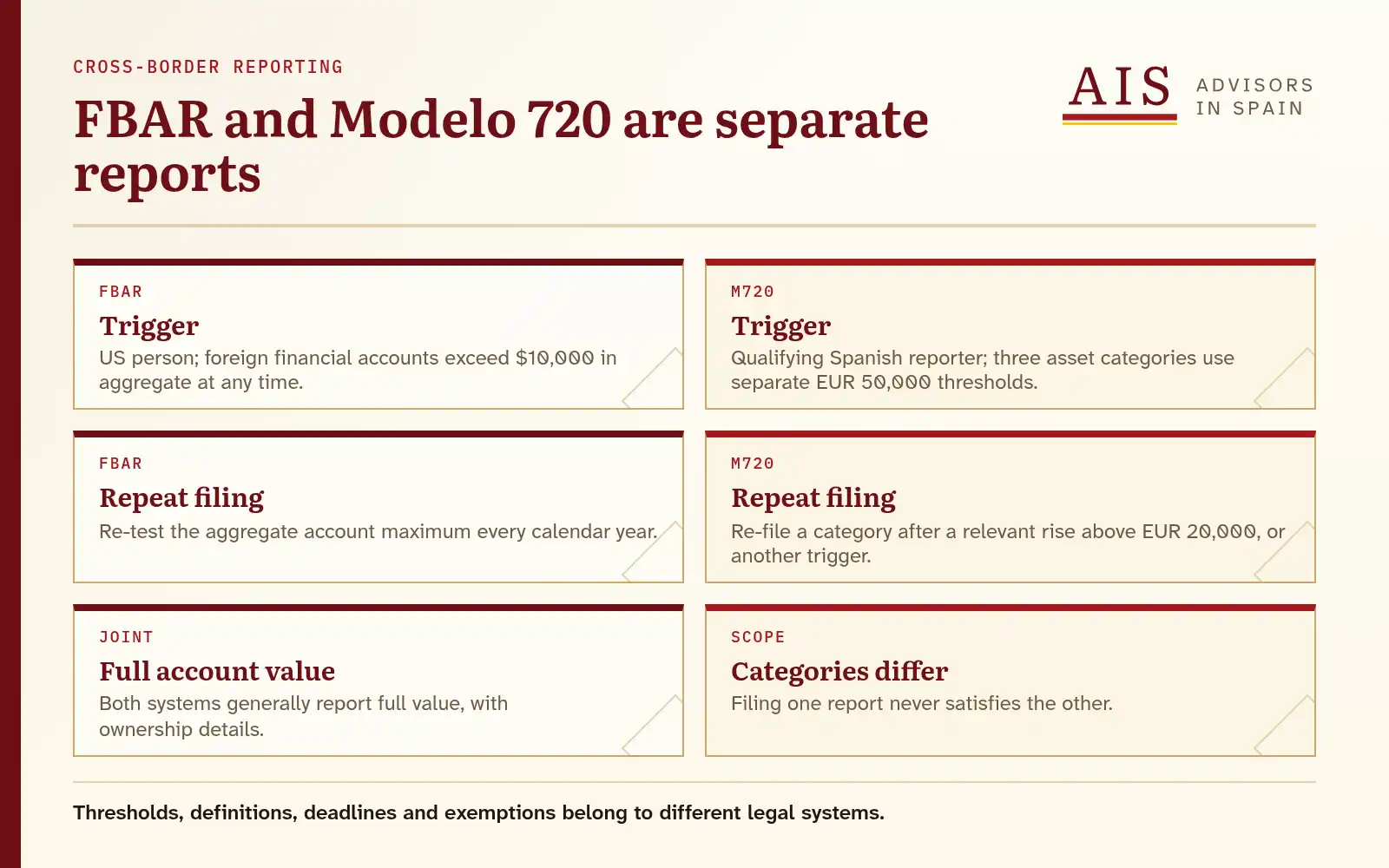
Diagram text version
FBAR tests whether a US person's foreign financial accounts exceeded 10,000 dollars in aggregate at any time. Modelo 720 tests three foreign-asset categories separately against 50,000 euros for qualifying Spanish reporters. Subsequent Modelo 720 reporting commonly uses a 20,000-euro increase test. The systems remain independent.
FBAR is filed with the US Treasury and Modelo 720 with Spain’s Agencia Tributaria. The two filings can both apply when a person meets each filing’s separate conditions. Form 706-NA and the IRS transfer certificate are separate US estate-tax documents.
Do You Need to File Both FBAR and Modelo 720?
Possibly. FBAR (FinCEN Form 114) is a US filing triggered when the combined value of a US person’s foreign accounts exceeds $10,000. Modelo 720 is Spain’s filing for tax residents whose foreign assets cross a category threshold, subject to the Beckham-regime exception for individuals.
The two filings go to different governments for different reasons. FBAR reports foreign financial accounts to the US Treasury’s Financial Crimes Enforcement Network, and it applies to US citizens and green-card holders regardless of where they live when the account threshold is met. Modelo 720 reports foreign assets to Spain’s Agencia Tributaria and uses Spanish tax residence and category thresholds. An individual under the Beckham regime is exempt, though resident family members outside the regime may still have to file. Filing one never substitutes for the other.
What Is FBAR (FinCEN Form 114)?
FBAR (FinCEN Form 114) is the US filing that reports foreign financial accounts to the Treasury’s Financial Crimes Enforcement Network. It does not go to the IRS directly, though it sits alongside your federal return. A “United States person”, defined as a US citizen (including a minor child), a US resident, or a US-formed entity or trust, must file one if the combined value of their foreign financial accounts exceeded $10,000 at any point in the calendar year, according to FinCEN’s own line-item instructions. The FBAR is due April 15 of the following year, with an automatic extension to October 15 that needs no separate request.
Directly held foreign real estate does not itself create a reportable account. FBAR reaches financial accounts; it does not reach property held in your own name, according to the IRS’s own account list. A foreign bank account opened to manage that property, or an interest in the property held through a foreign entity, can each bring its own separate reporting obligation. An IRA or an employer retirement plan you hold as owner, participant or beneficiary is excluded from FBAR’s account list as well.
What Is Modelo 720, and Does It Apply to You?
Modelo 720 (Declaracion de Bienes y Derechos en el Extranjero) is filed with Spain’s Agencia Tributaria (AEAT). It generally applies to Spanish tax residents when a category threshold is crossed, but an individual taxed under the Beckham regime is exempt. Resident family members outside the regime may still have to file. Nationality does not decide it. It covers three separate categories, each with its own €50,000 combined threshold and its own €20,000 re-filing trigger once you have filed once: foreign bank and credit accounts, foreign securities and rights, and foreign real estate, according to Real Decreto 1065/2007.
Becoming a Spanish tax resident is what starts the clock. US citizenship does not. An American who has never filed an FBAR can still owe Modelo 720 the year they become a Spanish tax resident, and the reverse holds too. The penalty regime changed after the Court of Justice of the European Union found Spain’s original, form-specific penalties disproportionate in a January 2022 ruling, and Ley 5/2022 replaced them with the general late-filing penalties, covered in full further down this page. The full Modelo 720 filing guide covers how to complete and submit the form itself.
How Do FBAR and Modelo 720 Compare?
FBAR and Modelo 720 overlap in what they ask about, foreign financial wealth, but differ on every other point: who administers each one, what triggers it, and what a missed filing costs.
| Point of comparison | FBAR (FinCEN Form 114) | Modelo 720 |
|---|---|---|
| Filed with | FinCEN, part of the US Treasury | Agencia Tributaria (AEAT) |
| Who must file | Any “United States person”: US citizens, US residents, and US-formed entities or trusts | Spanish tax residents above a category threshold, subject to the Beckham-regime exception for individuals |
| Threshold | Over $10,000 combined, on any day of the year | Over €50,000 combined, per category |
| Deadline | April 15, automatic extension to October 15 | Annual filing window set by AEAT |
| Penalty for missing it | Non-willful up to $16,536; willful, the greater of $165,353 or 50% of the account | General LGT late/incorrect-return penalties (arts. 198-199); the earlier form-specific penalties no longer apply |
FBAR penalty maximums shown are the inflation-adjusted figures under 31 CFR 1010.821 for penalties assessed on or after 17 January 2025.
What Happens If You’ve Never Filed?
Missing either filing does not disappear on its own, and each government offers a distinct route back into compliance. On the US side, the IRS’s Streamlined Foreign Offshore Procedures let a taxpayer who meets the non-residency test, no US abode and at least 330 full days outside the US in one of the last three years, file three years of delinquent returns and six years of delinquent FBARs without the usual failure-to-file, failure-to-pay, accuracy-related, information-return or FBAR penalties. Eligibility turns on certifying that the original non-filing was not willful.
On the Spain side, a Modelo 720 filed late falls under the same general LGT penalty regime set out below, since Ley 5/2022 removed the earlier, form-specific penalty scheme. Confirm separately whether the US streamlined route’s non-willful test is met.
Get Help Catching Up on a Missed Filing
A specialist who handles FBAR and Modelo 720 catch-up filings can tell you which of the two mechanisms above fits your situation, and start the paperwork for both governments at once.
Send an outline of what you have and have not filed, and the specialist handling your case reviews it.
Does Filing Modelo 720 Cover Your FBAR Obligation?
No. FBAR and Modelo 720 go to two different governments, cover overlapping but not identical assets, and filing one has no legal effect on the other’s requirement.
A Spanish tax resident who files Modelo 720 with AEAT still owes a separate FBAR to FinCEN if their combined foreign accounts crossed $10,000 at any point in the year, and the reverse holds too: filing an FBAR does nothing for a Modelo 720 obligation that Spanish tax residency has already created on its own. Treat them as two separate boxes to tick under two separate filing names.
Does FATCA Apply Too?
Potentially. FATCA is a third, separate US filing, Form 8938, with its own threshold. The IRS sets the abroad-resident thresholds at more than $200,000 on the last day of the tax year, or $300,000 at any time, for an unmarried filer, and $400,000 or $600,000 for a married couple filing jointly. It is distinct from both FBAR and Modelo 720, so all three can apply in the same year when their separate conditions are met.
What US Tax Paperwork Applies When a Spanish Estate Includes US Assets?
A Spanish estate that includes assets located in the United States, a US brokerage account or US-registered securities, for example, can trigger separate US paperwork alongside the Spanish process. Spain’s inheritance tax guide and the probate process cover the Spain side in full.
On the US side, Form 706-NA has its own filing threshold and deadline, while the IRS transfer certificate is used to release the estate’s US-situated assets. A US expat tax specialist can confirm how each applies to the estate in hand before anything is filed.
How Do You Get an IRS Transfer Certificate (Form 5173) for a Spanish Estate?
A US financial institution will not release a deceased nonresident, non-citizen’s US-situated assets until the IRS is satisfied the estate’s US tax, if any, is fully discharged or provided for. The estate’s executor applies for the transfer certificate that confirms this: by faxing the filed Form 706-NA where one was required, or a Part B document set, the will and any codicils, foreign death or inheritance tax returns, the death certificate, and a sworn affidavit covering the decedent’s birth and citizenship status, a full list of US assets and their date-of-death values, and residence at death, where no Form 706-NA was required. The Part B route takes 12 to 18 months from the time the IRS has received all the necessary documentation. Official IRS materials identify the certificate as Form 5173, Transfer Certificate. Ask a specialist to confirm the current requirements for the estate in hand.
When Do You File Form 706-NA?
The executor of a nonresident, non-citizen decedent’s estate must file Form 706-NA once the date-of-death value of the decedent’s US-situated assets, combined with the pre-1977 gift tax specific exemption and post-1976 adjusted taxable gifts, exceeds $60,000. The estate takes a unified credit of $13,000 against the resulting tax. Form 706-NA is due within 9 months of the date of death; an executor who cannot meet that deadline files Form 4768 for an automatic 6-month extension. This threshold applies only to a nonresident, non-citizen decedent’s US-situated assets. A US citizen’s estate files the separate Form 706 under a different exemption framework.
What Are the Penalties for Missing FBAR or Modelo 720?
FBAR’s civil penalties are steep, and Modelo 720’s have shrunk since 2022. For a non-willful FBAR violation, the maximum penalty is $16,536 per violation, the current inflation-adjusted figure under 31 CFR 1010.821, and a full reasonable-cause exception can eliminate it if the account was otherwise properly reported. A willful violation raises the ceiling to the greater of $165,353 or 50% of the account balance at the time of the violation, under 31 U.S.C. §5321(a)(5), and the reasonable-cause exception does not apply there.
Modelo 720’s own penalty regime is no longer form-specific. Following the Court of Justice of the European Union’s 27 January 2022 ruling in Case C-788/19, Ley 5/2022 moved Modelo 720 onto the general late or incorrect informational-return penalties in articles 198 and 199 of the Ley General Tributaria, according to AEAT’s guidance. The pre-2022 Modelo 720-specific penalties no longer apply and should not be quoted as current.
Send your enquiry once, and get an assessment of exactly what you owe on both sides.
Talk to a US Expat Tax Specialist in Spain
Our team reads your filing history on both sides of the Atlantic and tells you directly what still needs to be filed.
Get your own filings checked
An English-speaking specialist handles your FBAR, Modelo 720, FATCA and the rest of your US return together, including any catch-up filing you need.
Behind on FBAR or Modelo 720?
Tell us which filings you have missed and for how many years, and a specialist who handles US and Spanish catch-up filings together takes your case.
Questions
Common questions
Who needs to file Modelo 720?
Do I need to file both FATCA and FBAR?
Is Modelo 720 the same thing as FBAR?
What happens if I've never filed FBAR or Modelo 720 and I'm several years behind?
Should I talk to a tax adviser or a tax attorney about a missed filing?
Do I still have to file FBAR if I already pay Spanish taxes on my foreign accounts?
What counts as a "foreign account" for Modelo 720 if I'm American living in Spain?
Does my 401(k) or IRA need to be reported on Modelo 720?
What's the FBAR filing deadline?
Do jointly held accounts with a Spanish spouse need to be reported on both filings?
What is Form 5173, and why would a Spanish estate need one?
Related
Contact us
Your request is in
We read every request ourselves, assess the requirements and reply by email with the appropriate next steps.
We review your enquiry today. If you have not heard back within two working days, write to us and we chase it the same day.
Our guides are prepared in accordance with our Editorial Standards.