US Spain Tax Treaty: How It Prevents Double Taxation (2026)
The US-Spain tax treaty divides taxing rights between the two countries and reduces double taxation through a credit and a reduced-rate schedule, but a saving clause keeps the US taxing its own citizens on worldwide income regardless. This guide covers the saving clause, the residency tie-breaker, the current treaty-modified rates by income category, and how the treaty differs from the separate Social Security Totalization Agreement.

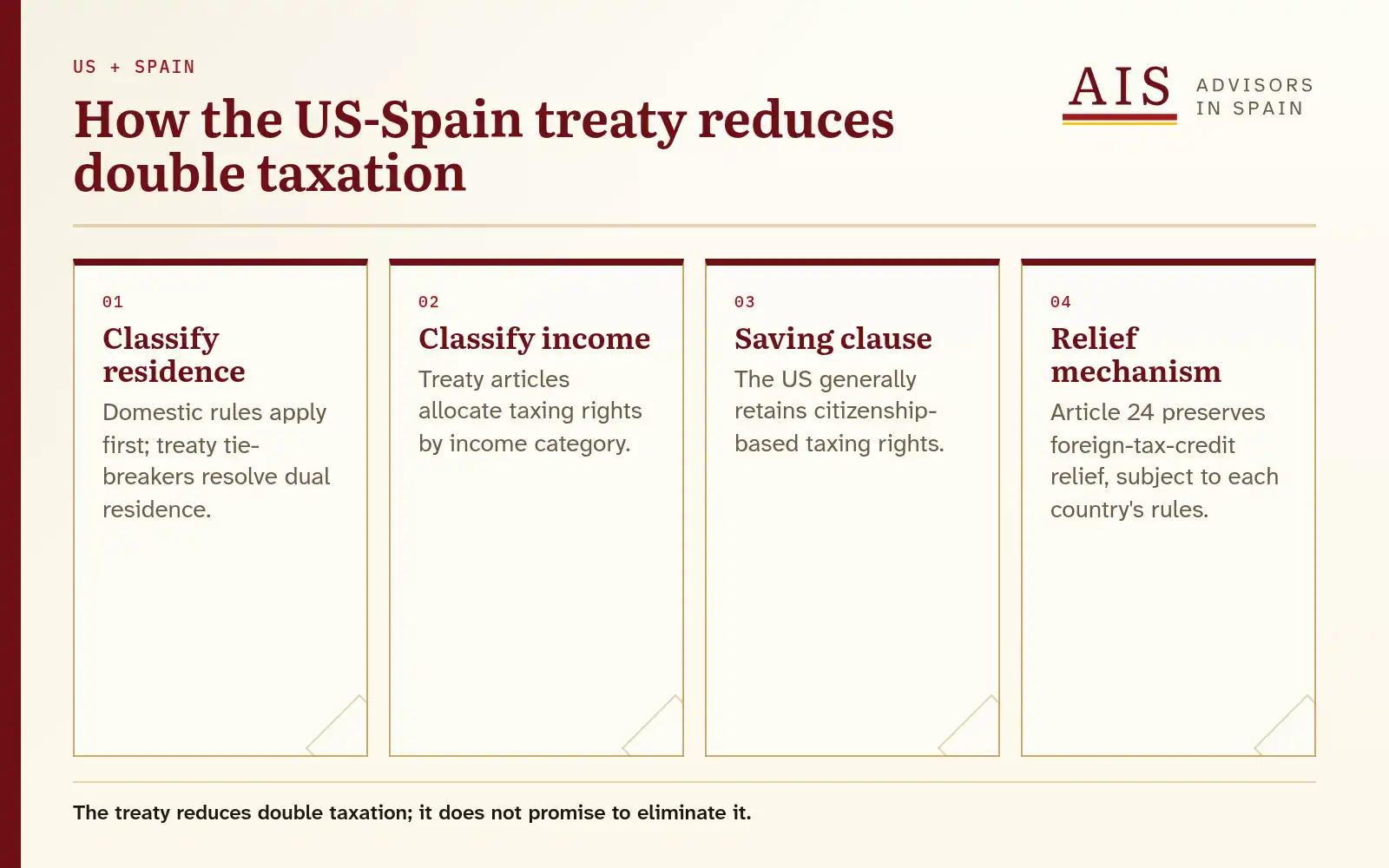
Diagram text version
Establish residence and, if necessary, apply treaty tie-breakers. Classify the income under the relevant treaty article. The saving clause generally preserves US citizenship-based taxation, while Article 24 preserves foreign-tax-credit mechanisms that can reduce double taxation.
The US-Spain tax treaty reduces double taxation, but its saving clause lets the US keep taxing its own citizens on worldwide income. This guide covers what the treaty actually does, where a saving clause limits it, how residency conflicts get resolved, the current rate by income category, and the separate agreement it is often confused with.
What is the US-Spain tax treaty?
The US-Spain tax treaty is the bilateral agreement dividing taxing rights between the two countries and reducing double taxation on the same income, though a saving clause means it does not exempt US citizens from US filing.
Spain and the United States signed the original Convention in Madrid on 22 February 1990, and it entered into force on 21 November 1990, the date the two countries exchanged their instruments of ratification, according to BOE. A Protocol amending that Convention was signed in Madrid on 14 January 2013 and entered into force on 27 November 2019, three months after the later of the two ratification notes, per the same BOE record.
For income paid on or after 27 November 2019, the Protocol changes the rates and rules in the articles it amended. Other provisions of the 1990 Convention remain in force. The categories changed by the Protocol are covered further down this page, and the IRS treaty documents page lists both texts as the current document set.
The treaty does not erase double taxation. It assigns which country taxes which income, and backs that with a credit mechanism that reduces, not removes, the double taxation that would otherwise result.
How does the treaty actually prevent double taxation in practice?
Two mechanisms do the actual work: the US Foreign Tax Credit and the treaty’s own reduced-rate schedule on specific income categories.
Article 24 of the treaty requires the United States to allow its citizens and residents a credit against US tax for income tax paid to Spain, according to the treaty text. That credit is claimed on Form 1116, and US domestic law authorizes the credit itself: the treaty reinforces that credit and does not create it, and Article 24.3 extends it to reach income the US taxes only because the taxpayer is a US citizen. The credit carries an annual limitation, and any foreign tax paid above that limitation carries back one year and forward ten, applied to the earliest eligible year first, per the Form 1116 instructions.
The treaty’s own rate schedule does the second half of the work by lowering or removing Spanish source-country tax on specific income categories before the credit calculation even starts. Interest and royalties, for income paid on or after 27 November 2019, are taxable only in the recipient’s state of residence, so a US resident holding Spanish-source interest or royalties owes no Spanish withholding on it under the current, protocol-amended text.
What is the saving clause, and why doesn’t the treaty erase US tax entirely?
A saving clause preserves the United States’ right to tax its own citizens and green-card holders on worldwide income as if the treaty did not exist, with only the carve-outs the treaty itself names.
Article 1, paragraph 3 of the treaty states that a Contracting State may tax its own residents and, by reason of citizenship, its own citizens, “as if the Convention had not come into effect,” according to the treaty text. Paragraph 4 then lists what that clause does not reach: relief under Article 9.2, part of Article 20.4, and Articles 24, 25 and 26 all survive it in full. A narrower carve-out preserves Articles 21, 22 and 28 for government employees, students and diplomatic staff, but only for someone neither a citizen of, nor an immigrant in, the taxing state. The 2013 Protocol left paragraphs 3 and 4 untouched, according to the Protocol text.
For a US citizen resident in Spain, the treaty shapes Spain-side withholding and the credit mechanics above, not a blanket exemption from US filing. Paragraph 4 is what keeps Article 24’s credit available against citizenship-based US tax, the specific route by which double taxation is still reduced even though the US keeps taxing its own citizens in full.
How does the treaty decide your tax residency when both countries claim you?
Article 4 of the treaty resolves the conflict only once you already qualify as a resident of both countries under each one’s own domestic law, and it works through a fixed sequence of tie-breakers.
The treaty does not change either country’s own residency rules; it applies only where Spain’s domestic test and the US’s own test both independently find you resident, according to Article 4, paragraph 2 of the treaty text. Article 4.2 then works through four tie-breakers in order: the state of your permanent home, or if you have one in both states, your center of vital interests; if that cannot be determined, or you have no permanent home in either state, your habitual abode; if your habitual abode is in both states or neither, your state of nationality; and if you are a national of both states or neither, mutual agreement between the two tax authorities.
Winning Article 4 residency for Spain answers a treaty question, not a US filing one. A US citizen who is a treaty resident of Spain still faces the saving clause above for US filing purposes.
Is the tax treaty the same as the US-Spain Social Security Totalization Agreement?
No. These are two separate agreements with different jobs. The income tax treaty decides which country taxes what income and at what rate, and the Totalization Agreement decides which country’s social security system a worker pays into.
For Spain, the Totalization Agreement covers the General System of Social Security for disability, old age, and death and survivorship, plus a list of Special Systems including agricultural, maritime, coal-mining, railroad, domestic-employee, self-employed, commercial-representative, student, artist, author, bullfighter and professional-soccer-player workers, according to the Social Security Administration. A self-employed worker who would otherwise owe contributions in both countries is assigned to the system of the country they reside in, with one exception: someone who transfers a self-employment activity from one country to the other for five years or fewer stays covered by the country they transferred from.
A reader looking for payroll or self-employment social security rules is in the wrong document here. That coverage question sits with the Totalization Agreement, not with the income tax treaty this guide covers.
See how the treaty applies to your own filing
The mechanics above turn on facts specific to your own return: which side of the Article 4 tie-breaker you land on, what kind of income you hold, and whether you file as a US citizen or a green-card holder. None of that changes by reading one more general page.
A US expat tax specialist can read your actual return, work out which treaty article and which credit mechanics apply to your own case, and tell you what changes because of it.
The US expat tax service covers treaty analysis and the US filing obligations affected by it.
How do you claim a treaty benefit on your US tax return?
You claim a treaty benefit by disclosing it on Form 8833, the Treaty-Based Return Position Disclosure, when the position falls into a category the IRS requires reporting for.
A taxpayer who maintains that a treaty overrules or modifies a provision of the Internal Revenue Code generally must disclose that position on a separate Form 8833 for each position taken, according to the form’s own instructions. Failure to disclose a required position can trigger a penalty of 1,000 dollars, or 10,000 dollars for a C corporation, under Internal Revenue Code section 6712.
Reporting is specifically waived for a position reducing tax on pensions, annuities, Social Security or other public pensions, and for a position resting on the Totalization Agreement above. A US retiree relying on Article 20’s residence-only pension rule does not need to file Form 8833 for that position. Other treaty positions must be checked against the form’s reporting rules.
What income does the treaty cover, and how does it change the tax rate?
The treaty covers dividends, interest, royalties, business profits, private pensions and government pensions, and the 2013 Protocol replaced the rate or the taxing right on most of those categories outright.
The Protocol replaced three articles in full: Article IV replaced Article 10 on dividends, Article V replaced Article 11 on interest, and Article VI replaced Article 12 on royalties, each effective for income paid or credited on or after 27 November 2019, according to the 2013 Protocol text. Interest and royalties saw the largest change: the 1990 text taxed both at source, up to a 10% cap, while the current text taxes each only in the recipient’s state of residence, removing the old source-country right for ordinary payments. The Protocol also added a pension-specific rule: growth inside a foreign pension fund, such as a 401(k) or an IRA held by a Spain resident, is taxed as that person’s income only once it is actually paid out, not while it accrues inside the fund.
| Income category | 1990 rate, no longer current | Current rate, 2013 Protocol |
|---|---|---|
| Dividends | 10% for a 25%+ corporate owner, 15% otherwise | 5% for a 10%+ corporate owner, 15% otherwise; 0% for a qualifying 80%+ corporate holder or a qualifying pension fund |
| Interest | 10% cap | Taxable only in the recipient’s state of residence, with two narrow exceptions the US can still tax: certain contingent interest, up to 10%, and REMIC excess inclusions under US domestic law |
| Royalties | 5%, 8% or 10% depending on type | Taxable only in the recipient’s state of residence |
| Business profits | Taxable only where a permanent establishment exists | Unchanged; Article 7 was not amended by the Protocol |
| Private pensions and annuities | Taxable only in the residence state | Unchanged, plus a new rule: growth inside a foreign pension fund is taxed as the individual’s income only when it is actually paid out, not as it accrues |
| Government pensions | Taxable only by the paying government | Unchanged, except where the individual is a resident and a national of the other state |
Protocol figures apply to income paid or credited on or after 27 November 2019, the Protocol's effective date.
For an individual portfolio investor, the operative dividend figure is the 15% rate: the lower 5% and 0% rates need an ownership stake or a pension-fund status most individual readers will not have. Citing the 1990 dividend rate, the 1990 interest rate or the 1990 royalty schedule as current is wrong for anything paid on or after 27 November 2019.
Does the treaty cover estate or inheritance tax?
No. This is an income tax treaty, and a Spanish inheritance or a US estate involves an entirely different tax with its own, more limited coverage.
The United States has no estate or gift tax treaty with Spain: Spain does not appear on the IRS’s own list of countries with an estate and gift tax treaty. The 1990 Convention and the 2013 Protocol address the taxes within their stated scope and do not supply an estate or inheritance tax relief mechanism.
Spanish inheritance tax covers what a Spain-situated estate owes, region by region. The US-side paperwork for a US heir of a Spanish estate is a separate question this treaty guide does not cover.
What mistakes do people make about the US-Spain tax treaty?
Six mistakes come up repeatedly around this treaty.
- Assuming the treaty eliminates double taxation. The treaty reduces it through the credit and rate mechanisms above. Article 24’s credit carries a floor, so it does not zero out US tax; the saving clause is why.
- Assuming the Foreign Earned Income Exclusion and the treaty combine to erase all US tax. Neither mechanism works that way on its own, and stacking them does not produce a zero US tax bill.
- Confusing the treaty with the Totalization Agreement. They are separate agreements with separate purposes, covered above.
- Skipping a required Form 8833 disclosure. Some treaty positions require it and others are specifically waived. Check which category a position falls into before assuming either way.
- Assuming Spain’s Beckham Law regime changes the US filing obligation. Beckham Law is a Spanish-domestic election under Spain’s own income tax law. It changes what Spain taxes, not what the saving clause requires the United States to tax.
- Citing a 1990 rate as though it is still current. The Protocol replaced the dividend, interest and royalty rules outright for income paid on or after 27 November 2019, covered above.
Spain’s digital nomad and Beckham Law tax treatment and the Beckham Law regime itself cover what that Spanish-side election actually changes.
When does the treaty actually change what you owe?
The treaty is background law until one of a few concrete situations puts it to work.
- A US retiree drawing a private pension while resident in Spain. Article 20’s residence-only rule and the new pension-fund deferral rule both apply.
- A US citizen holding Spanish dividend- or interest-paying investments. The current rate schedule sets what Spain can withhold at source, and the Foreign Tax Credit applies to whatever is left.
- A cross-border remote worker whose residency both countries could plausibly claim. The Article 4 tie-breaker decides which country’s domestic rules apply once both countries’ own tests independently find them resident.
- A Spanish resident with US-source income. Article 24.1 provides Spain-side relief through its own mechanism. It is not the US credit rule in Article 24.2 run in reverse, so the Spanish treatment and filing route must be checked separately.
Each scenario names the mechanism it triggers, reduced withholding, the credit, or the tie-breaker, and the dollar amount it changes turns on the specific facts of the case.
Talk to a specialist about your US-Spain tax treaty position
Advisors in Spain handles your US-Spain treaty position. The specialist handling your case reads your actual filing position, works out which treaty mechanics apply, and tells you what it means for your own return.
Get your own treaty position reviewed
The US expat tax service covers treaty positions and the filing obligations that follow.
Questions
Common questions
How do you avoid double taxation in Spain?
What is the saving clause in the US-Spain tax treaty?
Do US citizens pay taxes in Spain?
Should I pay tax if I hold dual citizenship in the US and Spain?
Does Spain tax American retirees?
Will Spain tax my US Social Security?
Is the tax treaty the same thing as Social Security Totalization?
How is my tax residency decided if both the US and Spain claim me?
Do I need to file Form 8833 to claim a treaty benefit?
Does Spain's Beckham Law regime change my US tax obligation under the treaty?
Should I work with a US tax attorney or a US tax advisor for treaty questions?
Start here
Your request is in
Your enquiry is with Advisors in Spain. We assess your requirements and reply by email with the appropriate next steps.
We review your enquiry today. If you have not heard back within two working days, write to us and we chase it the same day.
Our guides are prepared in accordance with our Editorial Standards.